China’s Shanghai Electric renews offer to purchase majority shares in Pakistan’s K-Electric

1 / 2
A view of the K-Electric head office, with solar panels at the parking area, in Karachi, Pakistan, on January 24, 2023. (REUTERS/File)
2 / 2
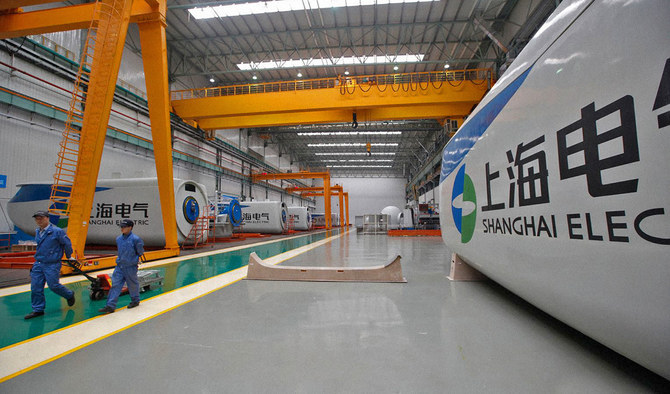
Employees work on the shell of a wind turbine tower in the assembly workshop in The Shanghai Electric Windpower Equipment Co., Ltd. in Shanghai on April 20, 2012. (REUTERS/File)
Short Url
Updated 22 January 2024
Follow

China’s Shanghai Electric renews offer to purchase majority shares in Pakistan’s K-Electric

  • Shanghai Electric has been in talks to acquire stake in KE for more than half a decade
  • Deal delayed due to regulatory approval and liquidity constraints caused by circular debt

KARACHI: Chinese power giant Shanghai Electric Power (SEP) has renewed its offer for the purchase of majority shares of Pakistani utility Karachi Electric (KE), after the previous offer expired on Sunday, KE said on Monday.

Shanghai Electric has been in talks to acquire a stake in KE since 2016, delayed due to regulatory approvals and liquidity constraints as a consequence of mounting circular debt plaguing the country’s power sector. The government of Pakistan owns a 24.4 percent stake in K-Electric, which powers the country’s largest city and commercial hub of Karachi.

In June, Shanghai Electric reiterated its commitment to the deal, which was worth approximately $1.77 billion in 2016 but may change.

On Monday the KE informed its shareholders through a stock filing at the Pakistan Stock Exchange (PSX) that SEP had renewed its intention to acquire the company.

“K-Electric Limited (“KE” or “the Target Company) had received an intimation for public announcement of intention from Messrs. Arif Habib Limited (the “Manager to the Offer“) on behalf of Messrs. Shanghai Electric Power Company Limited (the “Acquirer“), valid for 180 days, for acquisition of 18,335,542,678 ordinary shares of KE, constituting 66.40 percent of total issued and paid-up capital of the Target Company, that was published on 25 July 2023, and which was due to expire on 21 January 2024,” KE said in the stock filing. 

Arif Habib Limited (AHL), the manager of the offer, said parties under the transaction had taken all reasonable steps toward obtaining the regulatory approvals as required under the applicable laws of China, as well as from domestic regulatory bodies as required under the Pakistani legal framework.

Some of the approvals were, however, yet to be issued and as such the parties under this transaction could not complete the transaction before receipt thereof, AHL said in the stock filing.

The new offer will remain valid April 20, 2024 and comes days after the utility company was granted distribution and supplier licenses for a period of 20 years. The previous license expired in July 2023. 

In December 2023, the government of Pakistan decided to release Rs57 billion ($202 million) to K-Electric to help resolve the company’s cash flow situation and pave the way for its long-delayed sale to Shanghai Electric.

In 2005 a consortium comprising Abraaj Group and Saudi Al-Jomaih group and the National Industries Group (NIG) of Kuwait had bought a 66.4 percent stake in K-Electric through a privatization process.

In 2016, the consortium decided to sell the stake to China’s Shanghai Electric Power and submitted an application for a National Security Certificate (NSC) to the Privatization Commission. 

However, the group still awaits approval of the deal due to long-standing issues of the company’s payables and receivables with various government entities.

The process was expedited after visits to Pakistan in the last few years by Abdulaziz Hamad Al-Jomaih, MD Investments at Al-Jomaih Holdings, one of the largest business groups in Saudi Arabia and a major investor in KE, who has met with Pakistani top government including former Prime Ministers Imran Khan and Shehbaz Sharif to get the issue resolved. 


ADB, Pakistan sign over $300 million agreements to undertake climate resilience initiatives

Updated 30 December 2025
Follow

ADB, Pakistan sign over $300 million agreements to undertake climate resilience initiatives

  • Pakistan ranks among nations most vulnerable to climate change and has seen erratic changes in weather patterns
  • The projects in Sindh and Punjab will restore nature-based coastal defenses and enhance agricultural productivity

ISLAMABAD: The Pakistani government and the Asian Development Bank (ADB) have signed more than $300 million agreements to undertake two major climate resilience initiatives, Pakistan’s Press Information Department (PID) said on Tuesday.

The projects include the Sindh Coastal Resilience Sector Project (SCRP), valued at Rs50.5 billion ($180.5 million), and the Punjab Climate-Resilient and Low-Carbon Agriculture Mechanization Project (PCRLCAMP), totaling Rs34.7 billion ($124 million).

Pakistan ranks among nations most vulnerable to climate change and has seen erratic changes in its weather patterns. In 2022, monsoon floods killed over 1,700 people, displaced another 33 million and caused over $30 billion losses, while another 1,037 people were killed in floods this year.

The South Asian country is ramping up climate resilience efforts, with support from the ADB and World Bank, and investing in climate-resilient infrastructure, particularly in vulnerable areas.

“Both sides expressed their commitment to effectively utilize the financing for successful and timely completion of the two initiatives,” the PID said in a statement.

The Sindh Coastal Resilience Project (SCRP) will promote integrated water resources and flood risk management, restore nature-based coastal defenses, and strengthen institutional and community capacity for strategic action planning, directly benefiting over 3.8 million people in Thatta, Sujawal, and Badin districts, according to ADB.

The Punjab project will enhance agricultural productivity and climate resilience across 30 districts, improving small farmers’ access to climate-smart machinery, introducing circular agriculture practices to reduce residue burning, establishing testing and training facilities, and empowering 15,000 women through skills development and livelihood diversification.

Earlier this month, the ADB also approved $381 million in financing for Pakistan’s Punjab province to modernize agriculture and strengthen education and health services, including concessional loans and grants for farm mechanization, Science, Technology, Engineering and Mathematics (STEM) education, and nursing sector reforms.