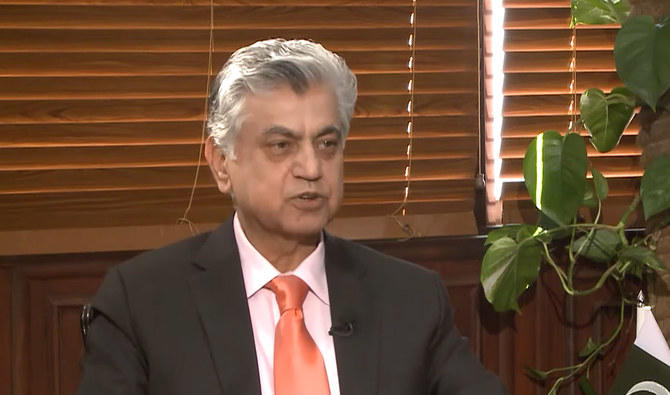
General elections to bring political stability in Pakistan— information minister

The still image taken from a video on January 20, 2024, shows Caretaker Information Minister Murtaza Solangi speaking during an interview with Indian English language news channel WION. (Photo courtesy: WION/YouTube)
Short Url
Updated 21 January 2024
Follow

General elections to bring political stability in Pakistan— information minister

  • General elections in Pakistan are scheduled to take place next month on February 8
  • Minister says elected governments in India, Pakistan can address longstanding disputes

ISLAMABAD: Caretaker Information Minister Murtaza Solangi said this week that general elections next month would bring about much-needed political stability in Pakistan, weeks before polling takes place in the South Asian country. 

Economically troubled Pakistan heads to the polls on February 8 amid a rise in security challenges and a macroeconomic crisis that has seen its foreign exchange reserves plummet and its national currency weaken against the US dollar. 

The South Asian country has been wracked with political instability ever since former prime minister Imran Khan was ousted from office in a parliamentary vote in April 2022. Despite speculation in the media, the caretaker administration has assured masses that the general election would be held across the country on February 8. 

“When it comes to political stability, it will be achieved through the popular mandate and we should wait for the results of the elections,” Solangi told the Indian English language news channel WION. 

“Once people speak their mind when they go to polls to elect a party or a group of party I am sure we will get political stability.”

On the issue of Pakistan’s relations with its neighbors, the minister said Pakistan and India can address longstanding disputes once the two countries have elected governments in place this year. 

“Once we have elected governments in both countries and they get fresh mandates, we can hope that they will discuss the issues including long-standing disputes both the countries have since three-quarters of a century,” he said. 

Solangi said relations between Islamabad and Kabul would depend “squarely” on the actions and behavior of the Afghanistan government. 

“If they continue to harbor terrorists including TTP, I am afraid the future of those relations does not seem to be too bright,” he said. 

Elections in Pakistan were originally expected to take place in November after the country’s national and two provincial assemblies were dissolved in August before their tenure expired. However, the Election Commission of Pakistan (ECP) decided to redraw hundreds of national and provincial constituencies based on a digital census carried out in April, before arranging the electoral contest.

Political experts and analysts have warned that the absence of free, fair and transparent polls in Pakistan would exacerbate the country’s political and economic crises. 


ADB, Pakistan sign over $300 million agreements to undertake climate resilience initiatives

Updated 30 December 2025
Follow

ADB, Pakistan sign over $300 million agreements to undertake climate resilience initiatives

  • Pakistan ranks among nations most vulnerable to climate change and has seen erratic changes in weather patterns
  • The projects in Sindh and Punjab will restore nature-based coastal defenses and enhance agricultural productivity

ISLAMABAD: The Pakistani government and the Asian Development Bank (ADB) have signed more than $300 million agreements to undertake two major climate resilience initiatives, Pakistan’s Press Information Department (PID) said on Tuesday.

The projects include the Sindh Coastal Resilience Sector Project (SCRP), valued at Rs50.5 billion ($180.5 million), and the Punjab Climate-Resilient and Low-Carbon Agriculture Mechanization Project (PCRLCAMP), totaling Rs34.7 billion ($124 million).

Pakistan ranks among nations most vulnerable to climate change and has seen erratic changes in its weather patterns. In 2022, monsoon floods killed over 1,700 people, displaced another 33 million and caused over $30 billion losses, while another 1,037 people were killed in floods this year.

The South Asian country is ramping up climate resilience efforts, with support from the ADB and World Bank, and investing in climate-resilient infrastructure, particularly in vulnerable areas.

“Both sides expressed their commitment to effectively utilize the financing for successful and timely completion of the two initiatives,” the PID said in a statement.

The Sindh Coastal Resilience Project (SCRP) will promote integrated water resources and flood risk management, restore nature-based coastal defenses, and strengthen institutional and community capacity for strategic action planning, directly benefiting over 3.8 million people in Thatta, Sujawal, and Badin districts, according to ADB.

The Punjab project will enhance agricultural productivity and climate resilience across 30 districts, improving small farmers’ access to climate-smart machinery, introducing circular agriculture practices to reduce residue burning, establishing testing and training facilities, and empowering 15,000 women through skills development and livelihood diversification.

Earlier this month, the ADB also approved $381 million in financing for Pakistan’s Punjab province to modernize agriculture and strengthen education and health services, including concessional loans and grants for farm mechanization, Science, Technology, Engineering and Mathematics (STEM) education, and nursing sector reforms.