


ISLAMABAD: The Pakistani government on Friday decided to restore diplomatic relations with Iran, the Pakistan prime minister’s office said, after Islamabad recalled its ambassador from Iran following an airstrike by Tehran in Pakistan’s southwest.
Tensions between Pakistan and Iran soared after Tehran on January 16 conducted an airstrike in Pakistan’s southwestern Balochistan province that it said targeted militant bases.
The strike prompted Islamabad on Wednesday to recall its ambassador from Iran and bar Tehran’s envoy from returning to Pakistan. A day later, the Pakistani military conducted multiple strikes on militant targets in Iran’s southeast.
The strikes by the two countries are the highest-profile cross-border intrusions in recent years and have raised alarm about a wider conflict in the Middle East since Israel waged a war on Gaza after Oct. 7 attacks by Hamas.
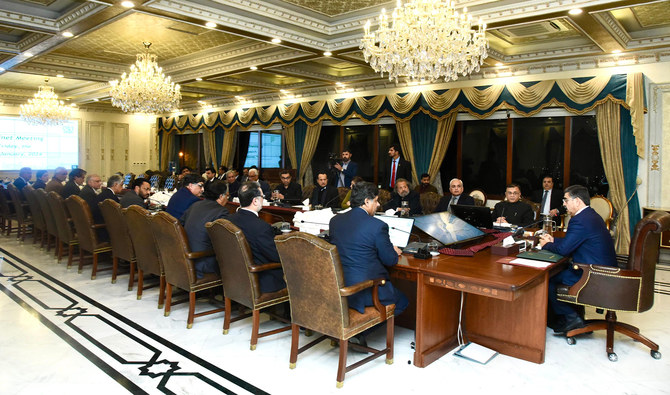
Amid mounting tensions, Pakistan’s federal cabinet and top security body, the National Security Committee (NSC), separately met on Friday to deliberate upon the matters.
“It was in the interest of both countries to take steps to restore the relationship to what it was prior to 16th January,” Pakistan PM Anwaar-ul-Haq Kakar’s office said in a statement after the federal cabinet meeting.
“In this regard, Pakistan would welcome and reciprocate all positive measures from the Iranian side.”
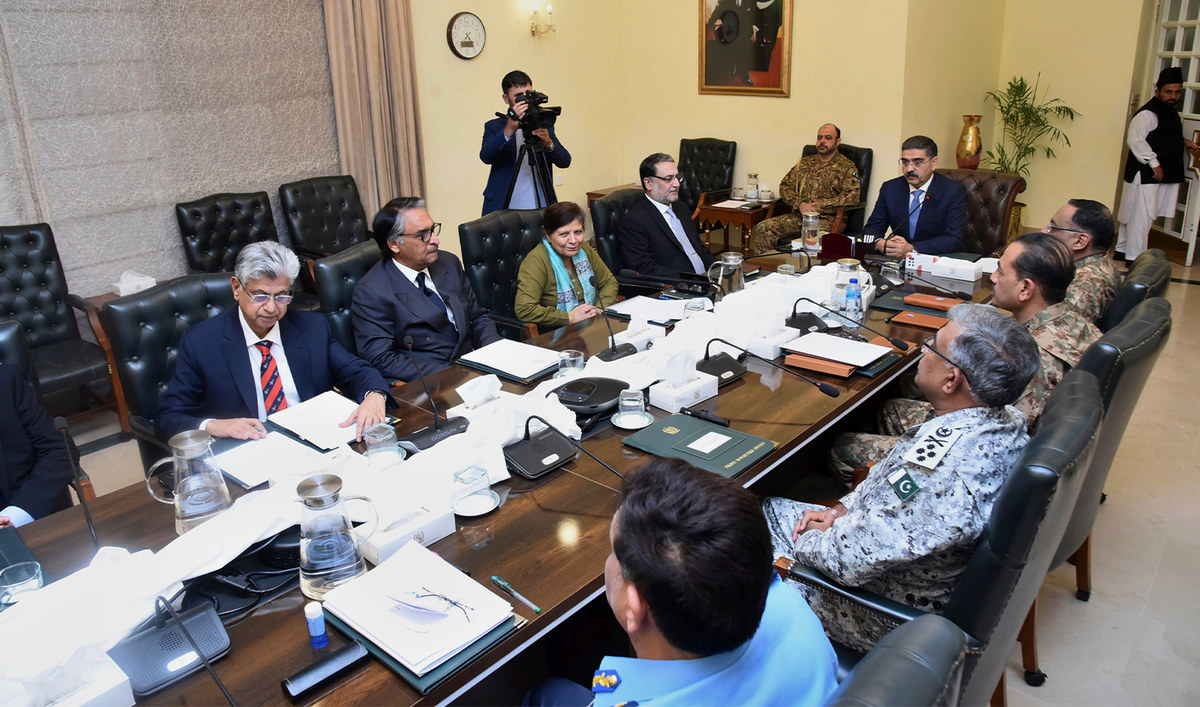
In this photo released Pakistan's Prime Minister office, the caretaker Prime Minister Anwaar ul-Haq-Kakar, center right, chairs a meeting of the National Security Committee, in Islamabad, Pakistan, on January 19, 2024. (Prime Minister Office)
During the cabinet meeting, officials briefed participants about details of the attack from the Iranian side as well as Pakistan’s response to it, according to the statement. The cabinet lauded the high professionalism with which Pakistani forces responded to the “breach of the Pakistan’s sovereignty.”
PM Kakar said Pakistan was a law-abiding and peace-loving country and it sought friendly and cooperative relations with all countries, particularly its neighbors, according to his office.
Prior to the cabinet meeting, the NSC undertook a wholesome review of the situation and lauded the “professional, calibrated and proportionate” response by the Pakistani forces against the “unprovoked” violation of Pakistan’s sovereignty, according to a statement issued after the NSC meeting.
The participants were briefed about political and diplomatic developments pertaining to the prevailing situation between Pakistan and Iran and its impact on the overall security environment in the region.
The forum, which included all the military services chiefs, took stock of Operation “Marg Bar Sarmachar” that was successfully executed against Pakistani-origin Baloch separatists residing on “ungoverned spaces” inside Iran, the statement said.
Islamabad said on Wednesday it had targeted the Baloch Liberation Front (BLF) and Baloch Liberation Army (BLA) separatist groups in Iran, while Tehran said its drones and missiles struck militants from the Jaish Al-Adl group in Pakistan’s Balochistan province.
The militant groups operate in an area that includes Pakistan’s southwestern Balochistan province and Iran’s southeastern Sistan-Baluchestan province, which are both mineral-rich but largely underdeveloped.
“An update on the situation along the borders and necessary full preparations done to comprehensively respond to any further violation of national sovereignty was also deliberated about,” the NSC statement read.
The forum reiterated that the sovereignty and territorial integrity of Pakistan were “absolutely inviolable and sacrosanct and any attempt by anyone to breach it on any pretext will be responded with full might of the state,” according to the statement.
It observed that existing multiple communication channels between the two countries should be mutually utilized to address each other’s security concerns in the larger interest of regional peace and stability.
“In line with the universal principles governing the conduct of good neighborly relations, the two countries would mutually be able to overcome minor irritants through dialogue and diplomacy and pave the way to further deepen their historic relations,” it added.
In a telephonic conversation earlier in the day, Pakistan’s Foreign Minister Jalil Abbas Jilani also urged his Iranian counterpart for “closer cooperation” on security issues, expressing Islamabad’s readiness to work with Iran.
“Foreign Minister Jilani expressed Pakistan’s readiness to work with Iran on all issues based on spirit of mutual trust and cooperation,” the Pakistani foreign ministry said on X. “He underscored the need for closer cooperation on security issues.”


