

Ex-PM Sharif hits campaign trail amid lukewarm election race, political uncertainty

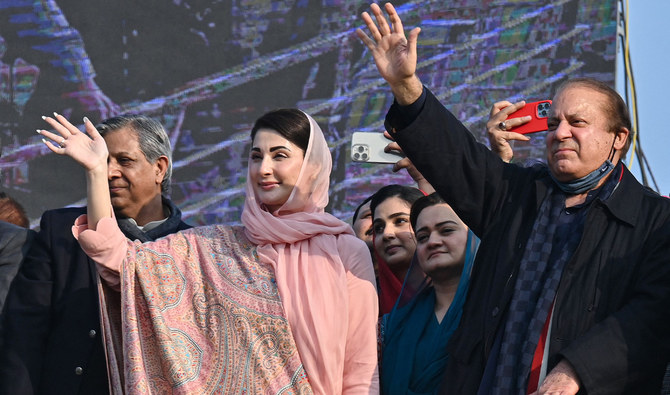
Pakistan's former Prime Minister and leader of Pakistan Muslim League (PML) party Nawaz Sharif (R) along with his daughter Maryam Nawaz (2L) wave to their supporters during an election campaign rally in Hafizabad of Punjab province on January 18, 2024. (AFP)
Short Url
Updated 18 January 2024
Follow

Ex-PM Sharif hits campaign trail amid lukewarm election race, political uncertainty

  • Sharif’s key rival ex-PM Khan’s party faces what is widely seen as a military-backed crackdown
  • The military says it does not prefer any particular party and does not meddle in political affairs

ISLAMABAD: Former Prime Minister Nawaz Sharif on Thursday hit the election campaign trail to lead his Pakistan Muslim League-Nawaz (PML-N) party in Feb. 8 elections, amid widespread accusations that the backing of the all-powerful military is already giving him an edge over rivals.

The campaign for the polls, delayed since November, has so far been lukewarm amid an uncertain political environment, with Sharif’s main rival and jailed former premier Imran Khan’s party facing what is widely believed to be a military-backed crackdown. The army says it does not prefer any particular party, nor meddle in political affairs.

Three-time PM Sharif returned to Pakistan in October last year after spending four years in self-imposed exile in London to lead his party in the election campaign. His PML-N party enjoys deep support in Pakistan’s most populous Punjab province where he is expected to lead rallies in the coming weeks, besides in the northwestern Khyber Pakhtunkhwa province.

Sharif, elected prime minister in 1990, 1997, and 2013, has blamed his 2017 ouster and subsequent corruption convictions on the military, with which he had fallen out. But analysts now believe the army has thrown its support to Sharif, 74, after it was locked in a standoff with former cricket star Khan, 71.

“If Nawaz Sharif were not ousted in 2017 … every person in Hafizabad would have employment,” the PML-N leader said while addressing a public gathering in Hafizabad district of Punjab province. “Pakistan would have become the Asian Tiger.”

In July 2017, the Supreme Court invoked corruption charges to remove Sharif from office, and later also disqualified him from heading his PML-N party ahead of July 2018 elections. This cut short the third tenure of a man who has been a leading figure in Pakistani politics for nearly three decades since his first term in the office from 1990 to 1993. Since his return to Pakistan, however, all court cases against Sharif have been dismissed and the bar against him contesting elections has also been lifted.

In his public address, Sharif listed his achievements in his previous term, including eliminating militancy and power shortages.

“My mission is to make Pakistan stand on its own feet and God willing, we will fulfil this mission,” he said as he concluded his brief speech without sharing a detailed economic revival plan.

PML-N Senator Afnan Mushahid said the party would be unveiling a detailed manifesto soon, which would cover its economic recovery plan and a solution for problems like inflation and unemployment.

“We have been checking each and everything before launching the manifesto as we don’t want to make promises with the public which we can not fulfil,” he said, adding that Sharif would be addressing around a dozen public gatherings before polling day on Feb. 8.


Pakistan army chief meets world leaders in rare Davos appearance

Updated 6 sec ago
Follow

Pakistan army chief meets world leaders in rare Davos appearance

  • Field Marshal Asim Munir attends World Economic Forum alongside prime minister
  • Pakistan delegation holds meetings with US, Saudi and Azerbaijani leaders

ISLAMABAD: Pakistan’s Chief of Army Staff Field Marshal Syed Asim Munir is attending the World Economic Forum’s annual meeting in Davos this week alongside Prime Minister Shehbaz Sharif, marking a rare appearance by a serving army chief at the global gathering of political and business leaders.

Pakistan’s participation at Davos comes as Islamabad seeks to attract investment, project economic stability and deepen engagement with key international partners following recent reforms aimed at stabilizing the economy. 

While Pakistani leaders routinely attend the World Economic Forum, it is uncommon for a serving army chief to be present. In 2017, former army chief Raheel Sharif addressed the forum only after his retirement, while General Pervez Musharraf spoke at Davos on a number of occasions in his role as president, not as military chief. 

Pakistan’s governance structure has evolved in recent years, particularly through the expanded role of the military in economic decision-making through bodies such as the Special Investment Facilitation Council, a civil-military platform designed to fast-track foreign investment in sectors including minerals, energy, agriculture and technology.

“The Prime Minister and the Field Marshal met with the President of Azerbaijan Ilham Aliyev, United States Secretary of State Marco Rubio, and Saudi Arabia’s Foreign Minister Prince Faisal bin Farhan Al Saud,” Sharif’s office said in a statement.

Officials say the delegation’s engagements focused on strengthening economic ties and maintaining high-level contact with partners in the Middle East, Central Asia and the United States at a time of shifting global economic and strategic alignments.

The World Economic Forum’s annual meeting brings together heads of state, ministers, investors and corporate leaders to discuss global economic risks, investment trends and geopolitical challenges. Davos is not a military forum, and while security issues are discussed there, the physical presence of a serving military chief remains the exception, not the norm, across countries. When military figures do appear, it is usually because they are heads of state or government, retired and speaking as security experts or hold a civilian defense portfolio such as defense minister or national security adviser.