

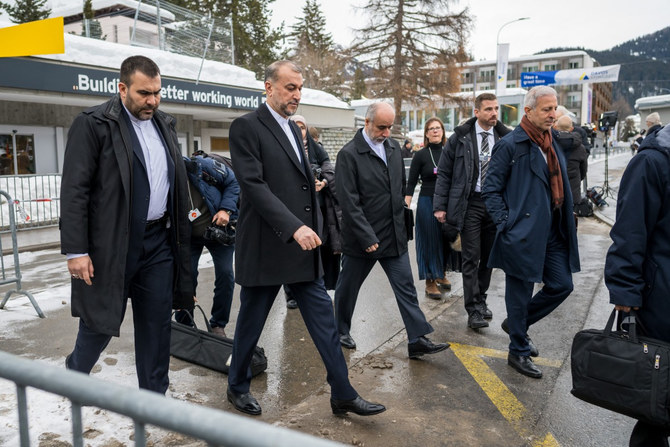
Israel should abandon war in Gaza to avert regional conflict, Iranian FM tells WEF

1 / 2
Iran's Foreign Minister Hossein Amir-Abdollahian during a discussion at the Annual Meeting of WEF in Davos, Switzerland, Wednesday, Jan. 17, 2024. (AP)
2 / 2
Iranian Foreign Minister Hossein Amir-Abdollahian (R) speaks to CNN journalist Fareed Zakaria during a session at the World Economic Forum meeting in Davos on January 17, 2024. (AFP)
Short Url
Updated 17 January 2024
Follow

Israel should abandon war in Gaza to avert regional conflict, Iranian FM tells WEF

  • Hossein Amir-Abdollahian addresses WEF day after Tehran carries out strikes in Iraq, Pakistan
  • Iran ‘respects sovereignty, territorial integrity’ of neighbors but has ‘no reservation’ about defending itself

LONDON: Iran’s foreign minister on Wednesday urged Israel to abandon its war on Gaza if the Middle East is to avoid collapsing into a broader regional conflict.

Hossein Amir-Abdollahian, addressing the World Economic Forum in Davos a day after Iran carried out strikes in Iraq and Pakistan, said instability in the region — including attacks against merchant shipping in the Red Sea — stems from the war in Gaza.

“We warned that if the war crimes and genocide against Gaza and the West Bank don’t stop, the war will spread out, it will become larger,” he said.  

“That doesn’t mean we want it or want to play a role in this enlargement, no, it’s because we have a proper understanding of the situation and conditions in the region. Some of the groups mentioned (Hezbollah in Lebanon and the Houthis in Yemen) have acted to defend Gaza.”  

Concerns of escalation increased this week after UK and US missile strikes against sites in Yemen to dissuade further Houthi attacks on commercial ships in the Red Sea.



Iranian Foreign Minister Hossein Amir-Abdollahian (R) speaks to CNN journalist Fareed Zakaria during a session at the World Economic Forum meeting in Davos on January 17, 2024. (AFP)

Asked to comment on the situation, Amir-Abdollahian pointed the finger at Israel, saying it brought the conflict into the waterway — through which 15 percent of global trade flows — with attacks against Yemenis bringing aid to Gaza.

Iran has become embroiled in its own diplomatic crisis after a series of what it claims were strikes inside other countries but not against them.

This included Tuesday night’s strike on what Tehran claimed was Iranian terrorist group Jaish Al-Adl in Pakistan’s Balochistan province on the border with Iran, which Islamabad said left two children dead and several others injured.

Amir-Abdollahian denied that Iranian attacks against purported terrorists in foreign jurisdictions were comparable to Israel’s response to the Oct. 7 Hamas attack.

“Israeli officials claim that 1,200 Israelis were killed, OK, but they didn’t differentiate between civilians and the military, and (in Gaza) now 16,000 children have been killed in defense (of those Israelis),” he said, adding that “24,000 Palestinians have been killed, meaning proportionality hasn’t been observed as more than 10 times as many Palestinians have been killed.”

Stressing that Iran “respects the sovereignty and territorial integrity” of neighboring states, Amir-Abdollahian nonetheless said Tehran has “no reservation nor hesitations” when it comes to defending the country from terrorist acts.

Despite his protestations, Iraq withdrew its ambassador from Tehran and filed a complaint to the UN, while Pakistan has banned Iran’s ambassador from returning to the country.  

This has added to the perception of heightened regional tensions, with little to no sign that Israeli Prime Minister Benjamin Netanyahu is ready to consider a sustained ceasefire or negotiations to end hostilities in Gaza.

Amir-Abdollahian said: “The solution to this crisis isn’t a military one. They (Israel) have to respect the rights of the Palestinians.”


Spain highlights importance of Gaza reconstruction

Palestinian prime minister, Mohammed Mustafa, and the Spanish foreign minister, Jose Manuel Albares. (AP)
Updated 02 January 2026
Follow

Spain highlights importance of Gaza reconstruction

  • Spain officially recognized Palestine as a state in May 2024, in a coordinated move alongside Ireland and Norway

RAMALLAH: The Palestinian prime minister, Mohammed Mustafa, and the Spanish foreign minister, Jose Manuel Albares, on Friday discussed the latest developments in the West Bank and Gaza Strip.
During their telephone conversation they emphasized the need to intensify international efforts to end the Israeli occupation and halt attacks and settler violence, and to secure the release of Palestinian funds held by Israeli authorities.
They affirmed the importance of ongoing efforts relating to plans for the reconstruction of Gaza, and Europe’s significant role in this process. Mustafa and Albares highlighted the need to unify Palestinian institutions in Gaza with those in the West Bank, with the aim of establishing a Palestinian state in line with international resolutions, including last year’s New York Declaration.
They also discussed coordination between their countries, and the strengthening of Spain’s political, diplomatic and financial support for Palestine, and Mustafa thanked Spain for its ongoing support.
Spain officially recognized Palestine as a state in May 2024, in a coordinated move alongside Ireland and Norway. Estephan Salameh, the Palestinian finance and planning minister, is set to visit Spain this month to discuss enhanced cooperation, particularly in the areas of development and reconstruction. Meanwhile, Israel continues operating in the occupied West Bank.
The Palestinian Prisoners media office said on Friday that Israel carried out numerous raids across the territory, including the major cities of Ramallah and Hebron, according to The Associated Press.
Nearly 50 people were detained, following the arrest of at least 50 other Palestinians on Thursday, most of those in the Ramallah area.
As 2026 begins, the shaky 12-week-old ceasefire between Israel and Hamas has largely ended large-scale Israeli bombardment of Gaza. 
But Palestinians are still being killed by Israeli fire, especially along the so-called Yellow Line that delineates areas under Israeli control, and the humanitarian crisis is compounded by frequent winter rains and colder temperatures.
On Friday, American actor and film producer Angelina Jolie visited the Rafah border crossing between Egypt and the Gaza Strip. 
The only crossing between the territory and a country other than Israel, it remains closed despite Palestinian requests to reopen it to people and aid.
Jolie met with members of the Red Crescent on the Egyptian side of the Rafah border crossing and then visited a hospital in the nearby city of Arish to speak with Palestinian patients on Friday, according to Egyptian officials.
Aid groups say not enough shelter materials are getting into Gaza during the truce.