

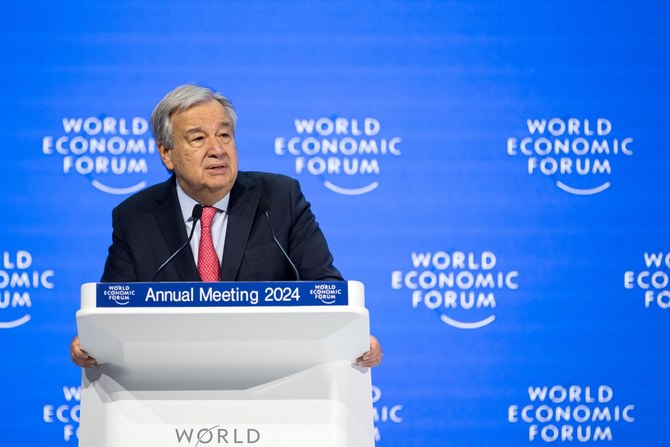
Geopolitical rifts preventing world tackling key issues, UN chief tells Davos

Guterres attributed the trust crisis in trust to the collapse of global norms. (AFP/File)
Short Url
Updated 17 January 2024
Follow

Geopolitical rifts preventing world tackling key issues, UN chief tells Davos

  • ‘Little wonder’ people are losing faith in governments, Antonio Guterres says
  • World ‘standing by as civilians, mostly women and children, are killed’

DAVOS: Geopolitical divides are hampering efforts to tackle issues like the climate crisis and unregulated developments in artificial intelligence, the UN secretary-general said on Wednesday.

In his address at the World Economic Forum in Davos, Antonio Guterres said that while the worsening climate crisis and AI-related risks were discussed at length at global and regional forums, the world lacked an effective strategy to deal with either.

“Geopolitical divides are preventing us from coming together around global solutions,” he said. “Little wonder that people everywhere are losing faith in governments, institutions and financial and economic systems.”

Some countries, he said, were “doing whatever it takes to further their own interests at all costs.”

Guterres pointed to the many conflicts that are fragmenting the world, including the war in Gaza, Russia’s invasion of Ukraine and the violence in Sudan, and said the parties driving them were “ignoring international law, trampling on the Geneva Conventions and even violating the United Nations Charter.”

“The world is standing by as civilians, mostly women and children, are killed, maimed, bombarded, forced from their homes and denied access to humanitarian aid.”

Guterres reiterated his call for a ceasefire in Gaza and said there was a need for “a process that leads to sustained peace for Israelis and Palestinians, based on a two-state solution.”

“This is the only way to stem the suffering and prevent a spillover that could send the entire region up in flames.”

The UN chief said also that geopolitical divisions played a major role in the faltering global economy and that economic insecurity was exacerbated by political instability.

Despite the challenges, Guterres expressed hope for the future.

“I am confident we can build a new, multipolar global order with new opportunities for leadership, balance and justice in international relations,” he said.

But to avoid a “slide into chaos,” it was vital that the world had strong multilateral institutions and frameworks, as well as effective mechanisms for global governance.

“Without them, further fragmentation is inevitable and the consequences are clear,” he said.

Guterres attributed the crisis in trust to the collapse of global norms.

“I am personally shocked by the systematic undermining of principles and standards we used to take for granted,” he said.

“I am outraged that so many countries and companies are pursuing their own narrow interests without any consideration for our shared future or the common good. I am certain that unless we take action, we can expect much, much worse.”

Rebuilding global trust required “deep reforms to global governance to manage geopolitical tensions during a new era of multipolarity” so we could build “a safer, more stable, more prosperous world,” he said.


Vietnam’s ruling Communist Party re-elects To Lam as general secretary

Updated 3 sec ago
Follow

Vietnam’s ruling Communist Party re-elects To Lam as general secretary

HANOI: Vietnam’s leader To Lam was re-elected Friday as the general secretary of its ruling Communist Party, securing a new five-year term in the country’s most powerful position and pledging to rev up economic growth in the export powerhouse.
Lam, 68, was reappointed unanimously by the party’s 180-member Central Committee at the conclusion of the National Party Congress, the country’s most important political conclave.
In a speech, he said he wanted to build a system grounded in “integrity, talent, courage, and competence,” with officials to be judged on merit rather than seniority or rhetoric.
No announcement was made about whether Lam will also become president. If he were to get both positions, he would be the country’s most powerful leader in decades, similar to Chinese leader Xi Jinping.
The Congress was framed by Vietnam’s defining national question: whether the country can transform itself into a high-income economy by 2045. During the meeting, Vietnam set a target of average annual GDP growth of 10 percent or more from 2026 to 2030.
The gathering brought together nearly 1,600 delegates to outline Vietnam’s political and economic direction through 2031. It also confirmed a slate of senior appointments, electing 19 members to the Politburo, the country’s top leadership body.
Beyond settling the question of who will lead Vietnam for the coming years, the Congress will also determine how the country’s single-party system responds to world grown increasingly turbulent as China and the United States wrangle over trade and Washington under President Donald Trump challenges a longstanding global order.
Vietnam’s transformation into a global manufacturing hub for electronics, textiles, and footwear has been striking. Poverty has declined and the middle class is growing quickly.
But challenges loom as the country tries to balance rapid growth with reforms, an aging population, climate risks, weak institutions and US pressure over its trade surplus. At the same time it must balance relations with major powers. Vietnam has overlapping territorial claims with China, its largest trading partner, in the South China Sea.
Lam has overseen Vietnam’s most ambitious bureaucratic and economic reforms since the late 1980s, when it liberalized its economy. Under his leadership, the government has cut tens of thousands of public-sector jobs, redrawn administrative boundaries to speed decision-making, and initiated dozens of major infrastructure projects.
Lam spent decades in the Ministry of Public Security before becoming its minister in 2016. He led an anti-corruption campaign championed by his predecessor, Nguyen Phu Trong. During his rise, Vietnam’s Politburo lost six of its 18 members during an anti-graft campaign, including two former presidents and Vietnam’s parliamentary head.