

US national security adviser says stopping Houthi Red Sea attacks is an ‘all hands on deck’ problem

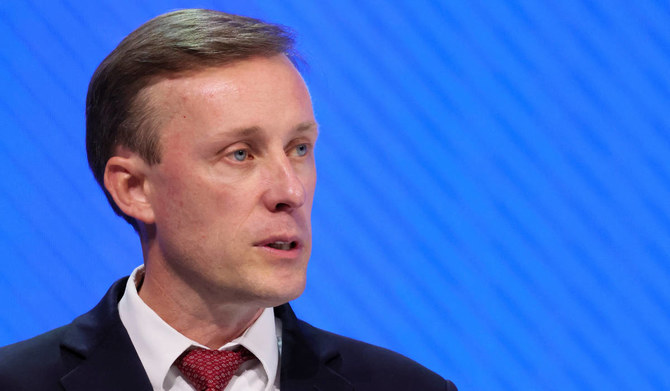
US National Security Advisor Jake Sullivan attends a session during the 54th annual meeting of the World Economic Forum in Davos, Switzerland, January 16, 2024. (REUTERS)
Short Url
Updated 17 January 2024
Follow

US national security adviser says stopping Houthi Red Sea attacks is an ‘all hands on deck’ problem

  • Qatar’s prime minister, Sheikh Mohammed bin Abdulrahman Al Thani: ‘Qatar believes that ending the conflict in Gaza will stop the Houthis and militant groups from launching attacks elsewhere in the region’

WASHINGTON: A senior White House official said Tuesday that addressing the ongoing threat by Yemen’s Houthi rebels on commercial vessels in the Red Sea is an “all hands on deck” problem that the US and allies must address together to minimize impact on the global economy.
“How long this goes on and how bad it gets comes down not just to the decisions of the countries in the coalition that took strikes last week,” White House national security adviser Jake Sullivan said during an appearance at the World Economic Forum in Davos, Switzerland.
The Iran-backed Houthi group has launched dozens of attacks since November on vessels in the Red Sea, a vital corridor for the world’s shipping traffic, in what they say is an effort to support Palestinians in the war with Israel. US and British forces have responded by carrying out dozens of air and sea strikes on Houthi targets in Yemen since Friday. The attacks by the Houthis have continued.
The Red Sea attacks have already caused significant disruptions to global trade. Oil prices have edged higher in recent days, though Brent crude futures were down slightly in early trading Tuesday. Tesla last week announced it would temporarily halt most production at its German factory because of attacks in the Red Sea.
The US launched a new strike against the Houthis on Tuesday, hitting anti-ship missiles in the third assault on the Iranian-backed group in recent days. The strike came as the Iranian-backed Houthis claimed responsibility for a missile attack against the Malta-flagged bulk carrier Zografia in the Red Sea. No one was injured.
Sullivan said it was critical that countries with influence on Tehran and other Middle East capitals make it clear “that the entire world rejects wholesale the idea that a group like the Houthis can basically hijack the world.”
President Joe Biden’s senior adviser acknowledged that the Houthi attacks in the Red Sea as well as groups allied to Iran carrying out attacks in Lebanon, Syria, Iraq and Yemen pose concerns that the Israel-Hamas war could escalate even as Israeli officials have indicated a shift in intensity in their military campaign.
“We have to guard against and be vigilant against the possibility that in fact, rather than heading toward de-escalation, we are on a path of escalation that we have to manage,” Sullivan said.
The comments from Sullivan came after Qatar’s prime minister, Sheikh Mohammed bin Abdulrahman Al Thani, said during an appearance at the Davos forum that the situation in the Middle East is a “recipe for escalation everywhere.” He said Qatar believes that ending the conflict in Gaza will stop the Houthis and militant groups from launching attacks elsewhere in the region.
Sullivan on Tuesday met with Al Thani as well as Iraqi Prime Minister Mohammed Shia Al-Sudani and Iraqi Kurdish Prime Minister Masrour Barzani, according to the White House.
Iran fired missiles late Monday at what it said were Israeli “spy headquarters” in an upscale neighborhood near the sprawling US Consulate compound in Irbil, the seat of Iraq’s northern semi-autonomous Kurdish region, and at targets linked to the extremist Daesh group in northern Syria.
Iraq on Tuesday called the attacks, which killed several civilians, a “blatant violation” of Iraq’s sovereignty and recalled its ambassador from Tehran.


A Kurdish-majority neighborhood in Syria recovers from clashes with hope for the future

Updated 8 sec ago
Follow

A Kurdish-majority neighborhood in Syria recovers from clashes with hope for the future

ALEPPO: A month after clashes rocked a Kurdish-majority neighborhood in Syria ‘s second-largest city of Aleppo, most of the tens of thousands of residents who fled the fighting between government forces and the Kurdish-led Syrian Democratic Forces have returned — an unusually quick turnaround in a country where conflict has left many displaced for years.
“Ninety percent of the people have come back,” Aaliya Jaafar, a Kurdish resident of the Sheikh Maqsoud neighborhood who runs a hair salon, said Saturday. “And they didn’t take long. This was maybe the shortest displacement in Syria.”
Her family only briefly left their house when government forces launched a drone strike on a lot next door where weapons were stored, setting off explosions.
The Associated Press visited the community that was briefly at the center of Syria’s fragile transition from years of civil war as the new government tries to assert control over the country and gain the trust of minority groups anxious about their security.
Lessons learned
The clashes broke out Jan. 6 in the predominantly Kurdish neighborhoods of Sheikh Maqsoud, Achrafieh and Bani Zaid after the government and the SDF reached an impasse in talks on how to merge Syria’s largest remaining armed group into the national army. Security forces captured the neighborhoods after several days of intense fighting during which at least 23 people were killed and more than 140,000 people displaced.
However, Syria’s new government took measures to avoid civilians being harmed, unlike during previous outbreaks of violence between its forces and other groups on the coast and in the southern province of Sweida, during which hundreds of civilians from the Alawite and Druze religious minorities were killed in sectarian revenge attacks.
Before entering the contested Aleppo neighborhoods, the Syrian army opened corridors for civilians to flee.
Ali Sheikh Ahmad, a former member of the SDF-affiliated local police force who runs a secondhand clothing shop in Sheikh Maqsoud, was among those who left. He and his family returned a few days after the fighting stopped.
At first, he said, residents were afraid of revenge attacks after Kurdish forces withdrew and handed over the neighborhood to government forces. But that has not happened. A ceasefire agreement between Damascus and the SDF has been holding, and the two sides have made progress toward political and military integration.
“We didn’t have any serious problems like what happened on the coast or in Sweida,” Sheikh Ahmad said. The new security forces “treated us well,” and residents’ fears began to dissipate.
Jaafar agreed that residents had been afraid at first but that government forces “didn’t harm anyone, to be honest, and they imposed security, so people were reassured.”
The neighborhood’s shops have since reopened and traffic moves normally, but the checkpoint at the neighborhood’s entrance is now manned by government forces instead of Kurdish fighters.
Residents, both Kurds and Arabs, chatted with neighbors along the street. An Arab man who said he was named Saddam after the late Iraqi dictator — known for oppressing the Kurds — smiled as his son and a group of Kurdish children played with a dirty but friendly orange kitten.
Other children played with surgical staplers from a neighborhood hospital that was targeted during the recent fighting, holding them like toy guns. The government accused the SDF of taking over the hospital and using it as a military site, while the SDF said it was sheltering civilians.
One boy, looking pleased with himself, emerged from an alleyway carrying the remnant of an artillery shell.
Economic woes remain
On Friday, SDF leader Mazloum Abdi said he had held a “very productive meeting” with US Secretary of State Marco Rubio and Syrian Foreign Minister Asaad Al-Shibani on the sidelines of a security conference in Munich to discuss progress made on the integration agreement.
While the security situation is calm, residents said their economic plight has worsened. Many previously relied on jobs with the SDF-affiliated local authorities, who are no longer in charge. And small businesses suffered after the clashes drove away customers and interrupted electricity and other services.
“The economic situation has really deteriorated,” Jaafar said. “For more than a month, we’ve barely worked at all.”
Others are taking a longer view. Sheikh Ahmad said he hopes that if the ceasefire remains in place and the political situation stabilizes, he will be able to return to his original home in the town of Afrin near the border with Turkiye, which his family fled during a 2018 Turkish offensive against Kurdish forces.
Like many Syrians. Sheikh Ahmad has been displaced multiple times since mass protests against the government of then-President Bashar Assad spiraled into a brutal 14-year civil war.
Assad was ousted in November 2024 in an insurgent offensive, but the country has continued to see sporadic outbreaks of violence, and the new government has struggled to win the trust of religious and ethnic minorities.
Hopes for reconciliation
Last month, interim President Ahmad Al-Sharaa issued a decree strengthening the rights of Syria’s Kurdish minority, including recognizing Kurdish as a national language along with Arabic and adopting Nowruz, a traditional celebration of spring and renewal marked by Kurds around the region, as an official holiday. Kurds make up about 10 percent of Syria’s population.
The decree also restored the citizenship of tens of thousands of Kurds in northeastern Al-Hasakah province after they were stripped of it during the 1962 census
Sheikh Ahmad said he was encouraged by Al-Sharaa’s attempts to reassure the Kurds that they are equal citizens and hopes to see more than tolerance among Syria’s different communities.
“We want something better than that. We want people to love each other. We’ve had enough of wars after 15 years. It’s enough,” he said.