

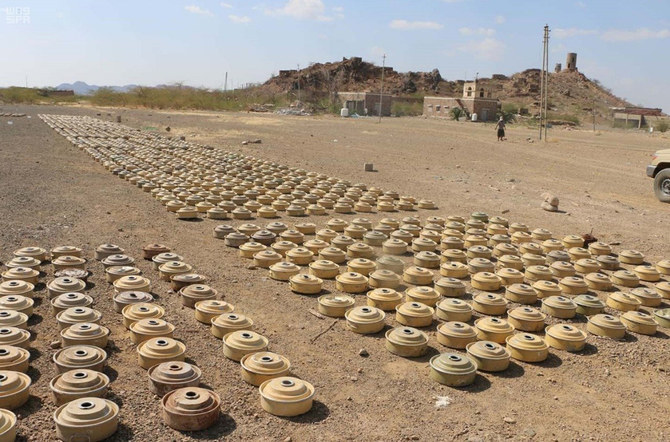
Saudi project clears 1,046 Houthi mines in Yemen in a week

Overseen by the Saudi aid agency KSrelief, the project’s special teams destroyed 915 pieces of unexploded ordnance, 118 anti-tank mines, 12 improvised explosive devices, and one anti-personnel mine. (SPA)
Short Url
Updated 16 January 2024
Follow

Saudi project clears 1,046 Houthi mines in Yemen in a week

  • A total of 428,580 mines have been cleared since the start of the initiative in 2018

RIYADH: Project Masam, a Saudi initiative to clear land mines in Yemen, in the second week of January dismantled 1,046 mines planted by the Iran-backed Houthi militia.

Overseen by the Saudi aid agency KSrelief, the project’s special teams destroyed 915 pieces of unexploded ordnance, 118 anti-tank mines, 12 improvised explosive devices, and one anti-personnel mine.

The explosives, which were planted indiscriminately by the Houthis across Yemen, posed a significant threat to the lives of innocent people, including children, women, and the elderly.

Project Masam is one of several initiatives undertaken by Saudi Arabia on the orders of King Salman to help the Yemeni people, clearing routes for humanitarian aid to reach the country’s citizens.

The demining operations took place in Marib, Aden, Jouf, Shabwa, Taiz, Hodeidah, Lahij, Sanaa, Al-Bayda, Al-Dhale, and Saada.

A total of 428,580 mines have been cleared since the start of the initiative in 2018, according to Ousama Al-Gosaibi, the project’s managing director.

These include 271,376 items of unexploded ordnance, 142,801 anti-tank mines, 7,947 improvised explosive devices, and 6,447 anti-personnel mines.

The project trains local demining engineers and provides them with modern equipment. It also offers support to Yemenis injured by the devices.

Up to 5 million people are estimated to have been forced to flee their homes since the beginning of the conflict in Yemen, many of them displaced by the presence of land mines on their land.

Masam teams are tasked with clearing areas such as villages, roads, and schools to facilitate the safe movement of civilians and the delivery of humanitarian goods and services.

The project’s contract was extended for another year in June 2023 at a cost of $33.29 million.


Saudi aid agency launches food distribution projects in Djibouti and Guinea

Updated 21 February 2026
Follow

Saudi aid agency launches food distribution projects in Djibouti and Guinea

  • Projects to benefit 40,000 individuals across Djibouti and 50,000 in Guinea
  • KSrelief's aid programs have reached a total of 113 countries across four continents

RIYADH: The King Salman Humanitarian Aid and Relief Center (KSrelief) has launched its 2026 food distribution projects in the African republics of Djibouti and Guinea.

The initiatives are part of Saudi Arabia’s broader humanitarian relief efforts to enhance global food security for vulnerable populations, according to statements carried by the Saudi Press Agency (SPA).

In Djibouti, Saudi Ambassador Mutrek Al-Ajaleen and other local officials rolled out the fifth phase of the year’s project. It consists of 6,715 baskets of essential food items designed to support 40,000 individuals across multiple regions of the country.

In Guinea, Saudi Ambassador Dr. Fahad Al-Rashidi led the launch ceremony for a similar initiative. Under this project, 8,400 food baskets will be distributed, benefiting 50,000 people nationwide.

Since its establishment in 2015, KSrelief has served as Saudi Arabia's primary humanitarian arm, making food security one of its largest and most critical operational sectors. According to the center's official statistics, KSrelief has implemented over 1,150 dedicated food security projects at a total cost of more than $2.2 billion.

These specific food distribution initiatives have successfully delivered vital sustenance to vulnerable populations in 86 countries worldwide. Broadening the scope beyond just food security, KSrelief's overall humanitarian and development aid programs have reached a total of 113 countries across four continents.