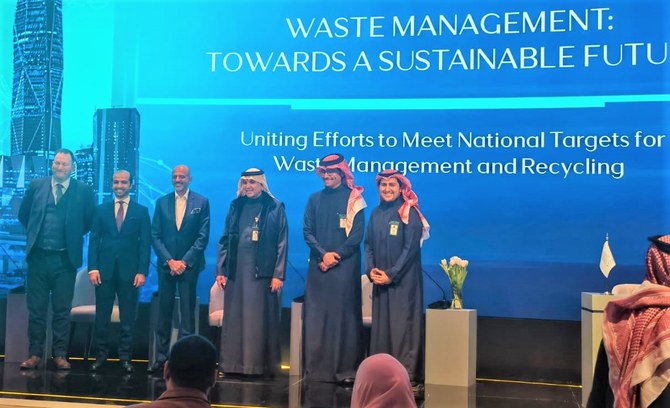
KAFD, SIRC sign deal to promote waste management solutions

King Abdullah Financial District Development and Management Co. signed a memorandum of understanding with Saudi Investment Recycling ‎Co.‎ Supplied
Short Url
Updated 14 January 2024
Follow

KAFD, SIRC sign deal to promote waste management solutions

RIYADH: Seeking to promote waste management solutions, King Abdullah Financial District Development and Management Co. signed a memorandum of understanding with Saudi Investment Recycling ‎Co.‎

This agreement was inked at an event titled “Meeting National Targets for Waste Management and Recycling,” which was recently held in Riyadh.

The MoU to collaborate on providing integrated solutions for different ‎types of waste was signed by SIRC CEO Ziyad Al-Shiha and Gautam Sashittal, CEO of KAFD ‎DMC.

Speaking to Arab News on the sidelines of the event, Al-Shiha said: “SIRC has developed a robust recycling infrastructure that includes collection centers and material recovery facilities. These facilities are equipped with advanced technologies to sort, process, and recycle different types of waste materials, including plastics, paper, metals, and electronic waste.”

He said his company believed in waste sorting and segregation at the source. “We encourage individuals, businesses, and communities to separate recyclable materials from general waste to maximize recycling rates and minimize landfill disposal.”

The official said SIRC promotes the concept of extended producer responsibility, which holds manufacturers responsible for the entire lifecycle of their products, including their disposal. “By implementing EPR programs, SIRC ensures that producers take responsibility for managing and recycling their products at the end of their useful life,” he explained.

Al-Shiha added: “SIRC actively engages in waste diversion programs to reduce the amount of waste sent to landfills. This includes initiatives such as composting organic waste, promoting reuse and upcycling of materials, and exploring alternative waste-to-energy solutions.”

The CEO also reiterated that his company places a strong emphasis on public awareness and education regarding waste management and recycling. “We conduct outreach campaigns, workshops, and educational programs to raise awareness about the importance of recycling, proper waste disposal, and the benefits of a circular economy,” he stated.

SIRC collaborates with various stakeholders, including government agencies, municipalities, businesses, and non-profit organizations, to foster a comprehensive waste management ecosystem. “These partnerships involve sharing knowledge, resources, and best practices to drive innovation and improve waste management practices in Saudi Arabia,” Al-Shiha affirmed.

Furthermore, SIRC invests in research and development to explore new technologies, processes, and approaches to waste management and recycling. This includes evaluating emerging trends, conducting pilot projects, and adopting innovative solutions to enhance recycling rates and improve waste management efficiency, the CEO pointed out.

“SIRC engages with international partners to align waste management policies and regulations with international standards and best practices. This collaboration helps ensure that Saudi Arabia’s waste management practices are in line with global sustainability goals and principles,” he explained.

Al-Shiha went on to say that SIRC’s initiatives can contribute to the development of a circular economy, which promotes resource efficiency and economic growth. “By recycling and recovering valuable materials, SIRC helps create a domestic market for recycled materials, reducing dependence on imports and raw material costs,” he said.

Sashittal told Arab News that he was proud to announce KAFD DMC’s partnership with SIRC. “As the largest industrial waste management company in the GCC, SIRC aligns with our commitment to advancing recycling initiatives, minimizing waste, and promoting environmental sustainability.”

He added: “SIRC pursues business opportunities across all segments of the waste management value ‎chain through establishing alliances with domestic partners, attracting foreign investments, and ‎promoting the utilization of innovative technologies to maximize waste recycling, minimize ‎waste disposal, maximize the value generated from waste utilization, protect the environment, and ‎improve the quality of life.”

Sashittal said KAFD DMC and SIRC strive to maximize value from waste utilization and support the Kingdom’s Waste Management National Regulatory Framework.

“This collaboration reflects our dedication to proactive and responsible waste management practices,” he concluded.


RLC Global Forum highlights role of Saudi youth in retail digital shift 

Updated 04 February 2026
Follow

RLC Global Forum highlights role of Saudi youth in retail digital shift 

RIYADH: Saudi Arabia’s young and highly digital population is reshaping how the Kingdom’s retail sector adopts new technologies and artificial intelligence, advancing faster than many global competitors, industry leaders told Arab News. 

Speaking on the sidelines of the RLC Global Forum in Riyadh, executives told Arab News that the intersection of a youthful population and strong investment in AI is driving a shift in the industry’s priorities. 

From understanding consumer behavior to leveraging the Kingdom’s growing status as a global AI leader, Saudi Arabia is becoming as a unique destination for the retail sector to thrive, learn, and evolve in the digital sphere. 

Abdullah Al-Tamimi, CEO of commercial real estate company Hamat Holding, told Arab News that the firm is keen to analyze and understand consumer behavior, with a particular focus on the younger generation as a key part of that insight. 

“Actually, it’s a big part of our day-to-day operation,” he said, adding that the company invests heavily in understanding customer needs and behavior and works to correct any missteps. 

Al-Tamimi emphasized paying close attention to small details, noting that younger consumers are especially sensitive to the overall experience and “deserve that we work around the clock in order to improve it.” 

He added that this focus “can be a competitive advantage for Saudi Arabia as well.” 

Al-Tamimi said that as the younger generation grows accustomed to new technology shaping retail customer experiences, Hamat Holding is leveraging AI to enhance them further. 

“We started a couple of initiatives improving digitalization,” he said, adding that the company sees digital tools as a way to enhance its work by automating day-to-day operations and allowing teams to focus on bigger-picture and more complex tasks. 

While the firm has expanded its use of technology, he stressed it has not replaced human workers, emphasizing the continued importance of human capital for creativity and interaction. “AI is a big part of our strategy,” Al-Tamimi added. 

Amit Keswani Manghnani, chief omnichannel and AI officer at luxury goods retailer and distributor Chalhoub Group, told Arab News that bridging a younger customer base with continuous digital development is key to advancing the Kingdom’s retail strategies. 

On Saudi Arabia’s demographics, he said: “We look at 2030 as really building products which serve especially the younger population, which is growing and very digitally savvy.” 

Manghnani underscored the unique characteristics of the Kingdom’s retail market as a tool for developing effective products and customer experiences. 

“So it’s very digitally savvy, much more than in other markets,” he said, noting that e-commerce penetration is rising not only through online purchases but also via digital catalogs that drive in-store visits. 

Manghnani said investment is focused on making products more digitally accessible and easier to use, while strengthening customer service to meet the expectations of what he described as a demanding but welcome consumer base. “Service excellence, digital — all these things together are how we are tapping into the younger population, which again is extremely savvy.” 

Manghnani reinforced Al-Tamimi’s point that the Kingdom holds a competitive advantage, citing the speed at which its retail and technology industries are aligning. 

“As a market, we’re tending to see the adoption of digital,” he said, referring to AI, data and other forms of digital interaction, adding that these tools are increasingly being combined. 

He noted that this market is moving “much quicker than the other markets.” 

The two-day RLC Global Forum brought together more than 2,000 global leaders, policymakers, and innovators from over 40 countries over the two-day event to define the next chapter of growth across retail, consumer, and lifestyle industries.