

Pakistan’s Sindh reports five more cases of JN.1 coronavirus variant, urges precautions 

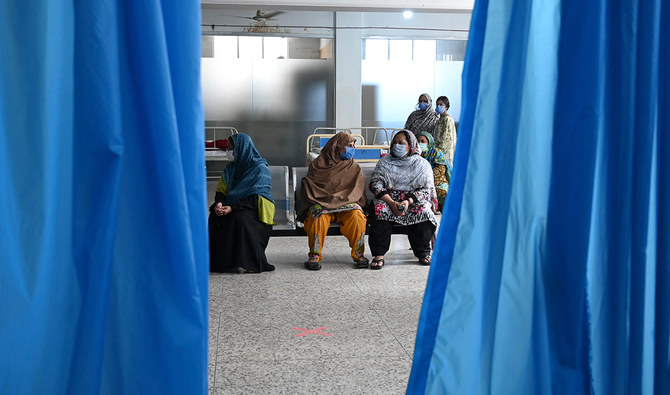
People wait for their turn to get a Covid-19 coronavirus Sinovac vaccine at the Red Crescent vaccination centre in Rawalpindi on May 24, 2021. (AFP/File)
Short Url
Updated 14 January 2024
Follow

Pakistan’s Sindh reports five more cases of JN.1 coronavirus variant, urges precautions 

  • All the five cases were transmitted locally, the provincial health department says 
  • The province previously identified JN.1 in two passengers who came from abroad 

KARACHI: Pakistan’s southern Sindh province has reported five more cases of a new coronavirus strain, JN.1, the provincial health department said on Saturday, urging the masses to take precautions to avoid its possible spread. 

JN.1, a subvariant of the omicron strain, first surfaced in the United States in September before its spread was observed in other parts of the world. 

According to the US Center for Disease Control and Prevention, there is no evidence that the new variant causes more severe cases of COVID-19 or poses any more of a risk to public health than other circulating types of coronaviruses. 

The results of all the five new cases in the Sindh province were confirmed by a private-owned hospital, according to the health department. 

“So far, five cases of JN.1 have been reported locally in Sindh, while two cases have come from abroad,” it said in a statement. 

The health department said it was alert with regard to the JN.1 variant. 

“Instructions have been issued to all DHOs (district health officers), THQs (taluqa headquarters) and other hospitals of Sindh,” it said further. 

“The public is requested to take precautionary measures to prevent its possible spread.” 

The World Health Organization has named JN.1 a variant of concern, indicating that it is being closely monitored, but it has not been added to the high-risk “watchlist” of strains. 

Its symptoms are thought to be similar to those of other members of the omicron family of COVID-19 variants, typically starting with a sore throat, followed by congestion and a dry cough. 


UN rights chief says 56 Afghan civilians killed since Pakistan conflict escalates

Updated 5 sec ago
Follow

UN rights chief says 56 Afghan civilians killed since Pakistan conflict escalates

  • Death toll includes 24 children and six women, with 129 others injured
  • UN says about 115,000 Afghans, 3,000 Pakistanis displaced by fighting along border

GENEVA::The United Nations rights chief said Friday that 56 Afghan civilians had been killed — nearly half of them children — since hostilities with neighboring Pakistan intensified last week.

“I plead with all parties to bring an end to the conflict, and to prioritize helping those experiencing extreme hardship,” Volker Turk said in a statement.

The neighbors have clashed along the frontier since February 26, when Afghanistan launched a border offensive in retaliation for Pakistani air strikes.

Islamabad has hit back along the border and with fresh air strikes, bombing multiple sites including the former US air base at Bagram, the capital Kabul and the southern city of Kandahar.

Turk said that since the intensification of hostilities, “56 civilians, including 24 children and six women, have been killed.”

“A further 129 people, including 41 children and 31 women, have been injured,” he said.

And since the start of the year, the numbers are even higher, with 69 civilians killed in Afghanistan and 141 injured, he said.

Pakistan insists it has not killed any civilians in the conflict. Casualty claims from both sides are difficult to verify independently.

The UN refugee agency said Thursday that around 115,000 Afghans and 3,000 people in Pakistan had been displaced by the fighting in the past week.

“Civilians on both sides of the border are now having to flee from air strikes, heavy artillery fire, mortar shelling and gunfire,” Turk said.

He lamented that a new wave of violence was affecting people “whose lives have been tormented by violence and misery for so long.”

He highlighted that over two million Afghans had returned to Afghanistan since Pakistan started to implement its “Illegal Foreigners Repatriation Plan” in September 2023.

And nearly as many were believed to remain in Pakistan, “where many face hardship and constant fear of arrest and deportation,” he said.

“As a result of the violence, humanitarian assistance is unable to reach many of those desperately in need. This is piling misery on misery,” the rights chief said.

He called on “the Pakistan military and Afghan de facto security forces to end immediately their fighting, and to prioritize helping the millions who depend on aid.”