

Five soldiers, three militants killed in southwest Pakistan operation — military 

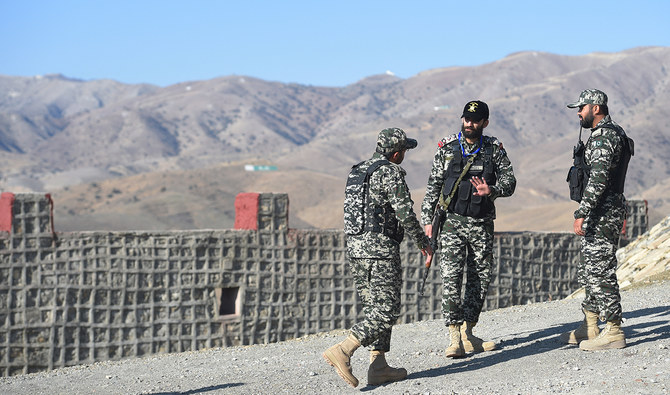
Pakistani army soldier stand guard on a border terminal in Ghulam Khan, a town in North Waziristan, on the border between Pakistan and Afghanistan, on January 27, 2019. (AFP)
Short Url
Updated 14 January 2024
Follow

Five soldiers, three militants killed in southwest Pakistan operation — military 

  • The operation was being conducted in Balochistan’s Kech District, when militants targeted a security forces vehicle 
  • A ‘sanitization operation’ was being carried out to eliminate any other threat present in the vicinity, the military says 

ISLAMABAD: Five Pakistani soldiers and three militants were killed during an operation in the country’s southwestern Balochistan province, the Pakistani military said late Saturday. 

Security forces were conducting an operation in Buleda area of Balochistan’s Kech District, when militants targeted their vehicle with an improvised explosive device (IED), according to the Inter-Services Public Relations (ISPR), the military’s media wing.

The explosion was followed by an exchange of gunfire between the two sides, in which three militants were killed. 

“However, during the operation, five brave soldiers, having fought gallantly, sacrificed their lives and embraced shahadat (martyrdom),” the ISPR said in a statement. 

“Sanitization operation is being carried out to eliminate any other terrorists found in the area.” 

Pakistan has been witnessing a spike in militant violence in its northwestern and southwestern regions that border Afghanistan, particularly after the Tehreek-e-Taliban Pakistan (TTP) called off its fragile truce with the government in Islamabad in November 2022. 

The militant group, which is said to have sanctuaries in neighboring Afghanistan, is separate from but a close ally of the Afghan Taliban. 

Earlier in the day, Pakistani security forces killed four militants involved in target killings and extortion activities in two separate intelligence-based operations in Pakistan’s Khyber Pakhtunkhwa province, the military said. 

Last year, a total of 306 militant attacks took place in Pakistan, including 23 suicide bombings, which killed 693 people and injured 1,124 others, according to the Pak Institute for Peace Studies (PIPS), an Islamabad-based research and advocacy think-tank. 

About 93 percent of all these attacks were concentrated in Pakistan’s northwestern Khyber Pakhtunkhwa and southwestern Balochistan provinces. The rise in attacks forced Pakistan to order expulsion of all illegal immigrants, mostly Afghans, in Oct. 2023.


Pakistani students stuck in Afghanistan permitted to go home

Updated 12 January 2026
Follow

Pakistani students stuck in Afghanistan permitted to go home

  • The border between the countries has been shut since Oct. 12
  • Worries remain for students about return after the winter break

JALALABAD: After three months, some Pakistani university students who were stuck in Afghanistan due to deadly clashes between the neighboring countries were “permitted to go back home,” Afghan border police said Monday.

“The students from Khyber Pakhtunkhwa (northwest Pakistan) who were stuck on this side of the border, only they were permitted to cross and go to their homes,” said Abdullah Farooqi, Afghan border police spokesman.

The border has “not reopened” for other people, he said.

The land border has been shut since October 12, leaving many people with no affordable option of making it home.

“I am happy with the steps the Afghan government has taken to open the road for us, so that my friends and I will be able to return to our homes” during the winter break, Anees Afridi, a Pakistani medical student in eastern Afghanistan’s Nangarhar province, told AFP.

However, worries remain for the hundreds of students about returning to Afghanistan after the break ends.

“If the road is still closed from that side (Pakistan), we will be forced to return to Afghanistan for our studies by air.”

Flights are prohibitively expensive for most, and smuggling routes also come at great risk.

Anees hopes that by the time they return for their studies “the road will be open on both sides through talks between the two governments.”