




Global warming pushes ocean temperatures off the charts: study

1 / 4
Burned palm trees and destroyed cars and buildings in the aftermath of a wildfire in Lahaina, western Maui, Hawaii on August 11, 2023. (AFP)
2 / 4
A billboard displays a temperature of 118 degrees Fahrenheit (48 degrees Celsius) during a record heat wave in Phoenix, Arizona on July 18, 2023. (AFP) Phoenix, Arizona, (AFP)
3 / 4
This aerial view shows a juvenile elephant carcass which died due to drought at a depleted watering hole in Hwange National Park in Hwange, northern Zimbabwe on December 16, 2023. (AFP)
4 / 4
Small boats washed up on the banks of the Villers-le-Lac basins, eastern France, on October 4, 2023. (AFP)
Short Url
Updated 12 January 2024
Follow

Global warming pushes ocean temperatures off the charts: study

  • Oceans soaked up around 9 to 15 zettajoules more than in 2022, according to estimates from the US NOAA and the Chinese Institute of Atmospheric Physics
  • Some of the colossal amounts of energy stored in the ocean helped make 2023, a year rife with heatwaves, droughts and wildfires, the hottest on record

PARIS: In 2023, the world’s oceans took up an enormous amount of excess heat, enough to “boil away billions of Olympic-sized swimming pools,” according to an annual report published Thursday.
Oceans cover 70 percent of the planet and have kept the Earth’s surface livable by absorbing 90 percent of the excess heat produced by the carbon pollution from human activity since the dawn of the industrial age.
In 2023, the oceans soaked up around 9 to 15 zettajoules more than in 2022, according to the respective estimates from the US National Oceanic and Atmospheric Administration (NOAA) and the Chinese Institute of Atmospheric Physics (IAP).
One zettajoule of energy is roughly equivalent to ten times the electricity generated worldwide in a year.
“Annually the entire globe consumes around half a zettajoule of energy to fuel our economies,” according to statement.
“Another way to think about this is 15 zettajoules is enough energy to boil away 2.3 billion Olympic-sized swimming pools.”
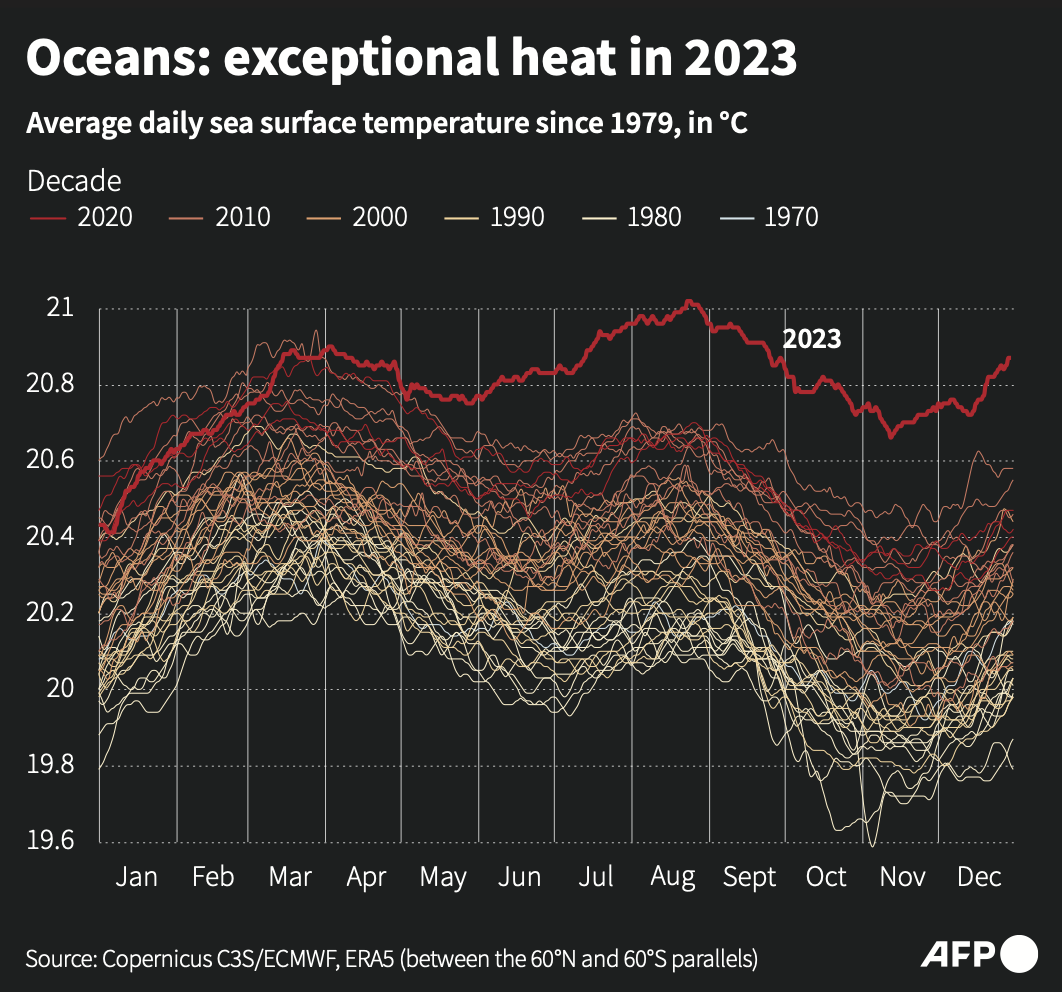
In 2023, sea surface temperature and the energy stored in the upper 2000 meters of the ocean both reached record highs, according to the study published in the journal Advances in Atmospheric Sciences.
The amount of energy stored in the oceans is a key indicator of global warming because it is less affected by natural climate variability than sea surface temperature.
Some of the colossal amounts of energy stored in the ocean helped make 2023, a year rife with heatwaves, droughts and wildfires, the hottest on record.
That’s because the warmer the oceans gets, the more heat and moisture enters the atmosphere. This leads to increasingly erratic weather, like fierce winds and powerful rain.
Warmer sea surface temperatures are driven mostly by global warming, caused mainly by the burning of fossil fuels.
Every few years, a naturally occurring weather phenomenon, El Nino, warms the sea surface in the southern Pacific, leading to hotter weather globally. The current El Nino is expected to peak in 2024.
Conversely, a mirror phenomenon called La Nina periodically helps cool the surface of the ocean.
Increasing water temperatures and ocean salinity — also at an all-time high — directly contribute to a process of “stratification,” where water separates into layers that no longer mix.
This has wide-ranging implications because it affects the exchange of heat, oxygen and carbon between the ocean and atmosphere, with effects including a loss of oxygen in the ocean.
Scientists are also concerned about the long-term capacity of the oceans to continue absorbing 90 percent of the excess heat from human activity.


Pakistani Taliban kill six soldiers in checkpoint attack

Updated 57 min 26 sec ago
Follow

Pakistani Taliban kill six soldiers in checkpoint attack

  • Pakistan has faced a surge in militant attacks along its border regions since the Taliban authorities retook control in Kabul in 2021

PESHAWAR, Pakistan: Pakistani Taliban militants stormed a security checkpoint in Pakistan’s northwestern border area with Afghanistan, killing six soldiers and wounding four others, a government official said Tuesday.
Pakistan has faced a surge in militant attacks along its border regions since the Taliban authorities retook control in Kabul in 2021.
It accuses Afghanistan of harboring the insurgents, a claim the Taliban government denies.
Late Monday, more than a dozen armed men attacked the checkpoint, leading to a heavy exchange of fire in Kurram, a tribal district in Khyber Pakhtunkhwa province.
“Six security personnel were martyred and four were injured, while two militants were also killed in the fighting,” the government official posted in Kurram, who was not authorized to speak to the media, told AFP on the condition of anonymity.
The Pakistani Taliban group, or Tehreek-e-Taliban Pakistan (TTP), has long been active in the region, and claimed responsibility for the attack.
Pakistan accuses the Taliban authorities in Afghanistan of sheltering TTP militants and allowing them to launch cross-border attacks from there — a charge Kabul denies.
The border between the two countries has been closed since the clashes in October, though Pakistan said last week it would allow UN aid supplies to pass to Afghanistan soon.
The attack comes days after an exchange of gunfire and shelling between Afghan and Pakistani forces at a major border crossing that killed four civilians and one soldier, according to Afghanistan.
Each side accused the other of starting the fighting.