


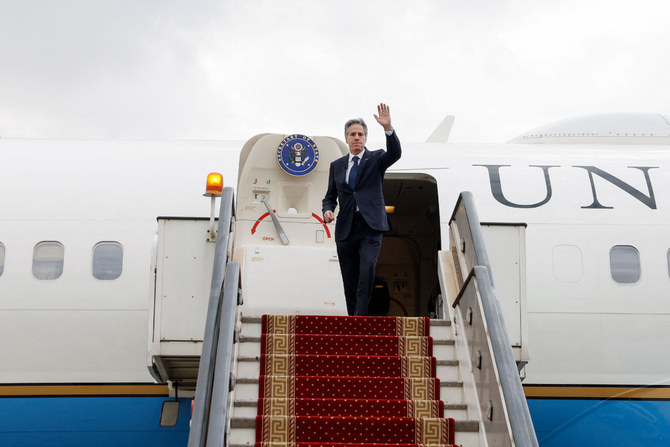

CAIRO: Offering a pathway to a Palestinian state is the best way to stabilize the wider region and isolate Iran and its proxies, US Secretary of State Antony Blinken said on Thursday, as he ended a frenetic regional tour over the Gaza war in Cairo.
Speaking to reporters after meeting Egyptian President Abdel Fattah El-Sisi, Blinken said the region faced two paths, the first of which would see “Israel integrated, with security assurances and committments from regional countries and as well from the United States, and a Palestinian state — at least a pathway to get to that state.”
Blinken said Israel bolstering its security and the creation of a Palestinian state is the best way to thwart attacks from Iran’s regional proxies, like Hamas, Lebanon’s Hezbollah, Yemen’s Houthis and various militia that have staged attacks on US and foreign interests in Iraq and Syria.
He added: “The other path is to continue to see the terrorism, the nihilism, the destruction by Hamas, by the Houthis, by Hezbollah, all backed by Iran.”
“If you pursue the first path ... that’s the single best way to isolate, to marginalize Iran and the proxies that are making so much trouble — for us and pretty much everyone else in the region.”
He said there is “a greater willingness now of countries to make the hard decisions and do what’s necessary to advance on that track.”
The meeting President El-Sisi and Blinken outlined Egyptian efforts to communicate with all parties, to reach an immediate ceasefire,and to ensure accessibility to humanitarian aid.
According to a statement from El-Sisi’s office, both sides stated their rejection of any displacement of Palestinians from their lands.
Egyptian General Intelligence Service Director Major General Abbas Kamel also attended the meeting.Presidential spokesman Ahmed Fahmy said that the regional situation was discussed, especially in the Gaza Strip and the Palestinian territories.
Blinken was keen to share with El-Sisi the course of his expanded tour in the region and to listen to Egypt’s vision on theprospects for a solution.
El-Sisi stressed the need for the international community to undertake its responsibilities to implement the relevant UN resolutions so that aid could enter in sufficient quantities to help the people of Gaza.
He said it was also imperative for the calming efforts to lead to a just and comprehensive settlement to the Palestinian issue that addressed the roots of the current situation, enabled the Palestinian people to obtain their legitimate rights, and achieved security, development and prosperity for all the people of the region.
Modest success
American officials claimed modest success in getting wide regional support for planning for reconstruction and governance in Gaza after Israel’s war with Hamas ends.
But progress is uncertain because Israel’s far-right government led by Prime Minister Benjamin Netanyahu is not on board with several key points and it remains unclear if it can be convinced to accept them.
Still, Blinken secured buy-in from previously reluctant Arab and Muslim nations to begin post-war planning planning for Gaza in discussions with the leaders of Turkiye, Jordan, Qatar, the United Arab Emirates, Saudi Arabia, Bahrain and the Palestinian Authority over the weeklong mission, his fourth to the Middle East since the war began in October.
Winning approval for the consideration of post-conflict scenarios along with tamping down renewed fears that the Gaza war could spread were Blinken’s main goals.
Each country — along with Greece, which Blinken also visited — pledged to participate in the general planning, although precise contributions have yet to be determined and Israel remained an outlier.
“On our previous trips here, I think there was a reluctance to talk about some of the day-after issues in terms of long-term stability and security on a regional basis,” Blinken told reporters at Cairo’s airport after his meeting with El-Sisi. “But now we’re finding that our partners are very focused on that and wanting to engage on those questions.”
“They’re also clearly prepared to take steps to do things, to make commitments necessary both for Gaza’s future and for long-term peace and security of the region,” Blinken said.
However, Arab support is contingent on not only the end of the conflict but also the establishment of a pathway for the creation of an independent Palestinian state, something that Netanyahu opposes.
US officials, speaking on the condition of anonymity to describe private diplomatic talks, said the conversations Blinken had in Israel on Tuesday were the most difficult on the trip. But, they added, the talks had been successful in getting Israel to agree to a United Nations inspection team visit to northern Gaza to gauge whether it is safe for residents who fled the Israeli offensive to return.
Also key to the plan is the reform of the Palestinian Authority, which was the main agenda item at a summit held Wednesday in Aqaba between El-Sisi, Jordan’s King Abdullah II and Palestinian President Mahmoud Abbas.
“We have a commitment from the Palestinian Authority to pursue meaningful reform,” Blinken said. Officials said the changes would include the appointment of a new technocratic government, a crackdown on corruption, judicial reform and an easing of media restrictions.
(With AP)


