
RIYADH: A sustainable future for the value chain within the mining industry hinges on an integrated system that involves connectivity, acceleration and technology, experts affirmed.
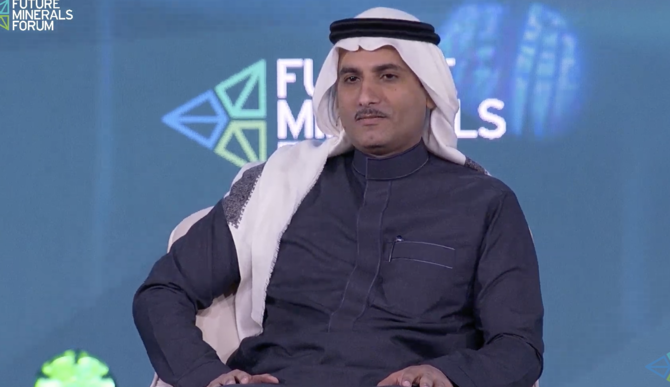
A panel at the Future Minerals Forum in Riyadh saw the Kingdom’s leading governmental entities in the sector outlining the key elements that are needed to sustain the local and global shift to clean energies of the future.
Addressing the forum, Suliman Al-Mazroua, CEO of National Industrial Development and Logistics Program, outlined that a clear path towards green power requires logistically accessible resources as well as supply chain and value chain integration.
In order for that to become possible, the sector must ensure increased mobility, access and logistical ease for its customers.
Saudi Arabia aims to fulfill the role as a global logistic hub that will interconnect the continent and allow providers to be closer to the customer.
Al-Mazroua said: “Since the inception of Vision 2030 in 2016, an integrated system was created by having a program called NIDLP where the four sectors — mining, industry, logistic and energy — integrated together and we started to make the all the mineral resources in Saudi available for our energy of the future.”
He added: “People look at where to be closer to the customer to make sure they avoid the high cost of logistics … Saudi is a place that will build this global logistic hub to interconnect with the continent.”
Al-Mazroua made these remarks in conversation with Khalid Al-Salem, the president of the Royal Commission for Jubail and Yanbu, the body which oversees Ras Al-Khair, which is one of the Kingdom’s most prominent logistical hubs and mining locales.
The president affirmed the ideas posed by Al-Mazroua, noting that as part of its efforts to become a global hub, the Kingdom embarked on the designation of special economic zones.
Citing the Ras Al-Khair economic zone under his jurisdiction, Al-Salem noted that even though it was launched only last year it is now almost entirely full of tenants and has already attracted SR175 billion ($46 billion) in investments.
According to the official, this stands as a testament to global investors’ perception of the Kingdom as an “ideal place” due to its location.
He added: “This shows how global investments are looking at Saudi Arabia as an ideal place because of its location and because of the ease of business happening with the Vision 2030.”
Another pivotal element, according to Al-Mazroua, is the digital economy and technology, which can be utilized as a tool to connect and facilitate collaboration between all players within the chain.
Through advanced facilities including factories and industrial cities that are powered through smart grids, goods and services will be able to be provided through “smart logistics.”
These connections will then be able to offer ample data to power and use efficient artificial intelligence in the future to prevent disaster, interruptions and ensure resilience.
In order to continue to grow the technologies needed, NIDLP announced an agreement with Newlab KSA that aims to attract global entrepreneurs and founders to work with Aramco, Ma’aden, SABIC and the rest of the ecosystem to solve future challenges and develop solutions that will contribute to the future of the industry and its value chain.
These combined efforts towards developing comprehensive supply value chains are rooted in sustainable action and efforts, the president added.
As the world continues to strive for the minerals needed to produce green energy products, the Commission seeks to ensure that efforts themselves are sustainable.
While public perception of the industry may largely view this as a contradiction, believing the industry itself to be a polluter, Al-Salem outlined that through material repurposing and waste utilization, the efforts are in-fact carbon negative.
He said: “We take care very carefully about the environmental impacts. You heard yesterday the CEO of Ma’aden talking about the mining industry, always the public they consider it's not friendly with the environment.
“We work with our partners to really utilize the waste material or deal with it. That's why we have almost 65 percent of our industrial waste stream that we recycle or deal with it with environmental friendly features.”
He added: “Let's take for example, the Ras Al-Khair because we are talking about mining. And if we take one example, our partner Madden, where they receive their bauxite from the mines through the railway, and then they process the material and the exported through Ras Al-Khair port.”