IMF board expected to approve $700 million disbursement for Pakistan later today

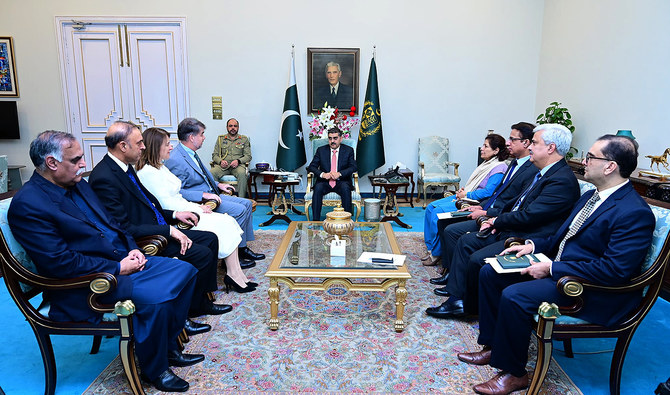
In this file photo, taken on November 15, 2023, the International Monetary Fund delegation with its Mission Chief for Pakistan Nathan Porter (2nd left) meets Pakistan Caretaker Prime Minister Anwaar-ul-Haq Kakar (center) and other officials (right) in Islamabad. (Photo courtesy: PMO/File)
Short Url
Updated 11 January 2024
Follow

IMF board expected to approve $700 million disbursement for Pakistan later today

  • The board approved a much-needed, 9-month loan amounting to $3 billion in July to support economic stabilization program
  • Experts say a clear economic roadmap can set the foundation for the next IMF program for Pakistan after the general elections

KARACHI: The Executive Board of the International Monetary Fund (IMF) is scheduled to meet today, Thursday, in Washington for the first review of a $3 billion short-term financing package and to consider the release of the $700 million second tranche to Pakistan.
The board had approved a much-needed, 9-month Stand-By Arrangement (SBA) for the country last year in July to support the government’s economic stabilization program. Pakistan also received the first tranche of $1.2 billion along with the endorsement for the loan program.
A visiting IMF delegation and Pakistani authorities reached a staff-level agreement (SLA) over the first review under the SBA in November, which was subject to the executive board’s approval to unlock the $700 million disbursement. Pakistani economists said they were hopeful the country would comfortably get access to the money after the SLA.
“There are big chances that the IMF board will easily grant approval for the disbursement of the funds to Pakistan because the country has successfully implemented the reforms and reached an SLA,” Dr. Sajid Amin, Deputy Executive Director at the Sustainable Development Policy Institute (SDPI), told Arab News.
Amin hoped the IMF board’s approval would help Pakistan’s national currency to regain some of its lost value, adding it would also have a positive impact on the country’s overall economic landscape.
Pakistan cleared the first review under the SBA after taking painful economic measures, including increases in energy prices and tax burden, which led to spiraling inflation that hit 38 percent in May last year. The prices of essential commodities still remain quite elevated.
As Pakistan prepares for the national election on Feb. 8, experts say it will have to chart a clear roadmap to run the economy.
“The next review of the program is important for Pakistan since it will lay down the foundation for the next IMF facility which the country will require,” Amin said.
Timely national elections and a well-thought-out economic gameplan by the next elected government will help secure the fresh IMF program and avoid any economic panic situation in the future, Amin argued.
Preparations for a follow-on program are likely to start after the conclusion of the current SBA in April 2024, as the country is scheduled to elect its new political leaders in the coming month.
Pakistan’s economic landscape has weathered a storm in recent years with fluctuating commodity prices, political turmoil and harsh blows dealt by floods.
The nation has been grappling with trade and current account deficits, mounting inflation and low foreign exchange reserves that exerted pressure on the currency that also hit historic lows against the United States dollar.


Pakistan, Muslim countries reject Israel’s plan to expel Palestinians from Gaza

Updated 4 sec ago
Follow

Pakistan, Muslim countries reject Israel’s plan to expel Palestinians from Gaza

  • Israel has announced plans to open the Rafah crossing with Egypt for Gaza residents fleeing the enclave
  • Muslim nations seek implementation of Trump’s peace plan, establishment of independent Palestinian state

ISLAMABAD: Pakistan, together with seven other Arab and Muslim countries, on Friday rejected Israel’s attempt to expel Palestinians by opening the Rafah border crossing with Egypt solely for fleeing Gaza residents, and called for adherence to the peace plan proposed by US President Donald Trump’s administration.

Trump’s Gaza plan calls on Israel to allow humanitarian aid into the territory and keep the Rafah crossing open from both sides.

However, Israel has continued to restrict aid flows, and its military said on Wednesday the crossing would open in the coming days “exclusively for the exit of residents from the Gaza Strip to Egypt.”

“The Foreign Ministers of the Islamic Republic of Pakistan, the Arab Republic of Egypt, the Hashemite Kingdom of Jordan, the United Arab Emirates, the Republic of Indonesia, the Republic of Türkiye, the Kingdom of Saudi Arabia, and the State of Qatar express their deep concern regarding the Israeli statements concerning the opening of the Rafah Crossing in one direction, with the aim of transferring residents of the Gaza Strip into the Arab Republic of Egypt,” said the joint statement circulated in Pakistan by the foreign office.

“The Ministers underscore their absolute rejection of any attempts to expel the Palestinian people from their land and stress the necessity of the full adherence to the plan proposed by US President Donald Trump, including its provisions on keeping the Rafah Crossing open in both directions, ensuring the freedom of movement for the population, and refraining from compelling any resident of the Gaza Strip to leave,” it continued.

The statement appreciated the US president’s commitment to establishing peace in the region and emphasized the importance of implementing his plan “without delay or obstruction” to help consolidate regional stability.

“The Ministers underscore the need to fully sustain the ceasefire, alleviate civilian suffering, ensure the unrestricted entry of humanitarian assistance into the Gaza Strip, initiate early recovery and reconstruction efforts, and create the conditions necessary for the Palestinian Authority to resume its responsibilities in the Gaza Strip,” the statement added.

They reaffirmed their countries’ readiness to work with the United States and all concerned regional and international actors to achieve “a just, comprehensive, and sustainable peace in accordance with international legitimacy and the two-state solution,” including the establishment of an independent Palestinian state on the pre-1967 lines with East Jerusalem as its capital.

Pakistan’s foreign office circulated the statement after Deputy Prime Minister Ishaq Dar held a telephone conversation with Saudi Foreign Minister Prince Faisal bin Farhan to discuss regional developments, particularly Gaza.

Dar condemned Israel’s plan to partially reopen the Rafah crossing only for fleeing Gaza residents, calling it a “clear violation” of the region’s peace plan.