KHAN YOUNIS, Gaza Strip: The Israeli military said Wednesday it has found evidence that hostages were present in an underground tunnel in the Gaza Strip city of Khan Younis, which has become the focus of Israel’s ground offensive.
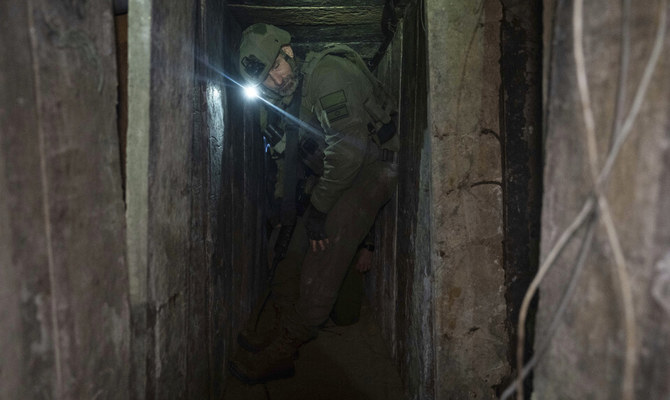
The military showed the tunnel to journalists who were escorted into a neighborhood near the ruins of destroyed homes and streets. A corrugated tin hut covered the tunnel’s entrance in a residential yard.
A makeshift ladder led to the narrow underground pathway, about 2.5 meters (8 feet) below. The tunnel was hot and humid, with walls lined with concrete and electrical wires. Farther inside was a bathroom, where the military said it found evidence that hostages had been there, including their DNA.
“Hostages were held here in this tunnel system,” said Rear Adm. Daniel Hagari, the army’s chief spokesman.
Hagari offered no details on what exactly was found in the tunnel, nor did he say when the hostages were there or identify them. He did not say if they were known to be dead or alive.
In a later statement to the media, he said the captives were held in “difficult conditions,” without elaborating.
Several hostages freed in a cease-fire deal in late November described being held inside tunnels, which Hamas has laid throughout the Gaza Strip and which Israel says have long been used to smuggle weapons and fighters throughout the blockaded territory.
The tunnel was found in a part of the city that appears to have endured heavy fighting. The nearby residence was badly damaged.
In another building, the walls were blasted out of several apartments. Large mounds of dirt surrounded the area, apparently from Israeli bulldozers searching for buried explosives. A tank was parked outside an empty school, where an Israeli flag was hung from the exterior walls. The sound of what appeared to be a drone buzzed overhead, and gunfire could be heard in the distance.
The military says Hamas is operating from inside the tunnels, and military officials have made the destruction of the tunnel system a top goal.
Brig. Gen. Dan Goldfus, commander of the military’s 98th Division, described the tunnels as posing “a 720-degree threat.”
“It’s not 360, but it’s 720, underground and over ground,” Goldfus said.
Israel also believes that Hamas leader Yehya Sinwar is hiding in a tunnel somewhere in Khan Younis.
The beleaguered city, Gaza’s second-largest, has become the focus of Israel’s war on Hamas in recent weeks. On Wednesday’s tour for journalists, no residents appeared to be in the area. Israel has ordered residents to evacuate portions of the city as it proceeds with the offensive.
In its fierce Oct. 7 attack, Hamas and other militants killed 1,200 people and took hostage roughly 250, according to Israeli authorities.
The attack sparked the war. More than 23,000 Palestinians, mostly women and children have been killed, according to the Health Ministry in Hamas-ruled Gaza. More than 85 percent of Gaza’s population of 2.3 million has been displaced, and vast swaths of the territory have been leveled.
About 110 hostages have been released. Some 110 remain with their captors, along with the bodies of about 20 people killed in captivity, according to Israel. Several other bodies of captives were retrieved by Israeli forces, and three hostages were killed mistakenly by the military.
The plight of the hostages has gripped Israelis, who see them as an enduring symbol of the state’s failure to protect its citizens on Oct. 7.
Israel has made freeing the hostages part of its war aims, along with crushing Hamas’ military and governing capabilities.


![]()

Israeli military says it found traces of hostages in an underground tunnel in Gaza
Short Url
https://arab.news/ytxvk
Israeli military says it found traces of hostages in an underground tunnel in Gaza
- The tunnel is hot and humid, with walls lined with concrete and electrical wires


Latest updates


© 2026 SAUDI RESEARCH & PUBLISHING COMPANY, All Rights Reserved And subject to Terms of Use Agreement.