Israel says five Gaza hostages died in tunnel, circumstances being probed

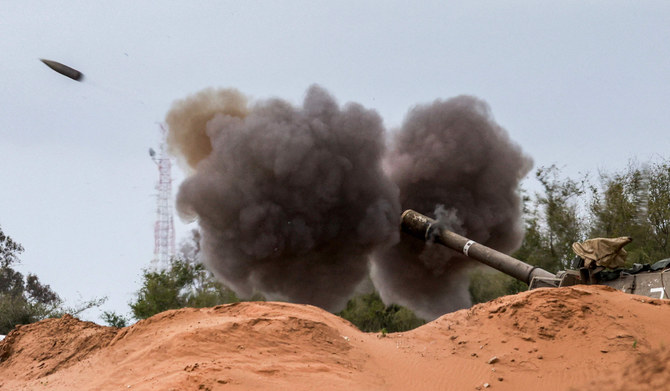
An Israeli army self-propelled artillery howitzer fires rounds from a position near the border with the Gaza Strip in southern Israel on December 24, 2023. (AFP)
Short Url
Updated 25 December 2023
Follow

Israel says five Gaza hostages died in tunnel, circumstances being probed

  • Hamas has previously said some hostages died in Israel’s shelling of Gaza

JERUSALEM: Five Israeli hostages killed in Hamas captivity were recovered from an underground tunnel network in the northern Gaza Strip, the military said on Sunday, showing footage of a white-tiled bathroom and work room linked by dark concrete-lined passages.
The publication left open the question of how they had died, with chief military spokesperson Rear Admiral Daniel Hagari saying post-mortems were pending. “We will brief the families and then, depending on what they approve, the public,” he said.
The three soldiers and two civilians were among 240 people dragged back to the Gaza Strip by Hamas gunmen during the cross-border rampage of Oct. 7 that sparked the war. The military announced the repatriation of their bodies earlier this month.
Hamas last week published video showing three of the hostages alive in what appeared to be a narrow, white-tiled and windowless bedroom with an electric wall socket.
In a Hebrew chyron directed at Israel, the Iranian-backed Islamist group said: “Your military weapons killed the three.”
Hamas has previously said some hostages died in Israel’s shelling of Gaza. It has also threatened to execute hostages.
Sunday’s military publication came as Prime Minister Benjamin Netanyahu said Israel would deepen operations in an almost 12-week-old war whose toll on Gaza civilians has alarmed Western powers also worried about the 129 remaining hostages.
Video released by the military showed its engineers in a dark and dusty tunnel network which, it said, had two storys — one 10 meters down and the other “dozens of meters” deeper.
One tunnel ran to the home of Ahmad Al Ghandour, chief of Hamas’ North Gaza brigade, the Israeli military said. Hamas declared him and several other commanders killed in action on Nov. 26. Israel said they were targets of one of its air strikes.
The video showed a section of tunnel lined with white tiles, as well as a similarly designed bathroom with a basic shower, toilet and sink, and a work room with a corner table and bench. One tunnel had a drinking water dispenser and a pile of bullets.
The military video did not include images corresponding to the hostages’ bedroom shown in the Hamas video, whose ceiling appeared differently designed though also tiled in white.


Lebanon’s south could become US-backed economic zone, according to local paper Nidaa Al-Watan

Updated 7 sec ago
Follow

Lebanon’s south could become US-backed economic zone, according to local paper Nidaa Al-Watan

  • Lebanese daily quotes sources as saying the US plan casts southern Lebanon as a key gateway for broader economic transformation
  • White House fails to respond to Arab News’ request for comment

LONDON: Lebanese daily Nidaa Al-Watan has reported that the office of Jared Kushner, son-in-law and senior adviser to US President Donald Trump, has prepared detailed maps for a so‑called “Trump Economic Zone” in southern Lebanon. 

According to columnist Tarek Abou Zeinab, the Kushner plan has been formally submitted to the White House for consideration. 

Citing unnamed sources, the column said that the idea is no longer just a “whispered” concept among political circles but has entered what it described as “concrete border‑related discussions aimed at fast‑tracking the plan onto the US administration’s Middle East implementation agenda.” 

Arab News asked the US Embassy in Beirut and the US State Department for comment, but was directed to the White House for any official response. The White House was subsequently contacted but has not responded. 

Lebanon has been mired in prolonged political paralysis. Large parts of the south remain under Hezbollah’s influence, while Israel illegally occupies at least five outposts along the border that are within Lebanese sovereign land. 

According to Nidaa Al‑Watan’s sources, the US concept frames southern Lebanon as a key gateway for a wider economic transformation, tying large‑scale investment and infrastructure projects to security arrangements on the ground. 

The reported plan would seek to attract international capital, establish factories and logistics hubs, upgrade infrastructure, and build a port connected to global shipping routes. 

Its aim, according to the column, would be to open new export channels through a free‑zone model and lure major energy companies by linking southern Lebanon to wider schemes such as the India–Middle East–Europe Economic Corridor. 

Supporters of the plan argue it could trigger large Arab and international investments, raise living standards and create long‑term jobs, thereby lowering the risk of renewed conflict. 

However, Lebanese political and media sources quoted by the daily have warned that the proposal follows a new “hegemonic” approach and carries major political implications that cannot be ignored. 

The critics say the reported US vision goes beyond development to include the establishment of Jewish settlements in parts of southern Lebanon, justified on religious and security grounds to protect northern Israel. 

One source expressed concern that such moves would create a geographic and symbolic link between Israel and southern Lebanon, deepening fears over sovereignty and the region’s future political trajectory. 

The paper said Kushner is focussed on areas stretching from Mount Hermon to Shebaa and Naqoura in the far south at a time when Israel has been pressing for a buffer zone along the border, citing security concerns since the end of major clashes with Hezbollah in November 2024. 

The proposed zone would cover more than 27 southern towns, raising questions over Lebanese sovereignty. 

In parallel, the Lebanese army has been tasked with bringing all weapons under state control and asserting government authority in areas long dominated by Hezbollah, as part of a broader disarmament and security plan. 

Despite a ceasefire, Israel has continued to carry out attacks inside Lebanese territory and maintains control over parts of the south, saying the measures are necessary for security. 

Lebanese and Israeli delegations held talks in Naqoura earlier in December to shore up the ceasefire and discuss reconstruction in the south.