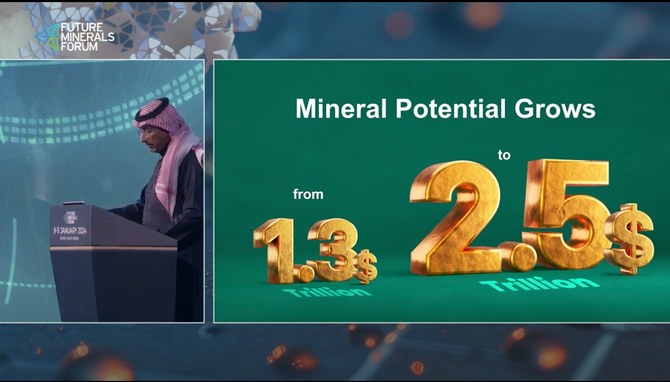
Saudi Arabia increases mineral potential projections by 90% to $2.5tn

Minister of Industry and Mineral Resources Bandar Alkhorayef highlighted that the revision is based on discoveries related to rare earth elements and an upswing in mineral volumes. AN Photo
Short Url
Updated 10 January 2024
Follow

Saudi Arabia increases mineral potential projections by 90% to $2.5tn

RIYADH: Saudi Arabia has elevated its projections for undiscovered mineral potential by 90 percent to $2.5 trillion, as stated by the minister of industry and mineral resources.  

Speaking during the opening remarks of the third Future Minerals Forum, Bandar Alkhorayef highlighted that the revision is based on discoveries related to rare earth elements and an upswing in mineral volumes.  

The minister said: “I am delighted to announce that our estimation for the Kingdom’s untapped mineral potential has increased from $1.3 trillion to $2.5 trillion, an increase of 90 percent.”   

He added: “This is based on new discoveries in the form of rare earth elements and the combination of the increase of volumes in phosphate, gold, zinc and copper as well as the revaluation of these minerals.” 

Alkhorayef further explained that this is only built on 30 percent of the Arabian Shield exploration suggesting that there is more to be discovered. In addition, it clearly shows that with more investment in exploration, it is possible to maximize the endowment potential.  

The minister also announced that the forum will witness signing of deals worth SR75 billion ($20 billion), driving research and development technology upstream and other value chain opportunities.  

“Today, we are at a historical point where minerals are at the spotlight as vital elements for the energy transition, food security and for global development,” Alkhorayef said.  

The minister also expressed his delight as he revealed many key initiatives, beginning with the exploration incentive program in partnership with the Ministry of Investment, which has a budget of more than $182 million.  

“This program will de-risk investments in our exploration securing to enable new commodities, greenfield projects, and junior miners. In addition, and to drive the existing future of the exploration sector, we are announcing the fifth and sixth rounds of licensing programs offering access to 33 exploration sites this year,” he continued.  

Looking at exponential progress made on the key initiatives the Kingdom agreed on last year, Alkhorayef announced to offer country-sized sites for exploration beginning with the Jabal Sayid Mineral Belt spanning over 4,000 sq. km.  

During the high-level ministerial roundtable meeting on Tuesday, Alkhorayef stated that the Kingdom has endorsed a detailed roadmap for the development of a regional critical mineral framework to promote global collaboration and maximize value creation in supplier countries.  

“We agreed on further work on exploring value chain creation opportunities for green metal hubs in the region, enabled by new technologies and renewable energy which we consider draft sustainability, expectations to be incorporated into the framework,” the minister said.  

He added: “We endorsed a roadmap for the creation of Mineral Innovation and Acceleration Park, the first phase of a global network of centers of excellence. All of this is proof that we are turning talk into action.”  


Bangladesh refuse to go to India for T20 World Cup

Updated 5 sec ago
Follow

Bangladesh refuse to go to India for T20 World Cup

  • Bangladesh board’s response comes a day after ICC rejected its demand to shift World Cup matches from India to Sri Lanka
  • Row erupted in January when India’s cricket board asked IPL franchise to drop Bangladesh player amid political tensions

DHAKA, Bangladesh: Bangladesh will not travel to India to play in next month’s T20 World Cup, its cricket board said on Thursday, effectively ruling the country out of the tournament.

“Our only demand is to play the World Cup — but not in India,” Bangladesh Cricket Board (BCB) President Aminul Islam Bulbul told reporters.

The refusal came a day after cricket’s governing body rejected Bangladesh’s plea to play its games in Sri Lanka instead.

“There is no scope for changing our decision,” said Asif Nazrul, an adviser for youth and sports issues in Bangladesh’s interim government.

The T20 World Cup begins on February 7, with Bangladesh scheduled to play their four group matches in the Indian cities of Kolkata and Mumbai.

The row between the neighboring nations erupted on January 3 when the Indian cricket board ordered the Indian Premier League (IPL) franchise Kolkata Knight Riders to release Bangladesh fast bowler Mustafizur Rahman.

Mustafizur’s removal from the IPL followed online outrage by right-wing Indian Hindus who invoked alleged attacks on a fellow community in Muslim-majority Bangladesh.

Dhaka maintains that Indian media had exaggerated the scale of the violence.

The sport’s global governing body said on Wednesday it had “engaged with the BCB in sustained and constructive dialogue” to ensure Bangladesh could participate in the tournament, but added that those efforts had been “rebuffed.”

The International Cricket Council (ICC) said “independent security assessments, comprehensive venue-level security plans and formal assurances from the host authorities” found there was “no credible or verifiable threat to the safety” of the Bangladesh team.

‘LOSE A HUGE AUDIENCE’

However, Nazrul said Bangladesh’s security concerns “did not arise from speculation or theoretical analysis.”

“They arose from a real incident — where one of our country’s top players was forced to bow to extremists, and the Indian cricket board asked him to leave India,” he said.

Bangladesh will hold elections during the World Cup, its first since a mass uprising in 2024 toppled then-prime minister Sheikh Hasina, a close ally of New Delhi.

Political relations have since soured between Bangladesh and India, where Hasina fled after she was ousted.

There are wider issues for India, which is preparing to host the 2030 Commonwealth Games that are seen as a stepping stone for its ambitions to host the 2036 Olympics.

“Bangladesh is a cricket-loving nation. If a country of nearly 200 million people misses the World Cup, the ICC will lose a huge audience,” the BCB’s Bulbul said.

“Cricket is entering the Olympics in 2028, Brisbane in 2032, India is bidding for 2036. Excluding a major cricket-loving country like Bangladesh would be a failure.”

Bangladesh’s appeal to the ICC was not without precedent, with India’s arch-enemy Pakistan to play all its games in Sri Lanka.

That deal was struck after India, a financial and administrative powerhouse within cricket, refused to travel to Pakistan for the 2025 Champions Trophy and played its matches in Dubai instead.

However, the ICC said a year later a similar shift was impossible for Bangladesh.

“There are many precedents worldwide where matches have been moved to other venues due to security risks,” Bangladesh’s Nazrul said.

ICC sources told AFP this week that Bangladesh could be replaced by Scotland, the highest-ranked team that did not qualify outright for the World Cup.