

Pakistani PM congratulates Bangladesh’s Hasina on election victory, calls for bilateral cooperation

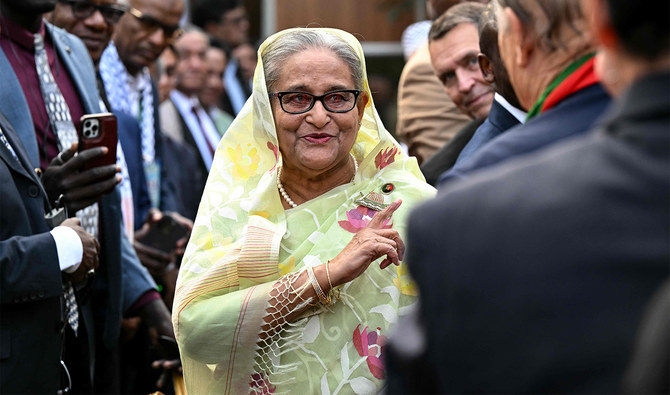
Bangladesh's Prime Minister Sheikh Hasina accepts greetings from the assembled media and election observers during a press conference, a day after she won the 12th parliamentary elections, in Dhaka on January 8, 2024. (AFP)
Short Url
Updated 09 January 2024
Follow

Pakistani PM congratulates Bangladesh’s Hasina on election victory, calls for bilateral cooperation

  • Sheikh Hasina won Bangladesh polls this week marred by an opposition boycott, low voter turnout
  • Ties between Pakistan, Bangladesh remain strained since former secured independence from latter

ISLAMABAD: Pakistan’s Caretaker Prime Minister Anwaar-ul-Haq Kakar congratulated Bangladesh leader Sheikh Hasina this week on winning a fourth term in office, saying he was looking forward to “enhanced cooperation” between the two countries under her leadership. 

Hasina will serve another five years in office after her party, the Awami League, and its allies won 223 out of 300 parliamentary seats contested this week. The national vote was marred by a boycott from the Bangladesh Nationalist Party, pre-election violence and a low voter turnout. 

Relations between Pakistan and Bangladesh remain strained ever since the bloody 1971 war, when Bengali nationalists backed by India broke away from what was then West Pakistan to form a new country. It was Hasina’s father, Sheikh Mujibur Rahman, who led the independence movement for Bangladesh. 

“I congratulate Sheikh Hasina on her re-election as the Prime Minister of Bangladesh,” Kakar wrote on social media platform X, formerly Twitter. “I wish Sheikh Hasina a successful term in office and look forward to enhanced cooperation between Pakistan and Bangladesh under her leadership.”

Pakistan is currently being run by a caretaker government under Kakar that is meant to oversee a general election scheduled for February 8. 

Caretakers are usually limited to overseeing elections, but Kakar’s set-up is the most empowered in Pakistan’s history thanks to last year’s legislation that allows it to make policy decisions on economic matters. 

Political analysts fear a prolonged period without an elected government in Pakistan would allow the military, which has ruled the country for over three decades since independence in 1947 and wields considerable control even if not in power, to consolidate control.

Kakar and his government have repeatedly assured masses that polls would be held as per schedule on February 8 and that a “level playing field“— a euphemism for fair chance for all political parties, would be provided to every contestant. 


Pakistan business body writes to PM seeking ‘clear roadmap’ to spur investment

Updated 5 sec ago
Follow

Pakistan business body writes to PM seeking ‘clear roadmap’ to spur investment

  • Business confidence in Pakistan has fallen sharply amid rising inflation, high energy costs and unpredictable tax environment
  • In a letter written to PM Shehbaz Sharif, the Pakistan Business Forum president highlights challenges facing the business community

KARACHI: The Pakistan Business Forum (PBF), a representative body of traders and businesspersons in the country, on Monday urged Prime Minister Shehbaz Sharif’s intervention in outlining a “clear economic roadmap” to promote long-term investment in Pakistan.

Business confidence in Pakistan has fallen sharply amid rising inflation, high energy costs and an unpredictable tax environment. Currency volatility and slowing demand have prompted many firms to delay investments and scale back expansion plans.

In a letter to PM Sharif, PBF President Khawaja Mehboob-ur-Rehman highlighted the challenges facing the business community, including high input costs, soaring energy tariffs and an increasingly “uncompetitive” tax regime that weakens exports.

“Looking ahead to 2026, the Pakistan Business Forum urged the prime minister to provide the business community with a clear, credible, and forward-looking economic roadmap,” read a PBF statement.

“Such clarity... is essential to restore confidence, encourage investment, and enable long-term planning by businesses.”

The South Asian country of more than 241 million people is currently navigating a tricky path to economic recovery under a $7 billion International Monetary Fund (IMF) program since averting a default in 2023.

Besides introducing structural reforms relating to expansion of the country’s tax base and privatization of loss-making entities, the government of PM Sharif says it is taking various measures to boost foreign investment and trade.

The PBF highlighted the business community is ready to play its role in competing with regional markets, if provided with the “necessary competitive tools.” It outlined critical reforms relating to regionally competitive electricity tariffs and corporate tax rates.

An increase in electricity tariffs would put further strain on industries and could lead to widespread downsizing and the closure of industrial units, according to the PBF.

It urged the government to include business representatives in the policymaking process to ensure it understands “on-ground realities.”