

Israel signals it has wrapped up major combat in northern Gaza

A convoy of Israeli military vehicles manoeuver near the Israel-Gaza border, amid the ongoing conflict between Israel and the Palestinian Islamist group Hamas, in Israel, January 6, 2024. (Reuters)
Short Url
Updated 07 January 2024
Follow

Israel signals it has wrapped up major combat in northern Gaza

  • Speaking about military efforts to dismantle Hamas in the central and southern Gaza Strip, Hagari said “we will do it in a different way” without elaborating

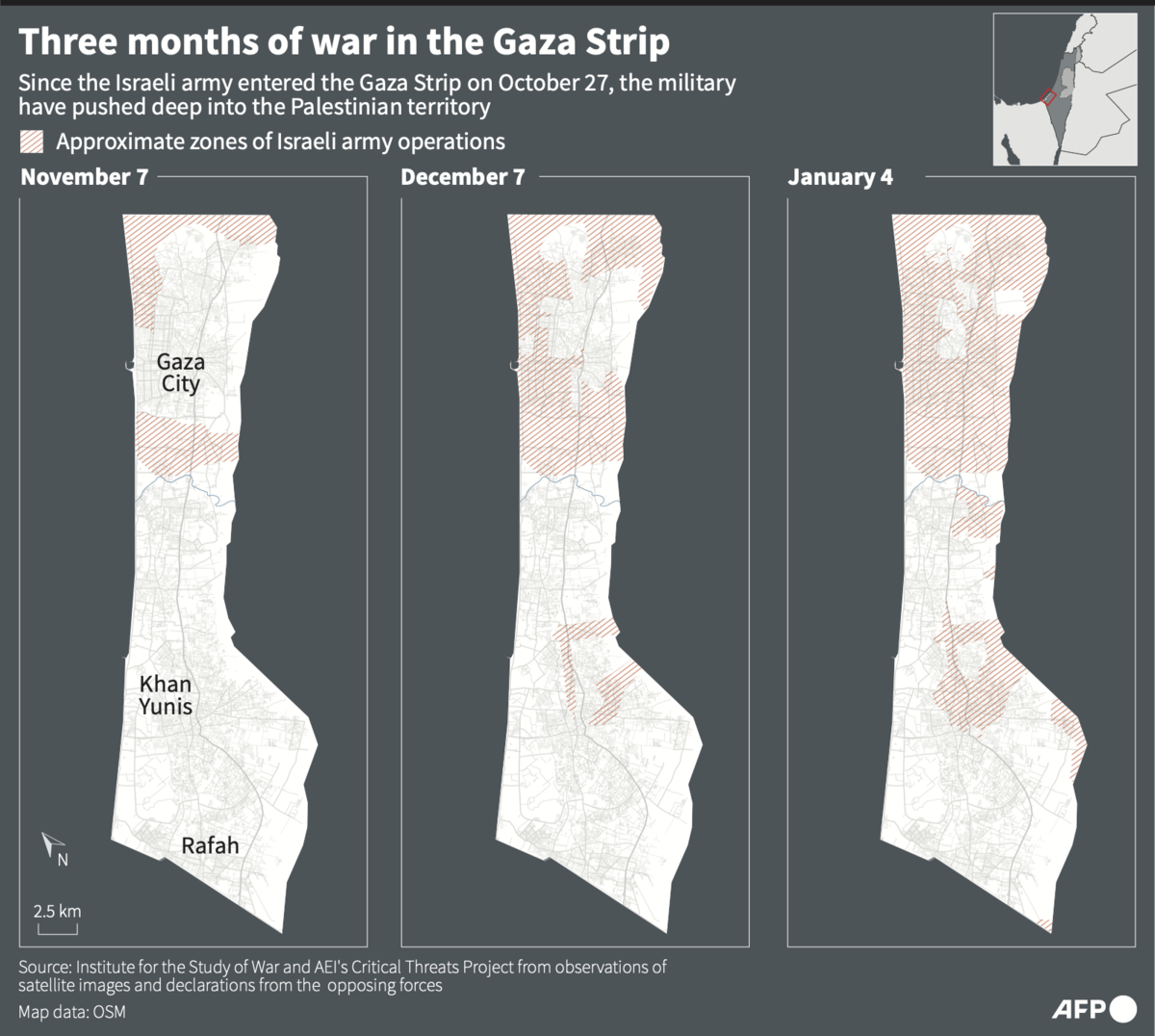
JERUSALEM: The Israeli military signaled that it has wrapped up major combat in northern Gaza, saying it has completed dismantling Hamas' military infrastructure there, as the war against the militant group entered its fourth month Sunday.
The military did not address troop deployments in northern Gaza going forward. Its spokesman, Rear Adm. Daniel Hagari, said late Saturday that forces would “continue to deepen the achievement” there, strengthen defenses along the Israel-Gaza border fence and focus on the central and southern parts of the territory.

Meanwhile, the health ministry in Gaza said Sunday at least 22,835 people have been killed in the besieged Palestinian territory since war with Israel broke out on October 7.
The ministry said in a statement that it had recorded 113 deaths in the past 24 hours, while a total of 58,416 people had been wounded in the Gaza Strip during the three months of fighting.

It resulted in the deaths of around 1,140 people, most of them civilians, according to an AFP tally based on official figures.
The militants also took around 250 hostages, 132 of whom remain in captivity, according to Israel.
Israel responded by bombarding the territory and sending in ground forces, killing at least 22,722 people, most of them women and children, according to the health ministry in Hamas-run Gaza.
Speaking about military efforts to dismantle Hamas in the central and southern Gaza Strip, Hagari said “we will do it in a different way” without elaborating.
“The refugee camps in the central Gaza Strip are crowded and full of terrorists,” he said.
In the south, the large urban landscape of Khan Yunis has an elaborate underground network of tunnels, he said.
“It takes time.”
Earlier on Saturday, Prime Minister Benjamin Netanyahu said his government had directed the army to “eliminate Hamas,” return all the hostages and ensure that Gaza will “never again be a threat to Israel.”
“The war must not be stopped until we achieve all of the goals,” he said in a statement.


Sudan defense minister dismisses ‘intelligence document’ as fabrication after convoy strike

Updated 12 February 2026
Follow

Sudan defense minister dismisses ‘intelligence document’ as fabrication after convoy strike

  • Gen. Hassan Kabroun tells Arab News claims that army hid weapons in aid convoy are “completely false”

RIYADH: Sudan’s defense minister has firmly denied reports attributed to Sudanese intelligence alleging that a convoy targeted in North Kordofan was secretly transporting weapons under the cover of humanitarian aid.

Gen. Hassan Kabroun described the claims as “false” and an attempt to distract from what he called a militia crime.

The controversy erupted after news reports emerged that a document attributed to Sudan’s General Intelligence Service claimed the convoy struck in Al-Rahad on Friday was not a purely humanitarian mission, but was instead carrying “high-quality weapons and ammunition” destined for Sudanese Armed Forces units operating in the state.

The report further alleged that the convoy had been outwardly classified as humanitarian in order to secure safe passage through conflict zones, and that the Rapid Support Forces had destroyed it after gathering intelligence on its route and cargo.

Kabroun categorically rejected the narrative.

“First of all, we would like to stress the fact that this news is false,” he told Arab News. “Even the headline that talks about the security of the regions, such as Al-Dabbah, is not a headline the army would use.”

He described the document as fabricated and politically motivated, saying it was designed to “cover up the heinous crime they committed.”

The minister affirmed that the area targeted by drones is under full control of the Sudanese Armed Forces and does not require any covert military transport.

“Second, we confirm that the region that was targeted by drones is controlled by the army and very safe,” Kabroun said. “It does not require transporting any military equipment using aid convoys as decoys because it is a safe area controlled by the army, which has significant capabilities to transport humanitarian aid.”

According to the minister, the Sudanese military has both the logistical capacity and secure routes necessary to move equipment openly when needed.

“The army is professional and does not need to deliver anything to Kadugli or Dalang on board aid convoys,” he said. “The road between Dalang and Kadugli is open. The Sudanese forces used that road to enter and take control of the region. The road is open and whenever military trucks need to deliver anything, they can do so without resorting to any form of camouflage.”

Kabroun further rejected any suggestion that the military uses humanitarian operations as cover.

“Aid is transported by dedicated relief vehicles to the areas in need of this assistance,” he said. “Aid is not transported by the army. The army and security apparatus do not interfere with relief efforts at all, and do not even accompany the convoys.”

He stressed that the Sudanese Armed Forces maintains a clear institutional separation between military operations and humanitarian work, particularly amid the country’s crisis.

“These are false claims,” he said. “This fake news wanted to cover up the heinous crime they committed.”

Sudan has been gripped by conflict since April 2023, when fighting broke out between the Sudanese Armed Forces and the Rapid Support Forces, plunging the country into what the United Nations has described as one of the world’s worst humanitarian disasters.

The latest dispute over the convoy comes amid intensified fighting in South Kordofan, a strategically sensitive region linking central Sudan with the contested areas of Darfur and Blue Nile.

The false report suggested that intelligence monitoring had enabled the RSF to strike what it described as a military convoy disguised as humanitarian aid. But Kabroun dismissed that version outright.

“The intelligence agency is well aware of its duties,” he said. “The Sudanese Army has enough weapons and equipment to use in the areas of operations. These claims are completely false.”

He argued that the narrative being circulated seeks to shift blame for attacks on civilian infrastructure and humanitarian movements.

“This shows that they are trying to cover up the atrocities,” he added, referring to the militia.

Kabroun maintained that the army has regained momentum on multiple fronts and remains fully capable of sustaining its operations without resorting to deception.

“The region is secure, the roads are open, and the army does not need camouflage,” he said. “We are operating professionally and transparently.”

“These claims are completely false,” Kabroun said. “The Sudanese Army does not use humanitarian convoys for military purposes.”