

Thousands of mourners in Islamabad attend funeral for Pakistani cleric gunned down in broad daylight

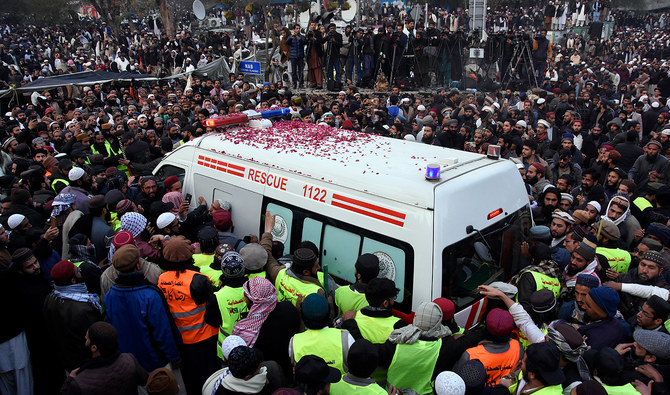
People gather around the ambulance carrying the casket of Pakistani Sunni Muslim cleric Masoodur Rehman Usmani, following his funeral prayer, in Islamabad, Pakistan, Sunday, Jan. 6, 2024. (AP)
Short Url
Updated 06 January 2024
Follow

Thousands of mourners in Islamabad attend funeral for Pakistani cleric gunned down in broad daylight

  • Masood-ur-Rehman Usmani of Sunni Ulema Council was killed by unidentified gunmen in the federal capital a day earlier
  • Police say they are using closed-circuit TV footage to track down the attackers while vowing to bring them to justice

ISLAMABAD: Thousands of mourners attended a funeral Saturday for a Pakistani Sunni Muslim cleric gunned down in broad daylight on the outskirts of the capital, Islamabad, police and a spokesman for the cleric’s organization said.
The funeral of Masood-ur-Rehman Usmani was held a day after unidentified gunmen shot and killed him and wounded his driver in the neighborhood of Ghauri Town, according to a statement issued by the Islamabad police.
No one claimed responsibility for the attack, which is a rare occurrence near Islamabad. Police said they were using closed-circuit TV footage to track down the attackers, and vowed that they would be arrested and brought to justice.
Authorities in Islamabad have stepped up security by deploying additional police and some embassies were advising their nationals to avoid visiting the area where the funeral for Usmani was to be held.
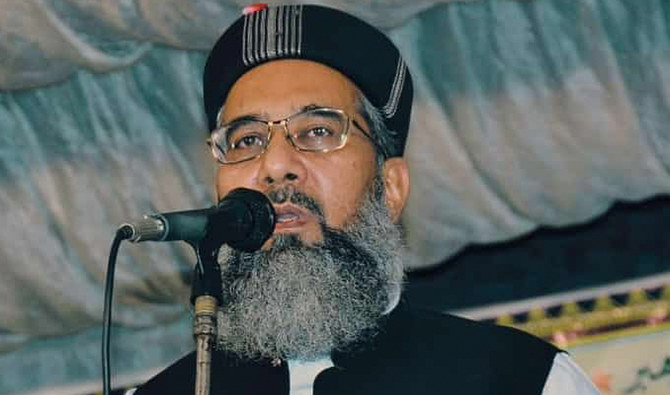


This undated file photo shows the late Pakistani cleric Masood-ur-Rehman Usmani. (Photo courtesy: X/@zarrar_11PK)

Usmani was a deputy secretary at his Sunni Ulema Council, which emerged after Pakistan outlawed the Sipah-e-Sahaba extremist group, which has been accused of killing thousands of Shiites in recent decades across the country.
Sunni Muslim clerics in their speeches at the funeral asked the government to ensure the arrest of those responsible for the killing of Usmani.
Pakistan has suffered frequent sectarian violence between the majority Sunni and minority Shiite groups, but authorities say it is still unclear who was behind the killing of Usmani, though mourners at his funeral were seen chanting slogans against Shiites and neighboring Iran, which is often accused by Sunni groups of backing Shiite organizations in Pakistan.
Most Sunnis and Shiites live together peacefully in Pakistan, though tensions have existed for decades.



World Bank approves $700 million for Pakistan’s economic stability

Updated 6 sec ago
Follow

World Bank approves $700 million for Pakistan’s economic stability

  • Of this, $600 million will go for federal programs and $100 million will ⁠support a provincial program in Sindh
  • The results-based design ensures that resources are only disbursed once program objectives are achieved

ISLAMABAD: The World Bank has approved $700 million in ​financing for Pakistan under a multi-year initiative aimed at supporting the country’s macroeconomic stability and service delivery, the bank said on Friday.

The funds will be released under the bank’s Public ‌Resources for Inclusive ‌Development — Multiphase ‌Programmatic ⁠Approach (PRID-MPA) that ‌could provide up to $1.35 billion in total financing, according to the lender.

Of this amount, $600 million will go for federal programs and $100 million will ⁠support a provincial program in ‌the southern Sindh province. The results-based design ensures that resources are only disbursed once program objectives are achieved.

“Pakistan’s path to inclusive, sustainable growth requires mobilizing more domestic resources and ensuring they are used efficiently and transparently to deliver results for people,” World Bank country director Bolormaa Amgaabazar said in a statement.

“Through this MPA, we are working with the Federal and Sindh governments to deliver tangible impacts— more predictable funding for schools and clinics, fairer tax systems, and stronger data for decision‑making— while safeguarding priority social and climate investments and strengthening public trust.”

The approval ‍follows a $47.9 ‍million World Bank grant ‍in August to improve primary education in Pakistan’s most populous Punjab province.

In November, an IMF-World Bank ​report, uploaded by Pakistan’s finance ministry, said Pakistan’s fragmented ⁠regulation, opaque budgeting and political capture are curbing investment and weakening revenue.

Regional tensions may surface over international financing for Pakistan. In May, Reuters reported that India would oppose World Bank funding for Pakistan, citing a senior government ‌source in New Delhi.

“Strengthening Pakistan’s fiscal foundations is essential to restoring macroeconomic stability, delivering results and strengthening institutions,” said Tobias Akhtar Haque, Lead Country Economist for the World Bank in Pakistan.

“Through the PRID‑MPA, we are launching a coherent nationwide approach to support reforms that expand fiscal space, bolster investments in human capital and climate resilience, and strengthen revenue administration, budget execution, and statistical systems. These reforms will ensure that resources reach the frontline and deliver better outcomes for people across Pakistan with greater efficiency and accountability.”

In Sindh, the program is expected to increase provincial revenues, enhance the speed and transparency of payments, and broaden the use of data to guide provincial decision making. The program will directly support the increase of public resources for inclusive development, including more equitable and responsive financing for primary health care facilities and more funding for schools.