

Blinken: Middle East nations need to use influence to prevent ‘endless cycle of violence’

1 / 2
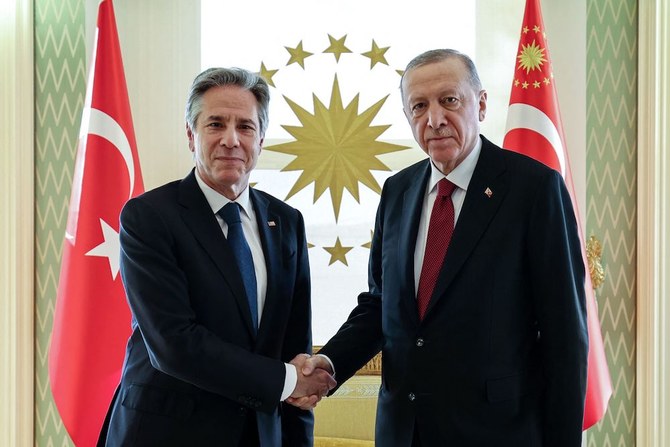
Turkiye’s President Erdogan (R) shaking hands with US Secretary of State Antony Blinken (L) prior to their meeting at the Vahdettin private residence of the presidency in Istanbul. (AFP/Turkish Presidency Press Office)
2 / 2
US Secretary of State Antony Blinken (C) arrives in Istanbul, Turkiye, on January 5, 2024, a first step of a new tour to the Middle East focused on the conflict in Gaza.(POOL / AFP)
Short Url
Updated 07 January 2024
Follow

Blinken: Middle East nations need to use influence to prevent ‘endless cycle of violence’

  • Blinken’s fourth crisis tour since the start of the Israel-Hamas war three months ago comes with fears mounting that the conflict will engulf swathes of the Middle East
  • Turkiye asked Hamas leaders to leave Istanbul after the Oct. 7 attack on Israel, but has since denounced Israel's reprisal attacks in Gaza

CHANIA, Greece: Middle Eastern nations need to use their influence over regional actors to ensure the Gaza conflict is contained and prevent “an endless cycle of violence,” US Secretary of State Antony Blinken said on Saturday.
Blinken spoke late in the day after meeting the leaders of Turkiye and Greece at the start of a week-long trip aimed at calming tensions that have spiked since Israel’s war with Hamas began in October.
It is in the interests of virtually all nations in the Middle East to contain the fighting, Blinken told reporters.
“We want to make sure that countries who feel that way are also using their ties, using their influence, using their relationships with some of the actors that might be involved to keep a lid on things, to make sure that we’re not seeing the spread of conflict,” he said before flying to Jordan.

Lebanon’s Iranian-backed Hezbollah group said on Saturday it had fired rockets at Israel, and its arch-foe said it had struck a “terrorist cell” in retaliation.
Blinken said it was very important that Israel had security in the north of the country.
“From the perspective of Israel, it’s clearly not interested, does not want escalation ... but they also have to be fully prepared to defend themselves,” he said.
Blinken, who will also visit Arab states, Israel and the occupied West Bank, said if efforts to settle the crisis failed the outcome would be “an endless cycle of violence ... and lives of insecurity and conflict for people in the region.”
He also said he would be looking at what could be done to maximize the protection of civilians in Gaza and increase deliveries of humanitarian assistance.
“Far too many Palestinians have been killed, especially children,” he said.
The war began when Hamas fighters attacked Israel on Oct. 7, killing 1,200 people and taking 240 hostages.
Israel’s retaliatory offensive has killed 22,700 Palestinians, according to Palestinian officials, and the conflict has spilled into the West Bank, Lebanon and Red Sea shipping lanes.
Blinken earlier met Turkish President Tayyip Erdogan, a strong critic of Israel’s military actions in Gaza.
Blinken and Foreign Minister Hakan Fidan had earlier discussed Gaza, as well as Turkiye’s process to ratify Sweden’s membership of the NATO military alliance, Turkiye’s foreign ministry said.
US officials have been frustrated by the length of the process, but are confident Ankara will soon approve Sweden’s accession after it won the Turkish parliament’s backing last month, said a senior State Department official traveling with Blinken, speaking on condition of anonymity.
US lawmakers have held up the sale of F-16 fighter jets to Turkiye until it signs off on Swedish membership.

BLINKEN VISITS GREECE
Blinken later traveled to Crete where he met Prime Minister Kyriakos Mitsotakis.
Fellow NATO member Greece is awaiting US Congress approval of a sale of F-35 fighter jets.
Blinken stressed the importance of Greece’s strong alliance with Washington, while Mitsotakis said the two countries could work together to help safeguard security in a turbulent region.



US Secretary of State Antony Blinken (R) meets with Greek Prime Minister Kyriakos Mitsotakis at the Prime Minister's Residence in Crete, on January 6, 2024, as part of the first leg of a trip that includes visits to both Israel and West Bank. (AFP)

Greece has condemned the Oct. 7 Hamas attack and backs Cyprus’ initiative for a maritime corridor to help deliver more aid to the enclave. It believes it can play an active role on that front due to its historic ties with the Arab world.
The US official said Turkiye has relationships with many parties in the conflict, a reference to its ties to US adversary Iran and Hamas. Unlike the US, Turkiye does not view Hamas as a terrorist group and hosts some of its members.

Blinken also hopes to make progress in talks on how Gaza could be governed if and when Israel achieves its aim of eradicating Hamas.
Washington wants countries in the region, including Turkiye, to play a role in reconstruction, governance and potentially security in the Gaza Strip, which has been run by Hamas since 2007, the official said.


First responders enter devastated Aleppo neighborhood after days of deadly fighting

Updated 12 January 2026
Follow

First responders enter devastated Aleppo neighborhood after days of deadly fighting

  • The US-backed SDF, which have played a key role in combating the Daesh group in large swaths of eastern Syria, are the largest force yet to be absorbed into Syria’s national army

ALEPPO, Syria: First responders on Sunday entered a contested neighborhood in Syria’ s northern city of Aleppo after days of deadly clashes between government forces and Kurdish-led forces. Syrian state media said the military was deployed in large numbers.
The clashes broke out Tuesday in the predominantly Kurdish neighborhoods of Sheikh Maqsoud, Achrafieh and Bani Zaid after the government and the Syrian Democratic Forces, the main Kurdish-led force in the country, failed to make progress on how to merge the SDF into the national army. Security forces captured Achrafieh and Bani Zaid.
The fighting between the two sides was the most intense since the fall of then-President Bashar Assad to insurgents in December 2024. At least 23 people were killed in five days of clashes and more than 140,000 were displaced amid shelling and drone strikes.
The US-backed SDF, which have played a key role in combating the Daesh group in large swaths of eastern Syria, are the largest force yet to be absorbed into Syria’s national army. Some of the factions that make up the army, however, were previously Turkish-backed insurgent groups that have a long history of clashing with Kurdish forces.
The Kurdish fighters have now evacuated from the Sheikh Maqsoud neighborhood to northeastern Syria, which is under the control of the SDF. However, they said in a statement they will continue to fight now that the wounded and civilians have been evacuated, in what they called a “partial ceasefire.”
The neighborhood appeared calm Sunday. The United Nations said it was trying to dispatch more convoys to the neighborhoods with food, fuel, blankets and other urgent supplies.
Government security forces brought journalists to tour the devastated area, showing them the damaged Khalid Al-Fajer Hospital and a military position belonging to the SDF’s security forces that government forces had targeted.
The SDF statement accused the government of targeting the hospital “dozens of times” before patients were evacuated. Damascus accused the Kurdish-led group of using the hospital and other civilian facilities as military positions.
On one street, Syrian Red Crescent first responders spoke to a resident surrounded by charred cars and badly damaged residential buildings.
Some residents told The Associated Press that SDF forces did not allow their cars through checkpoints to leave.
“We lived a night of horror. I still cannot believe that I am right here standing on my own two feet,” said Ahmad Shaikho. “So far the situation has been calm. There hasn’t been any gunfire.”
Syrian Civil Defense first responders have been disarming improvised mines that they say were left by the Kurdish forces as booby traps.
Residents who fled are not being allowed back into the neighborhood until all the mines are cleared. Some were reminded of the displacement during Syria’s long civil war.
“I want to go back to my home, I beg you,” said Hoda Alnasiri.