

Pakistan government to write to UK magazine over ex-PM Khan’s article criticizing national polls

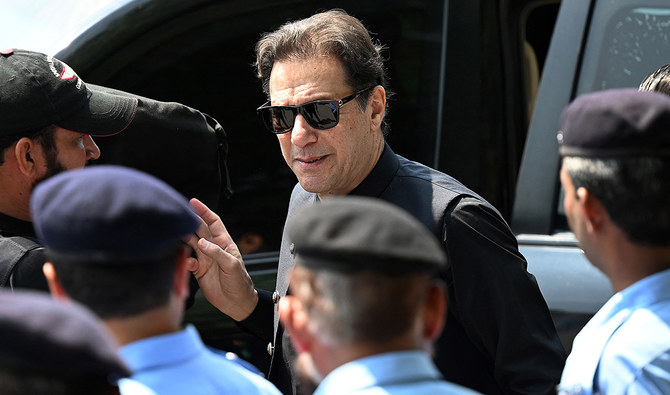
Pakistan’s former Prime Minister Imran Khan (C) arrives to appear in the Supreme Court in Islamabad on July 24, 2023. (AFP/File)
Short Url
Updated 05 January 2024
Follow

Pakistan government to write to UK magazine over ex-PM Khan’s article criticizing national polls

  • The interim information minister calls it disconcerting that The Economist can publish an article by a ‘jailed convict’
  • He wonders how many ‘ghost articles’ by incarcerated politicians have been printed by the British magazine before

ISLAMABAD: Caretaker Information Minister Murtaza Solangi announced the government’s plan to write to a British magazine that published an article allegedly written by Pakistan’s former prime minister Imran Khan who has been in prison since his conviction in a graft case last August.

Khan was ousted from power in a no-confidence vote in April 2022 and has since faced a slew of legal cases which he says are meant to keep him away from the country’s political landscape ahead of the next general elections.

The article in question, published by The Economist on Thursday, described Pakistan’s upcoming elections as “a farce” while adding that Khan’s Pakistan Tehreek-e-Insaf (PTI) party had been unfairly targeted and muzzled.

“Today, we are writing to the Editor of @TheEconomist about an article purportedly written by Mr. Imran Khan,” Solangi wrote in a social media post. “It is puzzling and disconcerting that such an esteemed media outlet published an article in the name of an individual who is in jail and has been convicted.”

He said it was vital to uphold ethical standards and promote responsible journalism.

“We would like to know how the editorial decision was made, and what considerations were taken into account regarding the legitimacy and credibility of the content by the @TheEconomist,” he continued.

“We would also be interested to know if @TheEconomist has ever published such ghost articles by jailed politicians ever from any other part of the world,” he added.

The minister maintained if “jailed convicts” were free to publish articles, they would only “air their one-sided grievances.”

Khan’s PTI, which has faced a crackdown since May 9 when hundreds of people carrying its flags targeted government buildings after the former prime minister was briefly arrested at an Islamabad jail on corruption charges, has demanded a level playing field in recent weeks.

Many of its top leaders have already left the party after being arrested by law enforcement agencies.

Those who are left behind say their nominations papers have been rejected by the election authorities ahead of the national polls.


IMF hails Pakistan privatization drive, calls PIA sale a ‘milestone’

Updated 10 January 2026
Follow

IMF hails Pakistan privatization drive, calls PIA sale a ‘milestone’

  • Fund backs sale of national airline as key step in divesting loss-making state firms
  • IMF has long urged Islamabad to reduce fiscal burden posed by state-owned entities

KARACHI: The International Monetary Fund (IMF) on Saturday welcomed Pakistan’s privatization efforts, describing the sale of the country’s national airline to a private consortium last month as a milestone that could help advance the divestment of loss-making state-owned enterprises (SOEs).

The comments follow the government’s sale of a 75 percent stake in Pakistan International Airlines (PIA) to a consortium led by the Arif Habib Group for Rs 135 billion ($486 million) after several rounds of bidding in a competitive process, marking Islamabad’s second attempt to privatize the carrier after a failed effort a year earlier.

Between the two privatization attempts, PIA resumed flight operations to several international destinations after aviation authorities in the European Union and Britain lifted restrictions nearly five years after the airline was grounded following a deadly Airbus A320 crash in Karachi in 2020 that killed 97 people.

“We welcome the authorities’ privatization efforts and the completion of the PIA privatization process, which was a commitment under the EFF,” Mahir Binici, the IMF’s resident representative in Pakistan, said in response to an Arab News query, referring to the $7 billion Extended Fund Facility.

“This privatization represents a milestone within the authorities’ reform agenda, aimed at decreasing governmental involvement in commercial sectors and attracting investments to promote economic growth in Pakistan,” he added.

The IMF has long urged Islamabad to reduce the fiscal burden posed by loss-making state firms, which have weighed public finances for years and required repeated government bailouts. Beyond PIA, the government has signaled plans to restructure or sell stakes in additional SOEs as part of broader reforms under the IMF program.

Privatization also remains politically sensitive in Pakistan, with critics warning of job losses and concerns over national assets, while supporters argue private sector management could improve efficiency and service delivery in chronically underperforming entities.

Pakistan’s Cabinet Committee on State-Owned Enterprises said on Friday that SOEs recorded a net loss of Rs 122.9 billion ($442 million) in the 2024–25 fiscal year, compared with a net loss of Rs 30.6 billion ($110 million) in the previous year.