

Sudan’s paramilitary chief Dagalo in Kenya on latest leg of regional tour

1 / 3
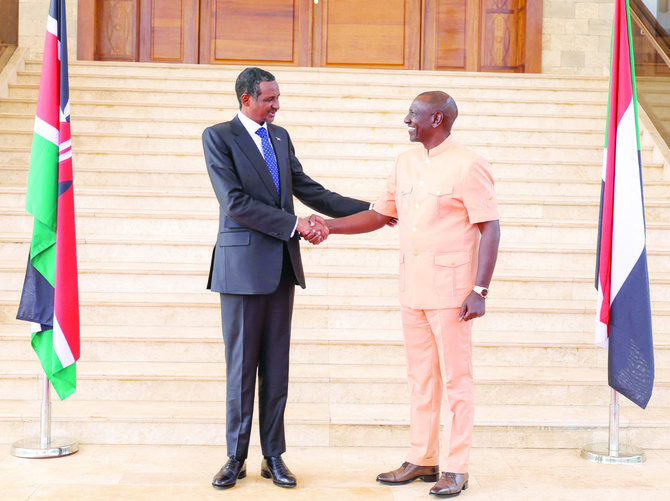
Kenya’s President William Ruto receives leader of Sudan’s paramilitary Rapid Support Forces Gen. Mohamed Hamdan Dagalo in Nairobi onThursday. (X)
2 / 3
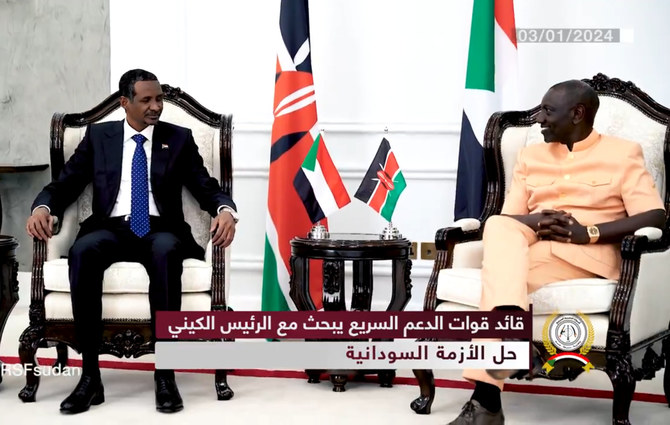
A screengrab from video posted by Sudan's paramilitary Rapid Support Forces on X shows Kenyan President William Ruto holding talks with RSF leader Mohamed Hamdan Dagalo on January 3, 2024, at the presidential office in Nairobi. (X: @RSFSudan)
3 / 3
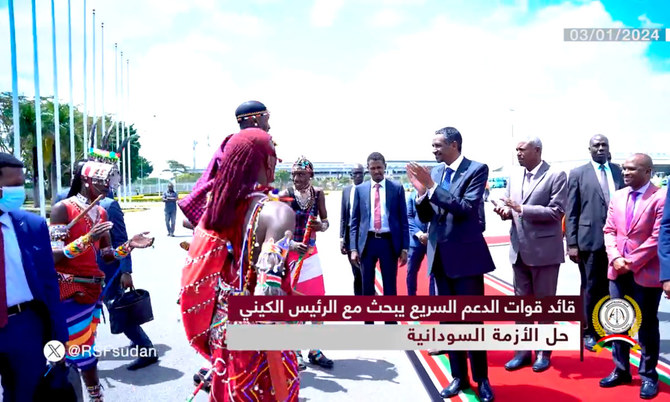
Kenyan wellwishers welcome Mohamed Hamdan Dagalo, commander of Sudan's paramilitary Rapid Support Forces, as he arrives at the airport in Nairobi on the latest leg of a multinational diplomatic tour amid the RSF's war with Sudan's national army. (Screengrab from RSF video)
Short Url
Updated 04 January 2024
Follow

Sudan’s paramilitary chief Dagalo in Kenya on latest leg of regional tour

  • Dagalo says he is committed to ending the conflict in Sudan through dialogue

NAIROBI: The leader of Sudan’s paramilitary Rapid Support Forces held talks in Kenya on Wednesday amid regional diplomatic efforts to try to forge a ceasefire  in the war at home.

Kenya is the latest leg of Mohamed Hamdan Dagalo’s first trip abroad since the fierce fighting erupted between the RSF and the Sudanese army in mid-April.

President William Ruto posted pictures on X of him meeting with Dagalo, saying Kenya appreciated the commitment of the RSF and Dagalo “in ending the conflict in Sudan through dialogue.”

“The ongoing Intergovernmental Authority on Development  talks should bring about a political settlement that would effect a lasting peace in the country,” he added.

IGAD, an eight-nation East African bloc headquartered in Djibouti, is leading diplomatic efforts to broker a meeting between Dagalo and his rival, Sudanese Army chief Abdel Fattah Al-Burhan.


The warring generals have not met face-to-face since the outbreak of the conflict that has killed more than 12,000 people by some conservative estimates, and forced millions to flee.

Dagalo has also visited Djibouti, Ethiopia and Uganda on his regional tour and said he was committed to ending the conflict.

“Next week, as chair of IGAD, Djibouti will also prepare the ground for Sudanese dialogue and will host a critical meeting,” Djibouti Foreign Minister Mahmoud Ali Youssouf said on X on Saturday when Dagalo visited.

Last Wednesday, Djibouti’s foreign ministry said a meeting between the rivals planned for December 28 had been “postponed to early January for technical reasons.”

The UN Security Council in November voiced alarm at the growing violence in Sudan and the spread of fighting to areas previously considered a haven for those displaced by the conflict.

By the end of November, at least 12,190 people had been killed, according to a conservative estimate from the Armed Conflict Location and Event Data project.

The United Nations says more than seven million people have been internally displaced by the war, while another 1.5 million have fled into neighboring countries.

Both sides have been accused of war crimes.


Brazil, India eye critical minerals deal as leaders meet

Updated 1 sec ago
Follow

Brazil, India eye critical minerals deal as leaders meet

  • The two leaders are expected to sign a memorandum on critical minerals and discuss efforts to increase trade links
NEW DELHI: India’s Prime Minister Narendra Modi and Brazilian President Luiz Inacio Lula da Silva are set to meet in New Delhi on Saturday, seeking to boost cooperation on critical minerals and rare earths.
Brazil has the world’s second-largest reserves of these elements, which are used in everything from electric vehicles, solar panels and smartphones to jet engines and guided missiles.
India, seeking to cut its dependence on top exporter China, has been expanding domestic production and recycling while scouting for new suppliers.
Lula, heading a delegation of more than a dozen ministers as well as business leaders, arrived in New Delhi on Wednesday for a global summit.
Officials have said that in talks with Modi on Saturday, the two leaders are expected to sign a memorandum on critical minerals and discuss efforts to increase trade links.
The world’s most populous nation is already the 10th largest market for Brazilian exports, with bilateral trade topping $15 billion in 2025.
The two countries have set a trade target of $20 billion to be achieved by 2030.
With China holding a near-monopoly on rare earths production, some countries are seeking alternative sources.
Rishabh Jain, an expert with the Delhi-based Council on Energy, Environment and Water think tank, said India’s growing cooperation with Brazil on critical minerals complements recent supply chain engagements with the United States, France and the European Union.
While these partnerships grant India access to advanced technologies, finance and high-end processing capabilities, “Global South alliances are critical for securing diversified, on-ground resource access and shaping emerging rules of global trade,” Jain said.
‘Challenges’
Modi and Lula are also expected to discuss global economic headwinds and strains on multilateral trade systems after both of their countries were hit by US tariffs in 2025, prompting the two leaders to call for stronger cooperation.
Washington has since pledged to roll back duties on Indian goods under a trade deal announced earlier this month.
“Lula and Modi will have the opportunity to exchange views on … the challenges to multilateralism and international trade,” said Brazilian diplomat Susan Kleebank, the secretary for Asia and the Pacific.
Brazil is India’s biggest partner in Latin America.
Key Brazilian exports to India include sugar, crude oil, vegetable oils, cotton and iron ore.
Demand for iron ore has been driven by rapid infrastructure expansion and industrial growth in India, which is on track to become the world’s fourth largest economy.
Brazilian firms are also expanding in the country, with Embraer and Adani Group announcing plans last month to build aircraft in India.
Lula addressed the AI Impact summit in Delhi on Thursday, calling for a multilateral and inclusive global governance framework for artificial intelligence.
He will travel on to South Korea for meetings with President Lee Jae Myung and to attend a business forum.