

Pakistan recovers with determined batting to hit 313 on first day of third Test against Australia

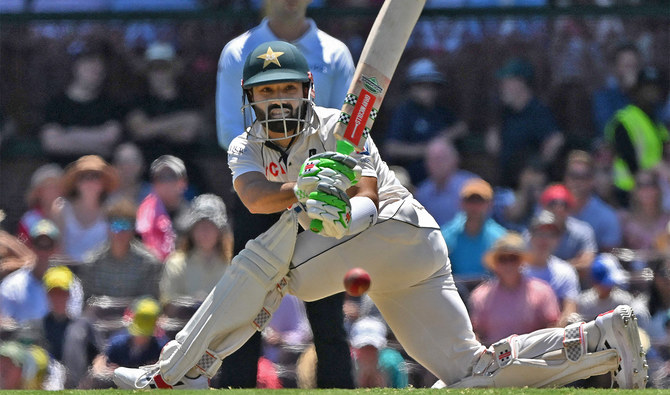
Pakistan's Mohammad Rizwan plays a shot during the first day of the third cricket Test match against Australia at the Sydney Cricket Ground in Sydney, Australia, on January 3, 2024. (AFP)
Short Url
Updated 03 January 2024
Follow

Pakistan recovers with determined batting to hit 313 on first day of third Test against Australia

  • Rizwan, Salman and Agha rescued Pakistan with half centuries after finding their team at 96 for five
  • Australia skipper Pat Cummins took five for 61 for his third successive five-wicket haul in the series

SYDNEY: Gritty Pakistan clawed back from looming disaster to finish with 313 on the back of fighting half-centuries from Mohammad Rizwan, Agha Salman and Aamer Jamal on the first day of the third Test against Australia on Wednesday.

The tourists, staring down a meagre innings total at 96 for five after winning the toss, counter-attacked to frustrate the Australians at the Sydney Cricket Ground.

Rizwan clubbed 88 off 103 balls, number nine Jamal a spirited 82 off 97 and Salman 53 off 67 to give the tourists some hope after a car-crash start to the innings.

David Warner, playing in his 112th and final Test, had to see off a tense final over before the close and survived a scare before finishing with six in Australia’s reply of 6-0.

Australia skipper Pat Cummins took five for 61 for his third successive five-wicket haul in the series.

In a day that began in elation for Australia ended in frustration as Pakistan’s tail wagged furiously to rescue their side after a terrible start.

Mohammad Rizwan and Agha Salman triggered the comeback with a spirited 94-run stand to defy the Australia attack.

Rizwan, who had been dropped for the first Test, blasted two sixes and 10 fours off 103 balls before he fell to a legside trap set by Cummins.

Rizwan top-edged a pull shot for Josh Hazlewood to take the catch at fine leg after posting the highest individual score by a Pakistan batsman of the series.

Salman took up the cudgels with a half-century before he was caught by Travis Head off Mitchell Starc.

Jamal kept the fightback going as he registered his highest Test score before he fell to Nathan Lyon.

That left Warner to see out the final over of the day and he began with a flourish, cutting the first ball for four from spinner Sajid Khan.

It was a rousing morning session for Australia as openers Abdullah Shafique and debutant Saim Ayub were dismissed inside two overs.

The out-of-form Shafique fell to the second ball of Starc’s opening over and Ayub, brought in for Imam-ul-Haq to make his Test debut, only lasted two balls before a Hazlewood outswinger had him caught behind by Alex Carey.

Babar Azam hit three glorious cover drives to the ropes before he was out for 26.

Cummins appealed vociferously for lbw but was turned down by the umpire, only to seek a review and get the verdict, leaving the tourists tottering at 39 for three.

Saud Shakeel copped a nasty blow on the collarbone from a Cummins lifter and in the Australian skipper’s next over he prodded a catch behind to Carey for five, leaving his side further in the mire at 47 for four.

Skipper Shan Masood, on 32, was caught by Smith at second slip off Mitchell Marsh just after lunch but it was ruled a no-ball.

Marsh got the last laugh two overs later when Masood, on 35, again edged the medium-pacer to Smith in almost identical fashion to leave Pakistan at 96 for five.

Australia clinched the three-match series with a tense 79-run win in the second Test in Melbourne over Christmas.


World Bank approves $700 million for Pakistan’s economic stability

Updated 20 December 2025
Follow

World Bank approves $700 million for Pakistan’s economic stability

  • Of this, $600 million will go for federal programs and $100 million will ⁠support a provincial program in Sindh
  • The results-based design ensures that resources are only disbursed once program objectives are achieved

ISLAMABAD: The World Bank has approved $700 million in ​financing for Pakistan under a multi-year initiative aimed at supporting the country’s macroeconomic stability and service delivery, the bank said on Friday.

The funds will be released under the bank’s Public ‌Resources for Inclusive ‌Development — Multiphase ‌Programmatic ⁠Approach (PRID-MPA) that ‌could provide up to $1.35 billion in total financing, according to the lender.

Of this amount, $600 million will go for federal programs and $100 million will ⁠support a provincial program in ‌the southern Sindh province. The results-based design ensures that resources are only disbursed once program objectives are achieved.

“Pakistan’s path to inclusive, sustainable growth requires mobilizing more domestic resources and ensuring they are used efficiently and transparently to deliver results for people,” World Bank country director Bolormaa Amgaabazar said in a statement.

“Through this MPA, we are working with the Federal and Sindh governments to deliver tangible impacts— more predictable funding for schools and clinics, fairer tax systems, and stronger data for decision‑making— while safeguarding priority social and climate investments and strengthening public trust.”

The approval ‍follows a $47.9 ‍million World Bank grant ‍in August to improve primary education in Pakistan’s most populous Punjab province.

In November, an IMF-World Bank ​report, uploaded by Pakistan’s finance ministry, said Pakistan’s fragmented ⁠regulation, opaque budgeting and political capture are curbing investment and weakening revenue.

Regional tensions may surface over international financing for Pakistan. In May, Reuters reported that India would oppose World Bank funding for Pakistan, citing a senior government ‌source in New Delhi.

“Strengthening Pakistan’s fiscal foundations is essential to restoring macroeconomic stability, delivering results and strengthening institutions,” said Tobias Akhtar Haque, Lead Country Economist for the World Bank in Pakistan.

“Through the PRID‑MPA, we are launching a coherent nationwide approach to support reforms that expand fiscal space, bolster investments in human capital and climate resilience, and strengthen revenue administration, budget execution, and statistical systems. These reforms will ensure that resources reach the frontline and deliver better outcomes for people across Pakistan with greater efficiency and accountability.”

In Sindh, the program is expected to increase provincial revenues, enhance the speed and transparency of payments, and broaden the use of data to guide provincial decision making. The program will directly support the increase of public resources for inclusive development, including more equitable and responsive financing for primary health care facilities and more funding for schools.