Profile: Who was Hamas’ Saleh Al-Arouri?

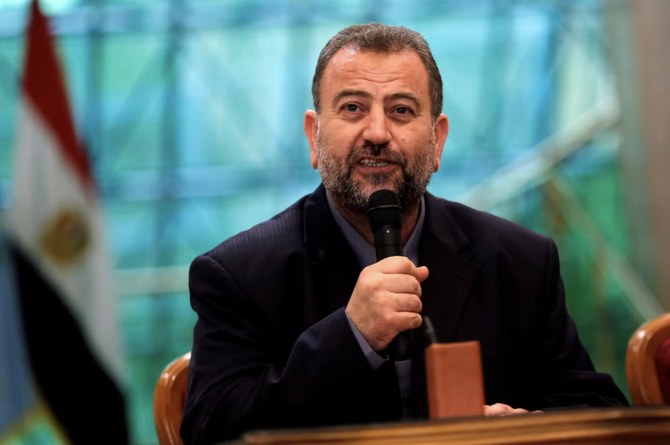
Saleh Al-Arouri was the deputy head of Hamas’ political bureau. (File/Reuters)
Short Url
Updated 04 January 2024
Follow

Profile: Who was Hamas’ Saleh Al-Arouri?

  • Israeli drone strike on Beirut's southern suburbs killed Al-Arouri and five others
  • The senior Hamas official was one of Israel's most wanted people

BEIRUT: One of Hamas’ most senior officials was killed on Tuesday night when an Israeli drone reportedly targeted the militant group’s offices in the Hezbollah-controlled southern suburbs of Beirut.

Saleh Al-Arouri, deputy head of Hamas’ political bureau, was a prominent name on Israel’s hit list and the highest-ranking member of the group to have been killed so far.

As well as being deputy to Ismail Haniyeh since 2017, Al-Arouri was a founding commander of Hamas’ military wing, Izz ad-Din al-Qassam Brigades.

He was also on the US Treasury’s sanctions list for allegedly being a financier for the group and facilitating weapon transfers since 1987 when Hamas was formed during the first Palestinian uprising against Israel.

The US Department of State’s Rewards for Justice program offered a $5 million reward for information leading to his arrest.

Al-Arouri’s death came a day before Iran commemorates the anniversary of losing its top general, Qasem Soleimani, who was killed in a US drone strike near Baghdad International Airport on Jan. 3, 2020.

Al-Arouri had been a member of Hamas’ Politburo since 2010 but rose to prominence in August 2014 when he told a conference in Turkiye that the militant group was responsible for the abduction and killing of three Israeli teenagers from a West Bank settlement.

Israel and the US also believe he was involved in the funding and training of the Hamas fighters who carried out the Oct. 7 attack on Israel, which saw 1,200 people killed and 240 taken hostage.

Israel responded by launching a military campaign against the Gaza Strip, which has so far seen the deaths of at least 22,000 Palestinians.

In October, Al-Arouri’s family home in the West Bank town of Aroura, near Ramallah, was demolished by the Israeli army. The demolition order was signed by Yehuda Fox, head of the Israel Defense Force Central Command.


Tunisian police arrest member of parliament who mocked president

Updated 5 sec ago
Follow

Tunisian police arrest member of parliament who mocked president

  • Ahmed Saidani mocked the president in a Facebook post, describing him as the “supreme commander of sewage and rainwater drainage”

TUNIS: Tunisian police arrested lawmaker Ahmed Saidani on Wednesday, two of his colleagues ​said, in what appeared to be part of an escalating crackdown on critics of President Kais Saied.
Saidani has recently become known for his fierce criticism of Saied. On Tuesday, he mocked the president in a Facebook post, describing him as the “supreme commander of sewage and rainwater drainage,” blasting what he said ‌was the absence ‌of any achievements by Saied.
Saidani ‌was ⁠elected ​as ‌a lawmaker at the end of 2022 in a parliamentary election with very low voter turnout, following Saied’s dissolution of the previous parliament and dismissal of the government in 2021.
Saied has since ruled by decree, moves the opposition has described as a coup.
Most opposition leaders, ⁠some journalists and critics of Saied, have been imprisoned since he ‌seized control of most powers in 2021.
Activists ‍and human rights groups ‍say Saied has cemented his one-man rule and ‍turned Tunisia into an “open-air prison” in an effort to suppress his opponents. Saied denies being a dictator, saying he is enforcing the law and seeking to “cleanse” the country.
Once a supporter ​of Saied’s policies against political opponents, Saidani has become a vocal critic in recent months, accusing ⁠the president of seeking to monopolize all decision-making while avoiding responsibility, leaving others to bear the blame for problems.
Last week, Saidani also mocked the president for “taking up the hobby of taking photos with the poor and destitute,” sarcastically adding that Saied not only has solutions for Tunisia but claims to have global approaches capable of saving humanity.
Under Tunisian law, lawmakers enjoy parliamentary immunity and cannot be arrested for carrying out their ‌duties, although detention is allowed if they are caught committing a crime.