

Pakistan aim to end Australia series on a high as they gear up for Sydney Test 

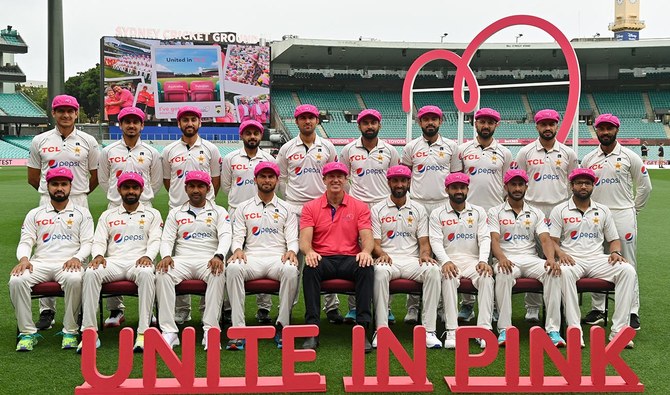
Former Australian player Glenn McGrath (front row C) poses with Pakistan's players ahead of the third Test match between Australia and Pakistan at the Sydney Cricket Ground in Sydney on January 1, 2024. (AFP)
Short Url
Updated 02 January 2024
Follow

Pakistan aim to end Australia series on a high as they gear up for Sydney Test 

  • After their 360-run defeat in the series opener, Pakistan put on spirited display in Melbourne before Australia claimed victory on 4th day 
  • The visitors are set to play the last match of the Benaud-Qadir Trophy at the Sydney Cricket Ground (SCG) from January 3 to January 7 

ISLAMABAD: Pakistan are looking to end their three-match Test series against Australia on a high as they gear up for the third Test in Sydney, skipper Shan Masood said on Tuesday. 

After their 360-run defeat at Perth in the series opener, Pakistan put on a spirited display in Melbourne before Australia claimed victory on the fourth day of the match. The Shan Masood-led side is now looking to avoid a whitewash by Australia. 

The visitors are set to play the last match of the Benaud-Qadir Trophy at the Sydney Cricket Ground (SCG) from January 3 to January 7. 

“We have learned from the mistakes we made in the first two matches. Going forth, it is about not repeating them, especially when playing against quality sides. If we keep playing like this, I am sure there will be a lot of Test wins in the future,” Shan said at a pre-match presser in Sydney. 

“At Melbourne, we played good cricket all four days but there were several chances we could have seized the game. We will work on the lessons learned. We are positive about the direction our team is taking.” 

Ahead of the third Test, Shan is leading the run-scoring chart for Pakistan after producing twin half-centuries in the Melbourne Test. Aamir Jamal, after making his debut in the series opener, is the second highest wicket-taker of the series so far. He has taken 12 wickets in two games, including a five-wicket haul. 

Opening batter Saim Ayub will be making his Test debut, coming in place of Imam-ul-Haq. Saim had earned his maiden Test call-up following an impressive domestic season. Left-arm pacer Shaheen Shah Afridi has been rested with spinner Sajid Khan replacing him in the side. 

Pakistan will be persisting with the three changes made ahead of Melbourne Test. Mir Hamza, who replaced an injured Khurram Shahzad in the playing XI, registered his career-best figures in Melbourne. He accounted for six wickets in the match, including a double-wicket maiden in Australia’s second innings. Hasan Ali and Mohammad Rizwan, who replaced Faheem Ashraf and Sarfaraz Ahmed respectively, have also kept their place in the side. 

Reflecting on Shaheen, Shan said fitness and workload impacted player performance and it was important to balance them with match significance. 

“Personally, and as a team, we have never had any doubts when it comes to Shaheen. If you look at his records, he has bowled the highest number of overs in a while in world cricket. It is up to us to make sure he is looked after, physically and mentally,” the skipper said. 

“Fitness and workload impact performance. Our all-format players have been playing continuous cricket for a while now— they have played three World Cups in the past three years while also playing the World Test Championship simultaneously. We have been trying to address this to balance match significance and workload.” 

Shan said players like Khurram Shahzad, Aamir Jamal and Mir Hamza had done well in tough conditions, which reflected success of Pakistan’s domestic system as it had broadened the side’s bench strength. 

“We want to give similar chances to our batters too, so we can widen our player pool in each department,” he added. 

Pakistan squad: 

Shan Masood (c), Saim Ayub, Abdullah Shafique, Babar Azam, Saud Shakeel, Mohammad Rizwan (wk), Salman Ali Agha, Sajid Khan, Aamir Jamal, Hasan Ali and Mir Hamza 


Pakistan’s Afghan salvo risks turning ‘open war’ into long crisis

Updated 3 sec ago
Follow

Pakistan’s Afghan salvo risks turning ‘open war’ into long crisis

  • Nuclear-armed Pakistan has a formidable military of 660,000 active personnel, backed by a fleet of 465 combat aircraft
  • But the Taliban have the option to lean on insurgent groups like the TTP and the BLA to move beyond border skirmishes

KARACHI: Weeks after the Taliban’s lightning offensive in 2021 wrested control of Afghanistan from a US-led military coalition, Pakistan’s then intelligence chief flew into the capital Kabul for talks, where the serving lieutenant general told a reporter: “Don’t worry, everything will be okay.”

Five years on, Islamabad — long seen as a patron of the Taliban — is locked in its heaviest fighting with the group, which Pakistan’s Defense Minister Khawaja Muhammad Asif described on Friday (February 27) as an “open war.”

The turmoil means that a wide swathe of Asia — from the Gulf to the Himalayas — is now in flux, with the United States building up a military deployment against Afghanistan’s neighbor Iran even as relations between Pakistan and arch rival India remain on edge after four days of fighting last May.

At the heart of the conflict with Afghanistan is Pakistan’s accusation that the Afghan Taliban provides support to militant groups, including the Tehreek-e-Taliban Pakistan (TTP), that have wreaked havoc across inside the South Asian country.

The Afghan Taliban, which has previously fought alongside the TTP, denies the charge, insisting that Pakistan’s security situation is its internal problem.

The disagreement is a reflection of starkly incompatible positions taken by both sides, as Pakistan expected compliance after decades of support to the Taliban, which did not see itself beholden to Islamabad, analysts said.

“We all know that the government in Pakistan supported the Taliban, the Afghan Taliban for many years, in the 90s and the 2000s, and provided havens to them during the period where the US and NATO were in Afghanistan.

So there’s a very close relationship between the Taliban and Pakistan,” said Jennifer Brick Murtazashvili, a political scientist at the University of Pittsburgh and an Afghanistan expert.

“It’s really surprising and shocking to many of us to see how quickly this relationship deteriorated,” she said.

Although tensions have simmered along their rugged 2,600-km (1,615-mile) frontier for months, following clashes last October, Friday’s fighting is notable because of Pakistan’s use of warplanes to hit Taliban military installations instead of confining the attacks to the militants it allegedly harbors.

These include targets deep inside the country in Kabul, as well as the southern city of Kandahar, the seat of Taliban supreme leader Hibatullah Akhundzada, according to Pakistan military spokesman Lt. Gen. Ahmed Sharif Chaudhry.

The clashes are unlikely to end there.

“I think in the immediate aftermath, I think hostilities will subside. There will be, I hope there will be a ceasefire through mediation. But I do not see these tensions subsiding in the foreseeable future,” said Abdul Basit,  an expert on militancy and violent extremism at Singapore’s S. Rajaratnam School of International Studies.

Nuclear-armed Pakistan has a formidable military of 660,000 active personnel, backed by a fleet of 465 combat aircraft, several thousand armored fighting vehicles and artillery pieces.

Across the border, the Afghan Taliban has only around 172,000 active military personnel, a smattering of armored vehicles and no real air force.

But the battle-hardened group, which took on a phalanx of Western military powers in 2001 and outlasted them, has the option to lean on insurgents like the TTP and the Baloch Liberation Army (BLA), moving beyond border skirmishes.

Based in Pakistan’s largest and poorest province of Balochistan that borders both Iran and Afghanistan, the BLA has been at the center of a decades-long insurgency, which in recent years has staged large coordinated attacks.

Pakistan has long accused India of backing the insurgents, a charge repeatedly denied by New Delhi, which has retained a robust military deployment along the border since last May.

Although a raft of countries with influence — including China, Russia, Turkiye and Qatar — have indicated an openness to help mediate the conflict, all such efforts have been met with limited success so far.