


Sweet connection: Mardan’s Budayuni Pera, a delicacy with roots in India, captivates people in Pakistan

Mardan’s Budayuni Pera are pictured in a shop in Mardan, Pakistan, on 27 December, 2023. (AN photo)
Short Url
Updated 01 January 2024
Follow

Sweet connection: Mardan’s Budayuni Pera, a delicacy with roots in India, captivates people in Pakistan

  • Budayuni Pera is a symbol of a shared history and enduring ties between the two South Asian countries 
  • Migrants from India brought the treasured recipe of the sweet with them to Pakistan after August 1947 

MARDAN: Amid the streets of Mardan, the second-largest city in Pakistan’s northwestern Khyber Pakhtunkhwa province, a sweet legacy from across the border captivates both locals and visitors. 

Budayuni Pera, a delicacy with its roots in the Indian city of Budaun in Uttar Pradesh, has found a second home in Pakistan owing to the migrants who brought the treasured recipe with them in the years following the 1947 partition. 

On Mardan’s Bank Road, about a dozen shops proudly display their version of the beloved sweet that is reminiscent of a dough ball despite being quite unique in its flavor. 

Budayuni Pera is more than just a treat: it’s a symbol of a shared history and enduring ties between the two South Asian countries, in spite of the geopolitical bitterness between them. 

“My father’s workers came from [Budaun] and brought the unparalleled formula from there,” Muhammad Adnan, 32-year-old custodian of one of the outlets stretching along the Bank Road, told Arab News, while narrating the journey of the sweet to Pakistan. “This is now Mardan’s gift which is known for its unique and sweet taste.”
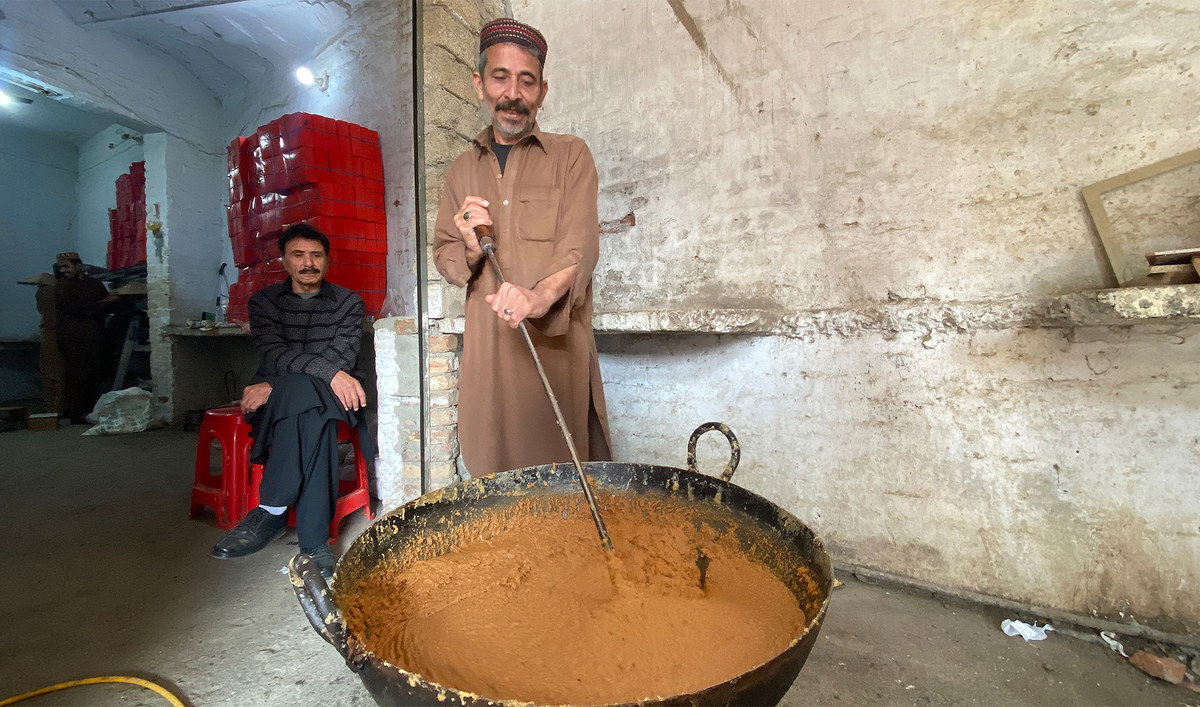


Fifty-year-old Hazrat Ali is making Badayuni Pera in Mardan, Pakistan, on 27 December, 2023 (AN photo)

Adnan’s father, Muhammad Usman, now 70, was among the first in the city to master the art of making Budayuni Pera, learning from Muhammad Zamir Khan, an early migrant from India. 

Usman dedicated 33 years to perfecting Budayuni Pera in Mardan before he quit working at other shops and set up his own in 2000, serving customers the delicacy. He passed the family business down to his sons and brothers. 

“We have taught many people the process of making the sweet,” Adnan said. “We don’t keep its ingredients secret. It’s the blessing of Allah that makes it special.” 

The primary ingredients of Budayuni Pera are simple yet precise: condensed milk and sugar, cooked in imported essential oil. 

Fifty-year-old Hazrat Ali, Usman’s brother and Adnan’s uncle, has been crafting the sweet since 2000. 

“We start with condensed milk, add sugar and cook it until it reaches the perfect consistency and color,” he said.
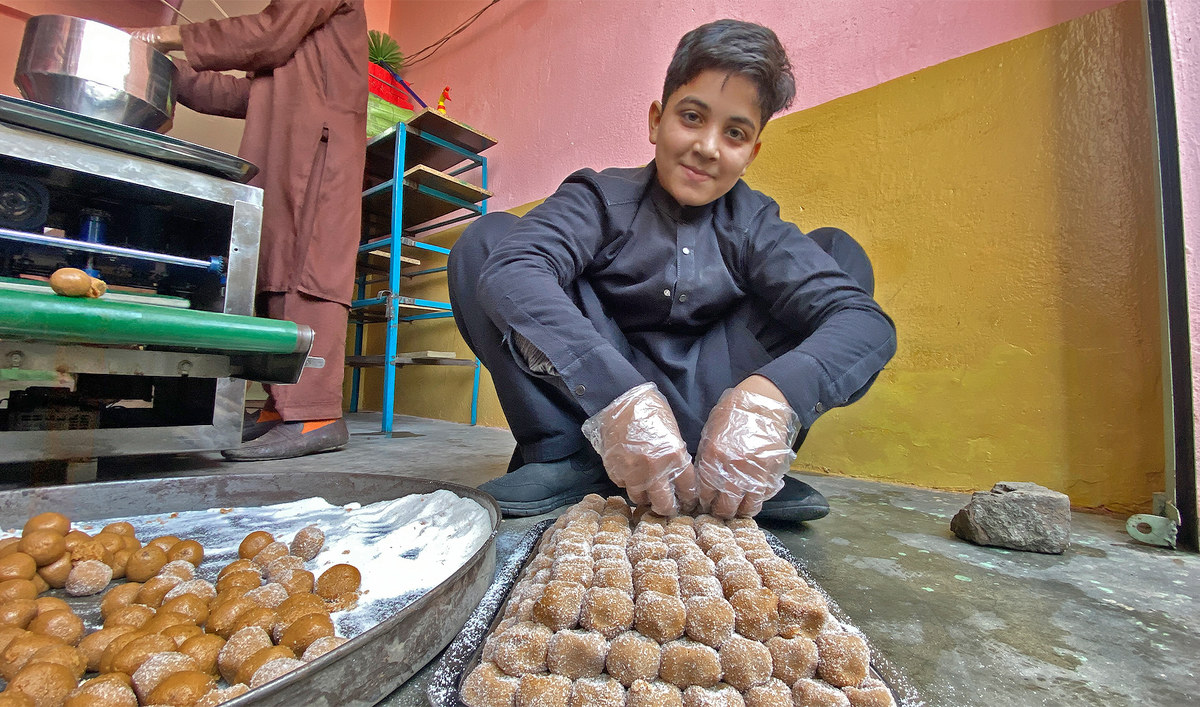


Hazrat Ali's son, Muhammad Sadiq, is placing the pera on a tray in Mardan, Pakistan, on 27 December, 2023. (AN photo)

The process requires at least one hour of cooking, followed by a cooling period before the mixture is cut into small pieces with a machine. 

Budayuni Pera has not only captivated local customers but also people living in other parts of the world. 

“We’ve sent it globally, particularly to Saudi Arabia, where there’s high demand for it among the Pathan community,” Adnan said. 

Muhammad Zakaria, a young customer who has been sending Budayuni Pera to friends in Saudi Arabia, and Hassan Meer, who is in his late 30s, are regular visitors to Mardan, both attesting to the unique taste of this special sweet. 

“Its flavor is unmatched by any other sweet,” Meer said. 


Pakistan PM calls for faster CPEC implementation, pledges security for Chinese workers

Updated 27 February 2026
Follow

Pakistan PM calls for faster CPEC implementation, pledges security for Chinese workers

  • Shehbaz Sharif pushes expanded cooperation in agriculture, IT and mining under CPEC phase two
  • Chinese envoy reaffirms Beijing’s support for Pakistan’s sovereignty and economic development

ISLAMABAD: Prime Minister Shehbaz Sharif on Friday called for speeding up projects under the China-Pakistan Economic Corridor (CPEC) and pledged stronger security guarantees for Chinese workers and investments, during a meeting with China’s ambassador in Islamabad.

Sharif made the remarks as the two countries strive to launch the second phase of CPEC, a multibillion-dollar infrastructure and energy initiative launched in 2015 as part of China’s Belt and Road Initiative (BRI).

CPEC’s first phase focused largely on power generation and transport infrastructure aimed at easing Pakistan’s chronic energy shortages and improving connectivity. The second phase seeks to expand cooperation into industrial development, with an emphasis on special economic zones and export-oriented growth.

“While highlighting the importance of accelerating ongoing CPEC projects, the Prime Minister stressed on the need to enhance cooperation in agriculture and IT and mining & minerals,” said a statement circulated by the PM Office after the meeting.

“He also underscored Pakistan’s resolve to provide a secure and conducive environment for Chinese personnel, investments, and institutions in Pakistan,” it added.

Chinese nationals and projects in Pakistan have faced security threats in the past, including attacks by militant groups targeting infrastructure sites and convoys. Islamabad has repeatedly vowed to tighten security and has deployed special protection units for Chinese workers.

China is Pakistan’s closest ally in the region and a key economic partner, with CPEC widely regarded by Islamabad as central to long-term economic growth.

During the meeting, the prime minister conveyed greetings to Chinese President Xi Jinping and Premier Li Qiang, particularly on the occasion of the Chinese New Year.

China’s Ambassador to Pakistan, Jiang Zaidong, reiterated Beijing’s support for Pakistan’s sovereignty and socioeconomic development, according to the statement. Both sides also exchanged views on regional and international issues and agreed to maintain close coordination.