

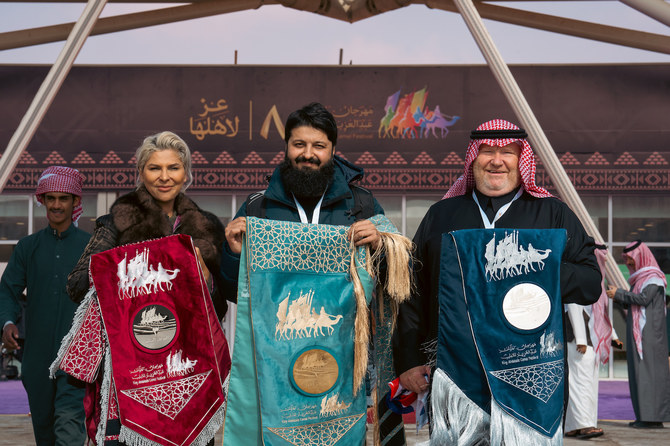
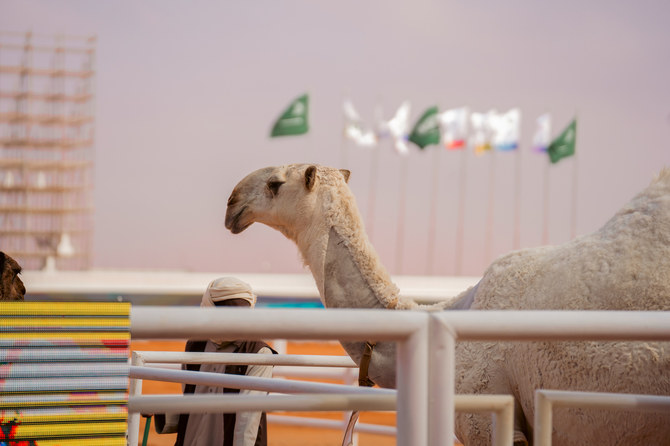
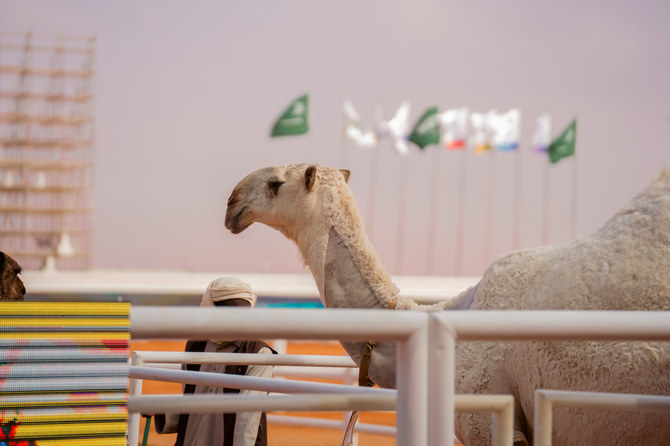
Al-Sayahid: Individuals from 40 countries competed with their camels in a beauty pageant during the International Camel Organization round of the eighth King Abdulaziz Camel Festival in Al-Sayahid on Saturday.
Held under the slogan “Glory to its people,” competitors from a range of ages took part in the contest. The festival, which started on Dec. 1, will conclude on Jan. 15.
Shafiq Khan, a Welshman who took first place, told Arab News how friendly the Saudi people were and how delighted he was to see so many kinds of camels.
“So, I’ve always had a love for camels, but we don’t get to see them in the United Kingdom; they don’t have them here. I just find that seeing the camels here brings the true heritage of Saudi Arabia and makes you feel like you are years back in history,” Khan said.
His camel, “Massakata,” which means “the silent one,” took first place after her white, long neck caught the audience’s attention.
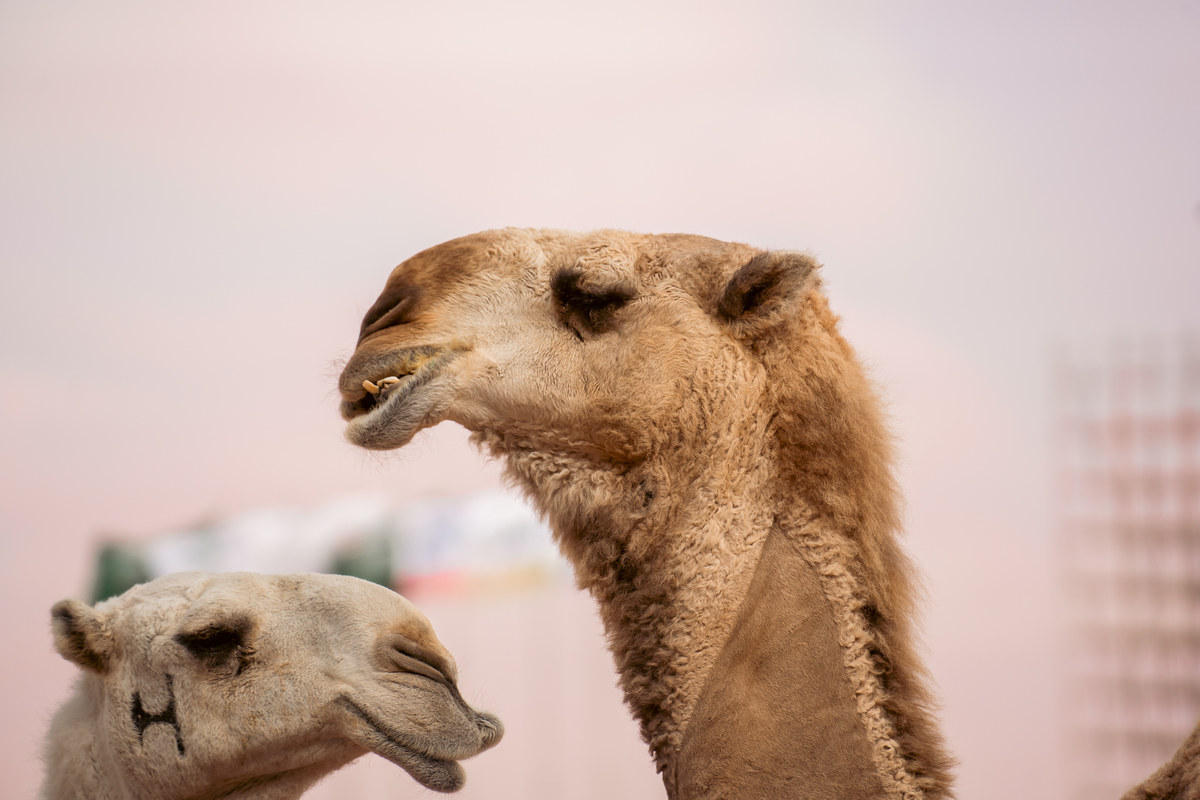
The winner camel today is named 'Massakata,' which translates to 'the silent one.' She got first place because of her stunning white, long-necked that caught the audience's attention. (AN/ Abdulrhman Bin Shalhoub)
“She’s beautiful; she’s white; she’s just the best thing that can happen, and she became number one today," Khan said. “She’s worked hard, she’s been looked after, and she did what she had to do today. She came as a champion, and she’s leaving like a champion.”
He added: “Looking at how the camels are and reading about them, and how I’ve got to know information about them, there are certain ways that they look in terms of their head, in terms of their neck, and terms of their body and everything, and when I saw her, I thought, she’s the one.”
Denis Pan Fode, an Englishman, took second place with his four-year-old, grey-coated camel called “Rolex.”
“I’m shocked that Rolex, a four-year-old camel with a nice disposition and other attributes, didn’t win in the first place. We call the camel “Rolex” like the watch, which is timeless and reminds me of the best watch ever. I’m a little shocked that it didn’t rank first, but that’s how things work. It has such an elegant and laid-back disposition that you can see there,” Pan Fode said.
Bally Binji, also from England, was third-place winner with her white camel called “Jathaba,” which translates as “the attractive one” in Arabic. Binji expressed disappointment that Wales, not England, had taken first place in the competition.
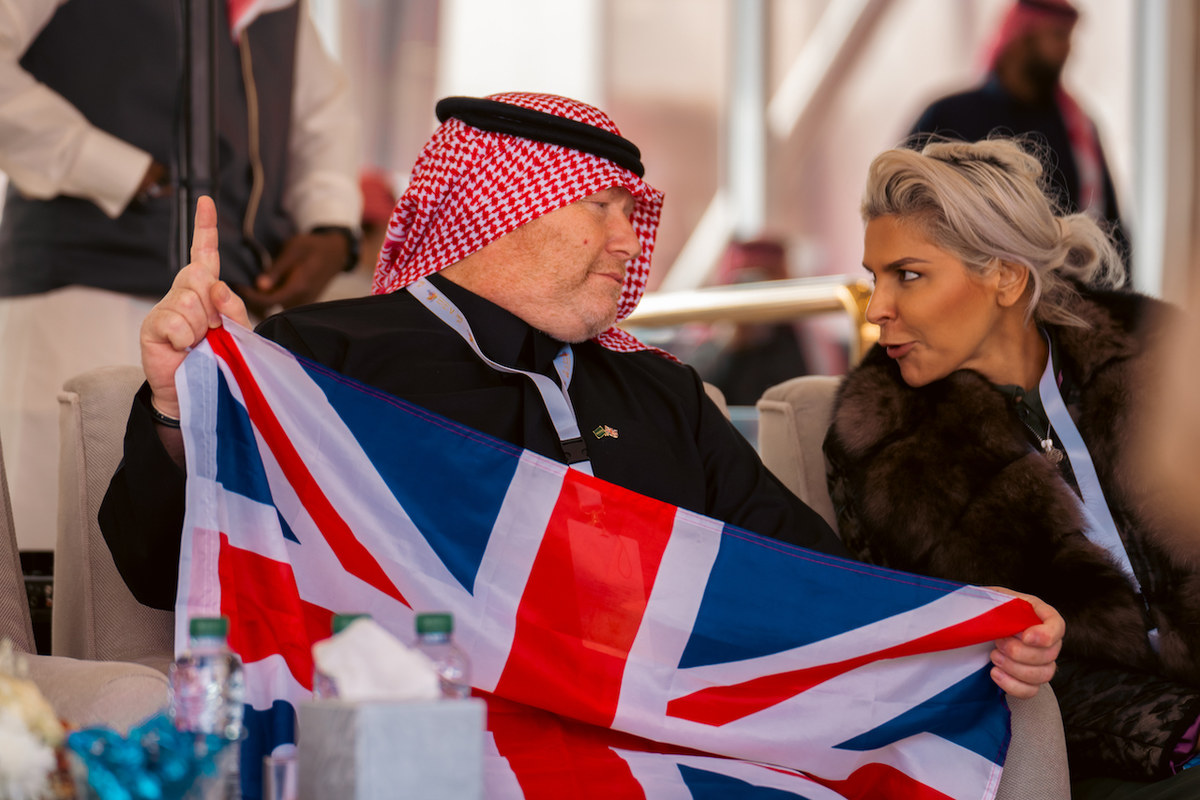
The list of names participating in the organization’s round witnessed the participation of four owners from Britain, a participant from Germany, a participant from France, and a participant from America. (AN/ Abdulrhman Bin Shalhoub)
Wales and England have consistently competed in sports such as rugby and football, so the camel contest is a new area of competition.
“Though I would have rather been first, it feels amazing to come in third. However, the UK and Wales, or more accurately, England and Wales, are obviously rivals. Consequently, the camel is elegant and white in color. Given that the first and third place camels are both white, the race was extremely close,” Binji told Arab News.
To encourage international participation and give more people an opportunity to participate, many competitive rounds have been included.
Saudi Arabia has designated 2024 as the Year of Camels amid growing interest in the Kingdom in preserving national and Arabian heritage.


