Tent retreats, cultural attractions draw visitors to camel festival

1 / 4
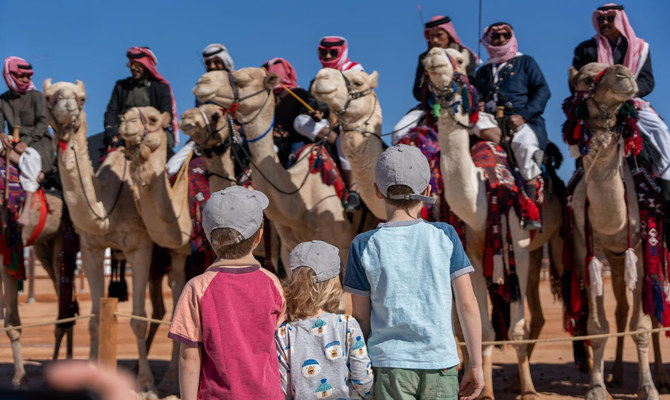
King Abdulaziz Camel Festival supports camel owners and highlights the importance of camels for Saudi citizens, inhabitants of the Arabian Peninsula, and the wider Arab region. (SPA)
2 / 4
King Abdulaziz Camel Festival supports camel owners and highlights the importance of camels for Saudi citizens, inhabitants of the Arabian Peninsula, and the wider Arab region. (SPA)
3 / 4
King Abdulaziz Camel Festival supports camel owners and highlights the importance of camels for Saudi citizens, inhabitants of the Arabian Peninsula, and the wider Arab region. (SPA)
4 / 4
King Abdulaziz Camel Festival supports camel owners and highlights the importance of camels for Saudi citizens, inhabitants of the Arabian Peninsula, and the wider Arab region. (SPA)
Short Url
Updated 26 December 2023
Follow

Tent retreats, cultural attractions draw visitors to camel festival

  • People can rent VIP tents accommodating around 20 people for about SR1,500 daily, depending on the furniture, lighting, restrooms and privacy

RIYADH: The eighth King Abdulaziz Camel Festival, organized by the Saudi Camel Club, is being held in Al-Sayahid, 120 km northeast of Riyadh. It aims to promote the Kingdom’s rich camel heritage while offering a wide array of activities to visitors and tourists, such as markets and tent retreats.

A group of investors said that Dahna Street, a local tent retreat for visitors, comprises more than 15 rental sites, with economy-class prices ranging from SR100 ($27) to SR170 a day and services such as lighting, water, restrooms and bedding for six people. People can rent VIP tents accommodating around 20 people for about SR1,500 daily, depending on the furniture, lighting, restrooms and privacy.

The tent owners where the celebrations are taking place are charged between SR90,000 to SR200,000, depending on the desired facilities. These tents include a courtyard and a large square covered with lighting and sleeping camps suitable for a large number of people. They also provide services such as supplies, restaurants and camping necessities such as firewood and charcoal, giving  visitors a chance to experience the local wilderness.

Investor Motaab Al-Otaibi said that the festival grounds are undergoing constant development every year. The club and authorities are also providing special support to productive families, offering them free spaces to display and sell their products to visitors, ensuring they have a source of income and decent livelihoods.

The festival highlights the importance of camels for Saudi citizens and inhabitants of the Arabian Peninsula, and the wider Arab region. Visitor Salman Al-Anzi said that the diverse pavilions aim to develop this heritage to visitors and introduce it to children. The festival’s Mataya Exhibition features photos depicting various camel breeds, Qur’anic verses and Prophet Muhammad’s sayings related to camels.

Salem Al-Rouqi, another visitor, praised the festival and its unique events, which he said are suitable for all family members, especially children. The festival “recalls the past as well as raises awareness on the camel’s national importance,” he added.

Held under the slogan “Glory to its People,” the festival supports camel owners and introduces new generations to their sporting heritage, strengthening their connection and making the festival a distinctive symbol for the people of the Kingdom.

The festival also aims to stimulate tourism, the economy and entertainment in the region.


Japanese researchers hope to restore coral from Saudi-made structures

Updated 10 sec ago
Follow

Japanese researchers hope to restore coral from Saudi-made structures

  • Coral skeletons made for Saudi Pavilion at Japan expo last year
  • Results of Japanese study to be revealed at Riyadh Expo 2030

TOKYO: Japanese universities are seeking to restore coral reefs and marine ecosystems after receiving artificial structures that Saudi Arabia made and showcased at last year’s Osaka-Kansai Expo.

The coral skeletons were donated to the University of the Ryukyus in Okinawa and Kansai University in Osaka Prefecture, Kyodo News reported at the weekend.

The structures are made from calcium carbonate, a material on which corals are believed to grow more easily compared to artificial alternatives such as concrete or metal.

The skeletal structures were created using 3-D printers, with one piece produced a day during the expo, and displayed across an entire wall in the Saudi Arabia Pavilion, which had an area focusing on sustainable marine environments.

Coral reefs serve as habitats for much marine life, but over 40 percent of the world’s 892 species face possible extinction, according to the International Union for Conservation of Nature.

The University of the Ryukyus, which received about 150 of the artificial coral skeletons, will place them in waters off the eastern coast of Okinawa’s main island and then examine their impact on the ecosystem.

Kansai University has placed theirs in the sea around Kagoshima Prefecture’s Yoron Island to observe their growth after transplanting coral polyps onto the structures.

The results of the research are expected to be revealed at the Riyadh Expo in 2030.

“I had never imagined that Japan and Saudi Arabia would cooperate on coral research,” said Masato Ueda, a professor specializing in regenerative medicine at Kansai University.

Ueda said he wants to demonstrate to children that “humanity is attempting to restore the environment.”