

UN restores Rohingya food rations amid acute malnutrition spike in refugee camps

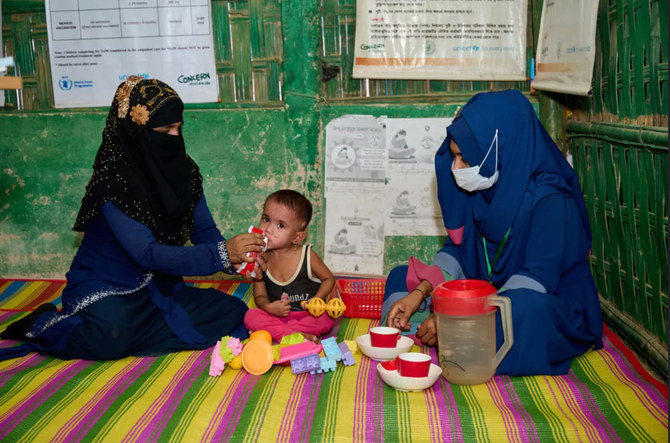
Rohingya mother feeds her daughter at a UNICEF nutrition facility in the Rohingya refugee camps in Cox's Bazar, Bangladesh. (UNICEF)
Short Url
Updated 31 December 2023
Follow

UN restores Rohingya food rations amid acute malnutrition spike in refugee camps

  • Earlier this year, WFP cut food aid for Rohingya by a third to $8 a month per person
  • Malnourishment was already prevalent in Cox’s Bazar camps before assistance cut

DHAKA: The UN’s World Food Programme will increase food rations for all Rohingya in Cox’s Bazar on Monday, months after severe aid cuts led to a rise in malnourishment in the refugee camps.

WFP reduced food assistance to the Rohingya by 33 percent earlier this year to $8 a month per person, citing a lack of funding, despite malnutrition being already widespread in the Cox’s Bazar camps.
“The year 2023 was a tumultuous one for the Rohingya in Bangladesh, who lived through multiple fire outbreaks, cyclones, and, for the first time, ration cuts. The rapid deterioration of the food and nutrition situation in the camps is extremely worrying,” said Dom Scalpelli, WFP country director in Bangladesh.  
WFP’s food assistance was cut twice in 2023, first in March when the value was reduced from $12 to $10, and again in June, when it was slashed to $8.
The UN body announced on Sunday that it will restore the critical food assistance to $10 per person per month from Jan. 1, 2024. To restore aid to the full amount, WFP said it needs $61 million to fill the current funding gap.
Malnourishment was a major problem in Cox’s Bazar even before the ration cut, with around 40 percent of children under 5 chronically malnourished, and 12 percent acutely malnourished.
“We have noticed a sharp increase in cases of severe acute malnutrition and moderate acute malnutrition among the Rohingya,” Dr. Abu Toha Bhuyan, health coordinator with Bangladesh’s Refugee Relief and Repatriation Commission, told Arab News.
“The $8 amount per month is very low for one person’s food requirements. As a result, the nutritional situation became very imbalanced. The children and the elderly are especially affected by malnutrition.”
The decline in food assistance is also affecting the immunity level of the Rohingya population, Bhuyan said.
“If people have a good immunity, they get less infected with different infectious diseases. Here, we experienced a rise in infectious diseases among the Rohingyas since their immunity was compromised due to less amount of food intake … Malnutrition has also severely impacted the growth of children.”
The challenging situation is an everyday reality for Monowara Begum, who has three children.
“It’s very tough to manage the food for my … family with this little amount … With less amount of food, my children became very skinny and are suffering from different diseases, like flu, coughs, diarrhea, all through the year,” the 41-year-old told Arab News.
“Everything happened because of malnutrition and less immunity. Their growth is also affected, even though they are at a growing age,” she said.
“As a mother, it’s unbearable for me to see my children going hungry most days. I feel very upset with this situation.”


Trump threatens to halt US trade with Spain over military bases, defense spending

Updated 6 sec ago
Follow

Trump threatens to halt US trade with Spain over military bases, defense spending

  • The US relocated 15 aircraft, including refueling tankers, from the Rota and Moron military bases in southern Spain after the country’s Socialist leadership said it would not allow them to be used to attack Iran
  • Spain’s Prime Minister Pedro Sanchez, one ​of a dwindling number of left-leaning voices in Europe, has ​risked Trump’s ire with a series of other policy moves, including refusing to let vessels transporting weapons to Israel dock in Spain

WASHINGTON/MADRID: US President Donald Trump threatened to impose a full US trade embargo on Spain on Tuesday ​after the European and NATO ally refused to let the US military use its bases for missions linked to strikes on Iran.
“Spain has been terrible,” Trump told reporters during a meeting with German Chancellor Friedrich Merz, adding that he had told Treasury Secretary Scott Bessent to “cut off all dealings” with Spain.
“We’re going to cut off all trade with Spain. We don’t want anything to do with Spain,” he added.
The US relocated 15 aircraft, including refueling tankers, from the Rota and Moron military bases in southern Spain after the country’s Socialist leadership said it would not allow them to be used to attack Iran.
Trump again referenced Spain’s refusal to heed US calls for all NATO members to spend 5 percent of their GDP on defense, and added: “Spain has absolutely nothing that we need.”
“All business having to do ‌with Spain, I ‌have the right to stop it. Embargoes — do anything I want with it — and ​we ‌may ⁠do that with ​Spain,” ⁠he said, again expressing his frustration with the Supreme Court’s ruling last month that his broadest global tariffs were illegal under a national emergencies law.

NO SEPARATE TREATMENT FOR SPAIN
Merz, speaking with reporters after the meeting, said he told Trump privately that Spain could not be excluded from a trade agreement reached between Brussels and Washington last year.
“I said that Spain is a member of the European Union and we negotiate about tariffs with the United States only together or not at all,” he said. “There is no way to treat Spain particularly badly.”
Trump publicly asked Bessent and US Trade Representative Jamieson Greer their opinions on cutting off Spanish trade.
“Well, sir, I think we’ll talk about it with you,” Greer said. “We know ⁠you can use it, and if you need to use it to assure national and economic ‌security, we’ll do it.”
Bessent said the Supreme Court affirmed Trump’s embargo powers under the ‌International Emergency Economic Powers Act, adding that the USTR and Commerce Department would ​begin investigations into how to penalize Spain under other trade laws.

HIGH BAR
Jennifer ‌Hillman, a trade law professor at Georgetown University, said the Supreme Court did not address the president’s ability to impose a trade ‌embargo under IEEPA. Trump could do so, but he would have to declare a national emergency over Spain as an “unusual and extraordinary” threat to the United States, she said, adding that such a move would go “well beyond” any previous emergency.
“It’s hard to see, however, how Spain denying us the use of air bases on its territory for us to launch an unprovoked attack on Iran poses ‘an unusual and extraordinary threat’ to our national security or foreign ‌policy,” added Peter Shane, a New York University adjunct law professor.

SPAIN RESPONDS
The Spanish government responded in a statement that the US must be mindful of the autonomy of private businesses, international law ⁠and bilateral trade agreements between ⁠the US and the European Union.
Madrid said it had the necessary resources to contain the potential impact of a trade embargo and support affected sectors, but said it would continue to push for free trade and economic cooperation with its partners.
Spain is the world’s top exporter of olive oil and also sells auto parts, steel and chemicals to the United States, but is less vulnerable to Trump’s threats of economic punishment than other European nations.
The US had a trade surplus with Spain for the fourth year in a row in 2025, at $4.8 billion, according to US Census Bureau data, with US exports of $26.1 billion and imports of $21.3 billion. US exports of crude oil and liquefied natural gas to Spain have grown in recent years.
Merz said pressure was being brought to bear on Spain from within Europe on defense spending.
“We are trying to convince Spain to catch up with the 3 percent or 3.5 percent which we agreed on in NATO,” he said, adding later that Spain’s defense spending levels had nothing to do with the trade negotiations.
Spain’s Prime Minister Pedro Sanchez, one ​of a dwindling number of left-leaning voices in Europe, has ​risked Trump’s ire with a series of other policy moves, including refusing to let vessels transporting weapons to Israel dock in Spain.