Bangladesh warns of deepening Rohingya crisis as refugee aid nosedives

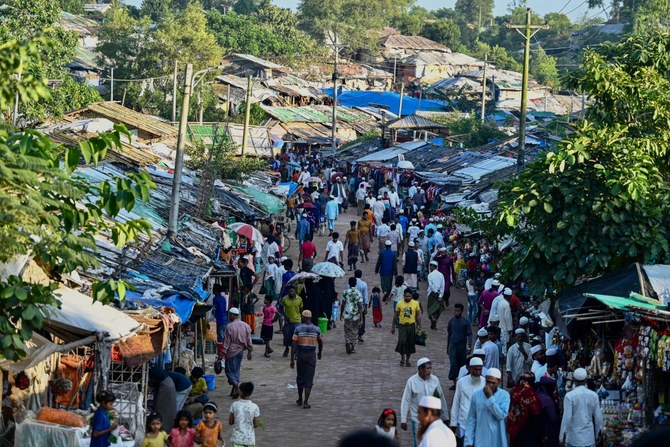
Rohingya refugees shop at a marketplace in Balukhali refugee camp in Cox’s Bazar, Bangladesh, on Nov. 25, 2023. (AFP)
Short Url
Updated 26 December 2023
Follow

Bangladesh warns of deepening Rohingya crisis as refugee aid nosedives

  • This year’s funding was the lowest since the beginning of the Rohingya crisis in 2017
  • Refugee commissioner says more Rohingya will make risky sea journeys to flee camps

Dhaka: Bangladesh warned on Tuesday of the deteriorating humanitarian crisis at its refugee camps hosting some 1 million Rohingya, as global aid for the oppressed stateless minority has sharply declined this year.

The Joint Response Plan, the annual UN fundraising plan by international agencies, was among the best funded humanitarian responses when it was set up in 2017, after a military crackdown forced hundreds of thousands of Rohingya Muslims to flee persecution in Myanmar.

Data released by the UN Refugee Agency last week showed that in 2023 the plan received only 50 percent of the $876 million needed to provide essential assistance to those sheltering in Bangladesh.

“It’s a very sharp decrease in the Joint Response Plan. This is the first time that we witnessed such a low response. In the previous years it was around 70 percent, sometimes more,” Bangladeshi Refugee Relief and Repatriation Commissioner Mizanur Rahman told Arab News.

“It has been impacting the Rohingya. The fund crisis affects their food, medical facilities, education and overall living conditions.”

The drop comes at a time when the World Food Programme earlier this year reduced food assistance to the Rohingya by 33 percent, to $8 a month per person, despite malnutrition being already widespread in the Cox’s Bazar camps.

Rahman said the deteriorating conditions will also affect security and increase the likelihood of human trafficking as people try to flee hunger and hopelessness in refugee settlements.

“The law and order situation inside the camps will deteriorate. It will increase the threat of more and more human trafficking ... it will trigger desperate attempts to leave the camps,” he said.

This year, the UN recorded at least 3,722 Rohingya refugees, mostly women and children, making desperate attempts to flee Bangladeshi camps by boat across the Andaman Sea — an increase from 3,705 last year.

Although Bangladesh is not a signatory to the 1951 UN Refugee Convention, its government says it spends an estimated $1.2 billion annually to support the Rohingya and provides not only land, but also water, electricity, a huge law enforcement presence, as well as medical and administrative officials.

“We want the donor communities, especially the US, EU and other rich countries who have been assisting the Rohingya in previous years to continue their support,” Rahman said.

“I also request Gulf countries to stand beside this stateless Muslim population.”


Top Australian writers’ festival canceled after Palestinian author barred

Updated 4 sec ago
Follow

Top Australian writers’ festival canceled after Palestinian author barred

SYDNEY: One of Australia’s top writers’ festivals was canceled on Tuesday, after 180 authors boycotted the event and its director resigned saying she could not ​be party to silencing a Palestinian author and warned moves to ban protests and slogans after the Bondi Beach mass shooting threatened free speech.
Louise Adler, the Jewish daughter of Holocaust survivors, said on Tuesday she was quitting her role at the Adelaide Writers’ Week in February, following a decision by the festival’s board to disinvite a Palestinian-Australian author.
The novelist and academic Randa Abdel-Fattah said the move to bar her was “a blatant and shameless act of anti-Palestinian racism ‌and censorship.”
Prime ‌Minister Anthony Albanese on Tuesday announced a national day ‌of ⁠mourning ​would ‌be held on January 22 to remember the 15 people killed in last month’s shooting at a Jewish Hanukkah celebration on Bondi Beach.
Police say the alleged gunmen were inspired by the Islamic State militant group, and the incident sparked nationwide calls to tackle antisemitism, and prompted state and federal government moves to tighten hate speech laws.
The Adelaide Festival board said on Tuesday its decision last week to disinvite ⁠Abdel-Fattah, on the grounds it would not be culturally sensitive for her to appear at the literary ‌event “so soon after Bondi,” was made “out of respect ‍for a community experiencing the pain ‍from a devastating event.”
“Instead, this decision has created more division and ‍for that we express our sincere apologies,” the board said in a statement.
The event would not go ahead and remaining board members will step down, it added.
Former New Zealand Prime Minister Jacinda Ardern, British author Zadie Smith, Australian author Kathy Lette, Pulitzer Prize-winning American Percival ​Everett and former Greek finance minister Yanis Varoufakis are among the authors who said they would no longer appear at the festival ⁠in South Australia state, Australian media reported.
The festival board on Tuesday apologized to Abdel-Fattah for “how the decision was represented.”
“This is not about identity or dissent but rather a continuing rapid shift in the national discourse around the breadth of freedom of expression in our nation following Australia’s worst terror attack in history,” it added.
Abdel-Fattah wrote on social media that she did not accept the apology, saying she had nothing to do with the Bondi attack, “nor did any Palestinian.”
Adler earlier wrote in The Guardian that the board’s decision to disinvite Abdel-Fattah “weakens freedom of speech and is the harbinger of a less free nation, where lobbying and political ‌pressure determine who gets to speak and who doesn’t.”
The South Australian state government has appointed a new festival board.