

World prepares to ring in 2024

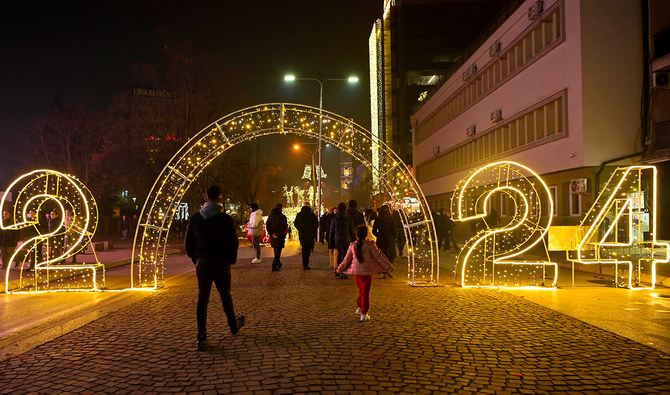
Pedestrians walk through a 2024 illuminated sign displayed in downtown Pristina on December 30, 2023, ahead of the New Year celebrations in Kosovo. (AFP)
Short Url
Updated 31 December 2023
Follow

World prepares to ring in 2024

  • 2023 was a turbulent year marked by clever chatbots, climate crises and wars in Gaza, Ukraine
  • 2024 will bring elections concerning half the world’s population and a summer Olympiad celebrated in Paris

SYDNEY: Jubilant crowds will bid farewell to the hottest year on record Sunday, closing a turbulent 12 months marked by clever chatbots, climate crises and wrenching wars in Gaza and Ukraine.

The world’s population — now over eight billion — will see out the old and usher in the new, with many hoping to shake the weight of high living costs and global tumult.

In Sydney, the self-proclaimed “New Year’s capital of the world,” more than a million partygoers are expected to pack the city’s foreshore, despite uncharacteristically dank weather.

Eight tons of fireworks will light the fuse on 2024, a year that will bring elections concerning half the world’s population and a summer Olympiad celebrated in Paris.

The last 12 months brought “Barbiegeddon” at the box office, a proliferation of human-seeming artificial intelligence tools and a world-first whole-eye transplant.

India outgrew China as the world’s most populous country, and then became the first nation to land a rocket on the dark side of the moon.

It was also the hottest year since records began in 1880, with a spate of climate-fueled disasters striking from Australia to the Horn of Africa and the Amazon basin.

Perhaps more than anything, 2023 will be remembered for Hamas’s October 7 assault on southern Israel — and Israel’s ferocious reprisals.

The United Nations estimates that almost two million Gaza residents have been displaced since Israel’s siege began — about 85 percent of the peacetime population.

With once-bustling Gaza City neighborhoods reduced to rubble, there were few places left to mark the new year — and fewer loved ones to celebrate with.

“It was a black year full of tragedies,” said Abed Akkawi, who fled the city with his wife and three children.

The 37-year-old, now living in a UN shelter in Rafah, southern Gaza, said the war had obliterated his house and killed his brother.

But still, he clings to modest hopes for 2024.

“God willing this war will end, the new year will be a better one, and we will be able to return to our homes and rebuild them, or even live in a tent on the rubble,” he told AFP.

In Ukraine, where Russia’s invasion grinds toward its second anniversary, there was defiance and hope in the face of a renewed assault from Moscow.

“Victory! We are waiting for it and believe that Ukraine will win,” said Tetiana Shostka as air raid sirens blared in Kyiv.

“We will have everything we want if Ukraine is free, without Russia,” the 42-year-old added.
Some in Vladimir Putin’s Russia are also weary of the conflict.

“In the new year I would like the war to end, a new president, and a return to normal life,” said 55-year-old theater decorator and Moscow resident Zoya Karpova.

Putin is already his country’s longest-tenured leader since Joseph Stalin and his name will again be on the ballot paper when Russians vote in March.

Few expect the vote to be fully free or fair, or for the former KGB man to return to the shadows.

Russia’s is just one of several pivotal elections scheduled, with 2024 looming as the year of the ballots.

In all, the political fate of more than four billion people will be decided in contests that could reshape Britain, France, India, Indonesia, Mexico, South Africa, Venezuela and a host of other nations.

But one election promises consequences for the entire world. In the United States, Democrat Joe Biden, aged 81, and Republican Donald Trump, aged 77, appear set to rerun their divisive 2020 election race this November.

As the incumbent, Biden has at times appeared to show his advancing age and even his supporters worry about the toll of another bruising four years in office.

But if there are worries about what a second Biden administration would look like, there are at least as many concerns about a return of Trump, who faces prosecution on several counts.

Voters could yet decide whether the bombastic self-proclaimed billionaire goes to the Oval Office or to jail.


Homeless Muslims in southern Philippines observe Ramadan as month of trial

Updated 4 sec ago
Follow

Homeless Muslims in southern Philippines observe Ramadan as month of trial

  • Thousands lost their homes when parts of Bongao in Tawi-Tawi were burnt to ashes
  • Many trying to fully observe the fasting month say they are grateful to be alive

Manila: As Annalexis Abdulla Dabbang was looking forward to observing the month of Ramadan with her family, just days before it began they lost everything when an enormous fire tore through whole neighborhoods of their city in the southernmost province of the Philippines.

Bongao is the capital of Tawi-Tawi, an island province, forming part of the country’s Muslim minority heartland in the Bangsamoro region. The city experienced its worst fire in years in early February, when flames swept through the coastal community, leaving more than 5,000 people homeless.

“We were swimming for our lives. We had to swim to escape from the fire ... We swam in darkness, and (even) the sea was already hot because of the fire,” Dabbang, a 27-year-old teacher, told Arab News.

“Everything we owned was gone in just a few hours — our home, our memories, the things we worked hard for, everything turned to ashes.”

Trying to save their 2-year-old daughter and themselves, she and her husband left everything behind — as did hundreds of other families that together with them have since taken shelter at the Mindanao State University gymnasium — one of the evacuation centers.

Unable to secure a tent, Dabbang’s family has been sleeping on the bleachers, sharing a single mat as their bed. When Ramadan arrived a few days after they moved to the makeshift shelter, they welcomed it in a different, more solemn way. There is no family privacy for suhoor, no room or means to welcome guests for iftar.

“Ramadan feels different now. It’s painful but at the same time more real. When we lost our home, we began to understand what sacrifice really means. When you sleep in an evacuation center, you understand hunger, discomfort in a deeper way,” Dabbang said.

“We don’t prepare special dishes. We prepare our hearts.”

While she and thousands of others have lost everything they have ever owned, she has not lost her faith.

“Our dreams may have turned to ashes, but our prayers are still alive,” she said.

“This Ramadan my prayers are more emotional than ever. I pray for strength, not just for myself, but for my family and for every neighbor who also lost their family home. I pray for healing from the trauma of fire. I pray that Allah will replace what we lost with something better. I pray for the chance to rebuild not just our house, but our sense of security.”

Juraij Dayan Hussin, a volunteer helping the Bongao fire victims, observed that many of them were traumatized and the need to cleanse the heart and mind during Ramadan was what kept many of them going, because they are “thankful that even though they lost their property, they are still alive.”

But the religious observance related to the fasting month is not easy in a cramped shelter.

“It’s hard for Muslims to perform their prayers when they do not have their proper attire because they usually have specific clothes for prayer,” he said. “Sanitation in the area is also an issue ... when you fast and when you pray, cleanliness is essential.”

For Abdulkail Jani, who is staying at a basketball court with his brother and more than 70 other families, this Ramadan will be spent apart from their parents, whom they managed to move to relatives.

“The month of Ramadan this year is a month of trial ... there will be a huge change from how we observed Ramadan in the past, but we will adjust to it and try to comfort ourselves and our family. The most important thing is that we can perform the fasting,” he told Arab News.

“Despite our situation now, despite everything, as long as we’re alive, we will observe Ramadan. We’ll try to observe it well, without missing anything.”