

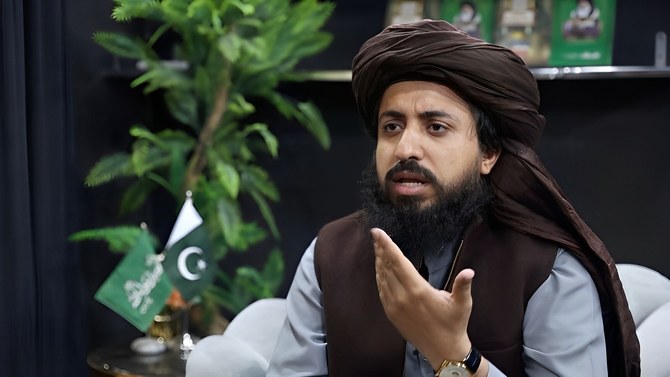

LAHORE: Saad Rizvi, head of the Tehreek-e-Labbaik Pakistan (TLP) religious party, this week said politicians in the South Asian country had strengthened the role of military establishment in politics.
Founded in 2016 by firebrand cleric, Khadim Rizvi, the TLP gained prominence a year later when it staged a sit-in at a key intersection between Pakistan’s capital and the twin city of Rawalpindi. The protest was aimed at reversal of changes made to the draft of a declaration for election candidates about the finality of prophethood in Islam.
Lasting 20 days, the sit-in disrupted intercity commute between Islamabad and Rawalpindi and was called off only after the military brokered a deal between the federal government and the TLP. The event propelled the TLP as a crusader against blasphemy in the country, where it remains a highly sensitive issue and carries the death penalty.
Khadim’s fiery speeches against politicians and the West resonated with the masses and his party’s popularity translated into over 2.2 million votes in the 2018 general election in Pakistan, making the TLP fifth largest party in the country in terms of number of votes. But despite bagging such a huge number of votes, the party could only secure three provincial assembly seats.
Critics say the establishment catapulted the TLP to prominence to break the vote bank of major political parties, but Rizvi, who took over the party following his father’s death in 2020, denies claims that the TLP was created to counter the Nawaz Sharif-led Pakistan Muslim League-Nawaz (PML-N) party in the 2018 election, and instead accuses the PML-N of trying to create a perception that the establishment is currently on its side.
“The establishment is a reality, politics is a reality, state is a reality. If you say that their (establishment) role should not be there in the state of Pakistan, then it is not possible,” the TLP chief told Arab News in an exclusive interview on Wednesday.
“Our people (politicians), political parties have strengthened their (establishment) connection with politics themselves.”
In Pakistan, the fate of politicians has historically rested on their relationship with the country’s powerful military, which has directly ruled the South Asian country for almost half of its 75-year history either through coups or as an invisible guiding hand in politics.
Rizvi faces his first electoral challenge in the form of the upcoming 2024 general election, scheduled for February 8, with his party fielding more than 1,400 candidates across the country.
The 29-year-old says he is optimistic about his party securing more seats this time.
“I think that the time has passed for all those groups who, by pursuing a policy of division, a policy of hatred, and by promoting their own interests, have sacrificed the entire Pakistani nation,” he told Arab News.
“The facts are in front of them that at this time, Tehreek-e-Labbaik (TLP) is standing before them as a strong wall, both theoretically and politically. Therefore, they are bewildered and talk in a disconcerted manner.”
Asked about Israel’s war on Gaza and Pakistan’s reaction, the 29-year-old said Islamabad’s response to that had been “very weak” and criticized Prime Minister Anwaar-ul-Haq Kakar for advocating for a two-state solution to the Palestine issue.
“[It’s a] very weak stance, and what the prime minister of Pakistan has said that there is a two-state formula for it, this is a betrayal of fundamental ideologies of Quaid-e-Azam [Muhammad Ali Jinnah] and Pakistan,” Rizvi said.
Pakistan does not recognize Israel as a state and calls for a viable, independent, and contiguous Palestinian State, with pre-1967 borders, Al-Quds Al-Sharif as its capital, and a comprehensive and lasting solution to the Palestinian question in accordance with the relevant United Nations and OIC resolutions.


