

‘It’s a big deal’: Exporters see demand growth for Bangladeshi spices in Saudi Arabia

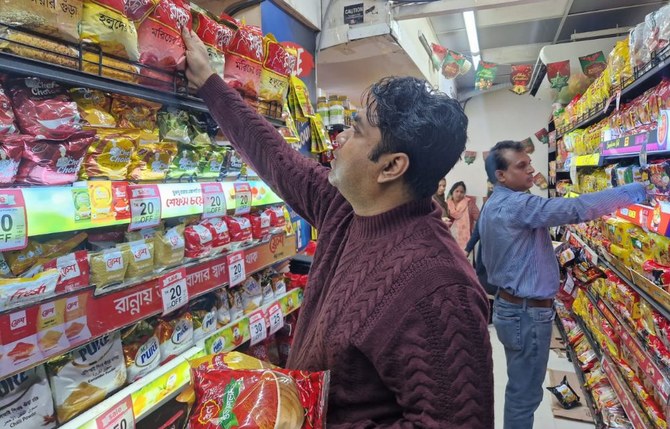
A customer browse through the spice section at a local supermarket in Dhaka. (AN Photo)
Short Url
Updated 25 December 2023
Follow

‘It’s a big deal’: Exporters see demand growth for Bangladeshi spices in Saudi Arabia

  • Gulf region is a top destination for Bangladeshi spices overall, official data shows
  • More than half of Bangladeshi spice exports to Gulf region had gone to the Kingdom

DHAKA: Saudi Arabia is a growing export destination for Bangladeshi spices, with the country’s producers crediting the growth to improved product quality and the Bangladeshi diaspora in the Kingdom.

Bangladesh exported more than $17 million worth of spices to Gulf countries between July and November this year, more than half of which had gone to Saudi Arabia, according to data from the Export Promotion Bureau.

“Saudi Arabia is our top export destination in the Gulf region. Next to the Kingdom, there is the UAE, Jordan and Oman,” Mohammad Sazzadul Karim, head of export at leading food company BD Food, told Arab News.

“In Saudi Arabia, we are noticing an increasing demand … all of our consumer goods producers have been producing better quality products in recent years. Our spices are penetrating into the Gulf markets, beating the Indian spices. It’s a big deal.”

BD Food mainly exports powder forms of turmeric, chili, curry, coriander and cumin, he said, adding that the Bangladeshi diaspora alone makes up a large base of consumers.

More than 2.6 million Bangladeshis live and work in Saudi Arabia, making them the biggest expat worker community in the Kingdom.

“We have a captive market for spices in the Kingdom as the country hosts more than 2.5 million Bangladeshis. Besides, there are a large number of Indian communities over there and both countries have similar food choices.”

The PRAN-RFL Group, one of Bangladesh’s largest conglomerates with a presence in more than 100 countries, said the spice market in the Gulf region has undergone a transformation in recent years.

“One decade ago, our customers were mostly Bangladeshi migrants in the Gulf region. Later on, people from India, Pakistan, Nepal, Sri Lanka, Bhutan and the Philippines started liking our spices,” Kamruzzaman Kamal, the group’s marketing director, told Arab News.

“In spite of the differences in food habits, Saudi locals are also consuming some of our spices. The number of our spice consumers is increasing day by day in Saudi Arabia.”

But to keep the momentum and to boost the spice market potential in the Gulf, Bangladeshi producers must “ensure quality and competitive prices,” said Dr. M.A. Rahim, who heads the department of agricultural science at the Daffodil International University.

“Neighboring India remains one of our main competitors in this sector. So, the government should also provide different policy support to accelerate our spice exports (to the Gulf).”


Afghan man goes on trial over deadly Munich car-ramming

Updated 4 sec ago
Follow

Afghan man goes on trial over deadly Munich car-ramming

  • The suspect, partially identified as Farhad N., 25, remained silent and did not offer a statement at the opening of the trial
  • He faces two charges of murder and 44 of attempted murder

MUNICH: An Afghan man went on trial in Germany on Friday accused of ramming a car into a crowd in Munich last year, killing a two-year-old girl and her mother and injuring dozens.
The suspect, partially identified as Farhad N., 25, remained silent and did not offer a statement at the opening of the trial, sitting in the dock wearing a green fur-lined hooded jacket.
He faces two charges of murder and 44 of attempted murder, with prosecutors saying he acted out of a “religious motivation” and expected to die in the attack.
The vehicle rampage in February 2025 was one of several deadly attacks linked to migrants which inflamed a heated debate on immigration ahead of a general election that month.
Farhad N. is accused of deliberately steering his car into a 1,400-strong trade union street rally in Munich on February 13.
The vehicle came to a halt after 23 meters (75 feet) “because its front wheels lost contact with the ground due to people lying in front of and underneath the car,” according to the charge sheet.
A 37-year-old woman and her young daughter were both hurled through the air for 10 meters and sustained severe head injuries, of which they died several days later.
Prosecutors have said Kabul-born Farhad N. “committed the act out of excessive religious motivation,” and that he had uttered the words “Allahu Akbar,” meaning “God is the greatest,” after the car rampage.
“He believed he was obliged to attack and kill randomly selected people in Germany in response to the suffering of Muslims in Islamic countries,” they said when he was charged in August.
However, he is not believed to have been part of any Islamist militant movement such as the Daesh group.
Farhad N. was examined by a psychiatrist after exhibiting “certain unusual behaviors” during pretrial detention, including a tic in which he sometimes twitches his head, a court spokesman said on Friday.
The preliminary psychiatric report concluded that he is criminally responsible, but the presiding judge has said that the issue could be considered during the proceedings, according to the spokesman.
The trial is scheduled to run for 38 days until the end of June.

- Spate of attacks -

Farhad N. arrived in Germany in 2016 as an unaccompanied teenager, having traveled overland at the height of the mass migrant influx to Europe.
His asylum request was rejected but he was spared deportation, found work with a series of jobs and was able to remain in the country.
Police said Farhad N. worked in security and was heavily engaged in fitness training and bodybuilding.
The Munich attack came a month after another Afghan man had carried out a knife attack on a kindergarten group that killed two people, including a two-year-old boy, in the city of Aschaffenburg.
The perpetrator was later confined to a psychiatric facility after judges found he had acted during an acute psychotic episode.
In December 2024, six people were killed and hundreds wounded when a car plowed into a Christmas market in the eastern city of Magdeburg. A Saudi man was arrested and is currently on trial.
Several Syrian nationals were also arrested over attacks or plots at around the same time, including a stabbing spree that killed three people at a street festival in the city of Solingen.
Germany took in more than a million asylum seekers in 2015-2016 — an influx that has proved deeply divisive and helped fuel the rise of the far-right AfD.
Chancellor Friedrich Merz, who took power last May, has vowed to crack down on criminal migrants and has ramped up deportations of convicts to Afghanistan.
Germany in December also deported a man to Syria for the first time since that country’s civil war broke out in 2011.
