Archbishop of Canterbury’s Christmas sermon highlights children’s plight in Gaza

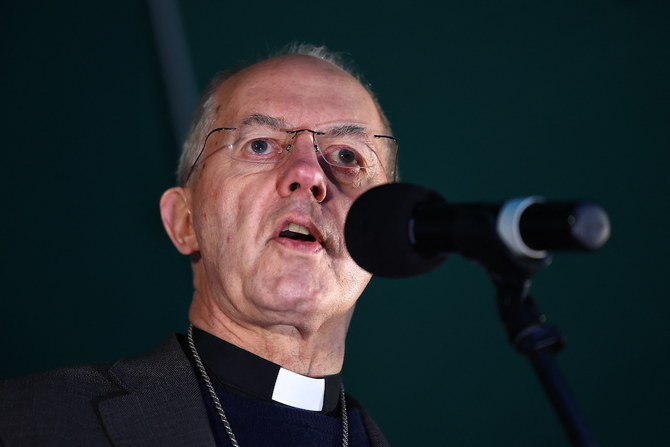
Archbishop of Canterbury Justin Welby addresses the "Building Bridges, Together for Humanity" vigil in central London on December 3, 2023. (File/AFP)
Short Url
Updated 25 December 2023
Follow

Archbishop of Canterbury’s Christmas sermon highlights children’s plight in Gaza

  • Palestinian Christians have previously slammed Welby's remarks on the Israel-Hamas war

LONDON: The Archbishop of Canterbury spoke about the impact of the Israel-Hamas war on children in his Christmas Day sermon, the BBC reported on Monday.

“This year, the skies of Bethlehem are full of fear rather than angels and glory,” Justin Welby said during a service at Canterbury Cathedral.

He drew parallels between the hardships faced by children in the region today and the turbulent times of Jesus’ birth.

“Today a crying child is in a manger somewhere in the world, nobody willing or able to help his parents, or her parents, who so desperately need shelter,” Welby said. “Or perhaps lying in an incubator, in a hospital low on electricity, like the Anglican Al-Ahli hospital in Gaza, surrounded by suffering and death.

“Or maybe the newborn lies in a house that still bears the marks of the horrors of Oct. 7, with family members killed, and a mother who counted her life as lost.”

The archbishop highlighted the importance of service over dominance in addressing global challenges such as climate change, terrorism, economic disparity, antisemitism, Islamophobia and racism.

God “confronts our cruelty with his compassion” and “responds to our selfishness with service,” Welby said.

He shared his experience of visiting a US church that collects guns off the streets and mentioned wearing a cross made from a melted-down automatic rifle, symbolizing hope and life.

“The angels cry, they cry out for peace — and let our voices join with theirs in prayer for such peace; for a cessation of violence, for the relief of such suffering, and for the release of hostages,” Welby said.

Earlier in October, the archbishop spent four days in Jerusalem to show solidarity “with the Christian community in the Holy Land” after Israel reportedly bombed the Anglican-run Al-Ahli hospital in Gaza.

Palestinian Christians had slammed his remarks on the Israel-Hamas war, accusing him of “relegating” their plight behind “British domestic political and ecumenical considerations.”


EU should consider forming combined military force: defense chief

Updated 4 sec ago
Follow

EU should consider forming combined military force: defense chief

  • Kubilius floated creating a “powerful, standing ‘European military force’ of 100,000 troops” that could eventually replace US forces
  • Trump has heightened fears among NATO allies over Washington’s reliability by insisting he wants to take over Greenland

BRUSSELS: EU countries should weigh whether to set up a combined military force that could eventually replace US troops in Europe, the bloc’s defense chief said Sunday.
EU defense commissioner Andrius Kubilius floated creating a “powerful, standing ‘European military force’ of 100,000 troops” as a possible option to better protect the continent.
“How will we replace the 100,000-strong American standing military force, which is the back-bone military force in Europe?” he asked in a speech in Sweden.
The suggestion comes as US President Donald Trump has heightened fears among NATO allies over Washington’s reliability by insisting he wants to take over Greenland.
Worries over Trump’s commitment to Europe have already spurred countries to step up efforts to bolster their militaries in the face of the threat posed by Russia.
Ideas about establishing a central European army have floated around for years but have largely failed to gain traction as nations are wary of relinquishing control over their militaries.
The US has pushed its European allies to increasingly take over responsibility for their own security, and raised the prospect it could shift forces from Europe to focus on China.
“In such times, we should not run away from the most pressing questions on our institutional defense readiness,” said Kubilius, a former Lithuanian prime minister.
In his speech Kubilius also advocated for the creation of a “European Security Council” of key powers — including potentially Britain — that could help the continent take decisions over its own defense quicker.
“The European Security Council could be composed of key permanent members, along with several rotational members,” he said.
“In total around 10-12 members, with the task to discuss the most important issues in defense.”
He said the first focus of such a body should be trying to change the dynamics in the war in Ukraine to ensure that Kyiv does not end up losing.
“We need to have a clear answer — how is the EU going to change that scenario?,” he said.
“This is the reason why we need to have a European Security Council now!“