

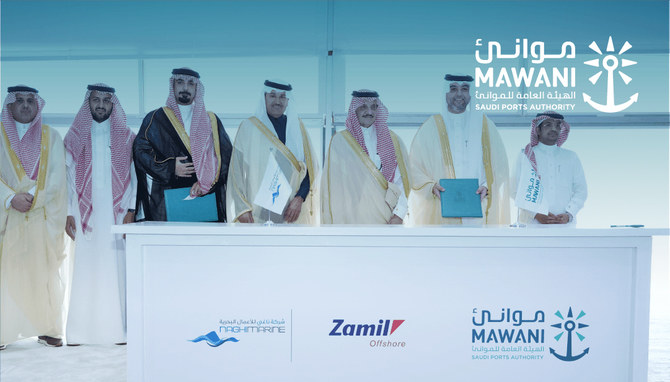

RIYADH: Among others, King Abdulaziz Port in Dammam will soon be pumped by maritime services, attracting private sector investments surpassing SR1 billion ($266.6 million).
The Saudi Ports Authority, also known as Mawani, has signed four agreements with Zamil Marine Services and Naghi Marine Co. to offer a range of services at eight ports associated with the authority in collaboration with the Ministry of Transport and Logistic Services and the National Center for Privatization.
According to the authority, the government is keen to support projects that will make Saudi terminals more appealing to trade and place them at the forefront of global logistics, in line with the goals of the National Transport and Logistics Strategy.
This will be done by providing a strong network of ports and efficient and highly competent integrated logistics services in accordance with best global practices.
Additionally, this will help stimulate the logistics services industry, satisfy the Kingdom’s economic growth ambitions, and achieve the targets and pillars of Saudi Vision 2030.
According to Minister of Transport and Logistic Services and Chairman of Mawani Saleh bin Nasser Al-Jasser the contracts will enhance the relationship with the private sector and promote the competitive capabilities of the logistics sector and Saudi ports.
Al-Jasser also stated that the agreements will improve the operational efficiency and performance of Saudi maritime services in ports, as well as renew the fleet of operational assets and units through investment in 44 new units, thus supporting the supply chain and economic growth.
Additionally, the minister acknowledged that these contracts aim to empower the private sector in transportation and logistics projects and initiatives, as the amount invested in this market through privatization projects exceeded SR17 billion in the first half of 2023.
Aligned with the National Transportation and Logistics Strategy and Saudi Vision 2030, Al-Jasser stated that the system will boost investment opportunities for the private sector and enhance the contribution of local content in its projects, cementing the Kingdom’s position as a global logistics hub.
According to a press note, Omar Hariri, president of Mawani, noted that these contracts aim to enhance the Kingdom’s regional and global competitiveness by utilizing the ports’ potential in value-added investment projects.
He also emphasized the importance of shipping services contracts in enabling the maritime transportation sector, diversifying the Kingdom’s economy, developing logistic services, and improving the region’s ranking in international performance metrics.
The agreements entail acquiring 27 new tugboats and 17 additional maritime assets, attracting new shipping lines, and advancing the ports sector to meet international standards. A key performance goal is reducing towing assistance time by 45 percent across the eight ports.
According to the CEO of the National Center for Privatization, Mohanad Basudan, signing contracts for the privatization of services in the eight ports is the result of integrated work among the team.
This demonstrates the ongoing interaction between the transportation and logistics services and privatization systems.
“We are currently working on presenting 200 vital projects, which in turn will contribute to improving the quality of the services provided and the operational efficiency of government assets,” he said.
The center received 64 firms and alliances during the indication of interest stage.
Furthermore, these contracts aim to support the Saudi maritime sector in propelling advanced positions in worldwide rankings and indicators by offering a range of essential services such as towing and guide operations, mooring in the hook area, and berthing.
Additional benefits include diving, rescue and firefighting as well as crew and sailor transportation, ship fuel delivery, and tug and marine unit repairs.
The contracts are distributed among eight ports, with Zamil Marine Services Co. responsible for providing support at the Jeddah Islamic Port, the Jazan Port, the Ras Al-Khair Port, the King Fahd Industrial Port in Jubail, and the Jubail Commercial Port.
On the other hand, Naghi Marine Co. is responsible for providing marine services at King Abdulaziz Port in Dammam, Yanbu Commercial Port, and the King Fahd Industrial Port in Yanbu.




