Archbishop of York warns Israel against seeking revenge, highlights escalating violence in Gaza

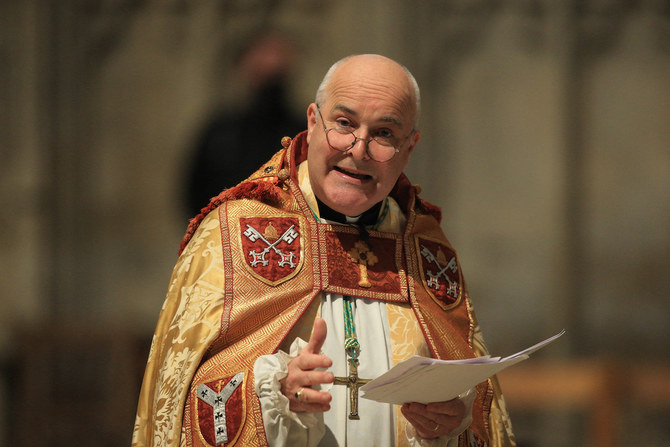
Rev. Stephen Cottrell, the 98th Archbishop of York, takes a service of evensong at York Minster in northern England. (File/AFP)
Short Url
Updated 24 December 2023
Follow

Archbishop of York warns Israel against seeking revenge, highlights escalating violence in Gaza

  • Cottrell emphasized the dangers of “endless cycles of reprisals”

LONDON: The Archbishop of York has cautioned Israel against embarking on a “journey of revenge” in his article for The Telegraph on Saturday.

Rev. Stephen Cottrell emphasized the dangers of “endless cycles of reprisals” and the fallacy of believing in the principle of “might is right.”

Referencing the Chinese philosopher Confucius, he said: “When you embark on a journey of revenge, dig two graves: one for your enemy and one for yourself.”

His statement, while not directly referencing the Israel-Gaza war, came as the UN voted on whether to call for a ceasefire in Gaza, where Israel’s relentless bombardment has killed over 20,000 people, many of whom are civilians.

Cottrell also drew upon the words of Martin Luther King, writing: “Violence begets violence, hate begets hate, and toughness begets a greater toughness. It is all a descending spiral, and the end is destruction — for everybody. Along the way of life, someone must have enough sense and morality to cut off the chain of hate.”

Earlier in December, the House of Bishops released a statement condemning the loss of Palestinian civilian lives and the humanitarian crisis in Gaza as unjustifiable.

Moreover, the archbishop expressed that amid war’s chaos and a world plagued by political extremism and corruption, divine guidance is still present. However, he warned that “anyone hoping for a message combining instant justice with the extermination of tyranny and divine retribution is likely to be disappointed.”


Venezuela’s acting president calls for oil industry reforms to attract more foreign investment

Updated 4 sec ago
Follow

Venezuela’s acting president calls for oil industry reforms to attract more foreign investment

  • In her speech, Rodríguez said money earned from foreign oil sales would go into two funds: one dedicated to social services for workers and the public health care system, and another to economic development and infrastructure projects

CARACAS, Venezuela: Venezuela’s acting President Delcy Rodriguez used her first state of the union address on Thursday to promote oil industry reforms that would attract foreign investment, an objective aggressively pushed by the Trump administration since it toppled the country’s longtime leader less than two weeks ago.
Rodríguez, who has been under pressure from the US to fall in line with its vision for the oil-rich nation, said sales of Venezuelan oil would go to bolster crisis-stricken health services, economic development and other infrastructure projects.
While she sharply criticized the Trump administration and said there was a “stain on our relations,” the former vice president also outlined a distinct vision for the future between the two historic adversaries, straying from her predecessors, who have long railed against American intervention in Venezuela.
“Let us not be afraid of diplomacy” with the US, said Rodriguez, who must now navigate competing pressures from the Trump administration and a government loyal to former President Nicolás Maduro.
The speech, which was broadcast on a delay in Venezuela, came one day after Rodríguez said her government would continue releasing prisoners detained under Maduro in what she described as “a new political moment” since his ouster.
Trump on Thursday met at the White House with Venezuelan opposition leader María Corina Machado, whose political party is widely considered to have won 2024 elections rejected by Maduro. But in endorsing Rodríguez, who served as Maduro’s vice president since 2018, Trump has sidelined Machado.
In her speech, Rodríguez said money earned from foreign oil sales would go into two funds: one dedicated to social services for workers and the public health care system, and another to economic development and infrastructure projects.
Hospitals and other health care facilities across the country have long suffered. Patients are asked to provide practically all supplies needed for their care, from syringes to surgical screws. Economic turmoil, among other factors, has pushed millions of Venezuelans to migrate from the South American nation in recent years.
In moving forward, the acting president must walk a tightrope, balancing pressures from both Washington and top Venezuelan officials who hold sway over Venezuela’s security forces and strongly oppose the US Her recent public speeches reflect those tensions — vacillating from conciliatory calls for cooperation with the US, to defiant rants echoing the anti-imperialist rhetoric of her toppled predecessor.
American authorities have long railed against a government they describe as a “dictatorship,” while Venezuela’s government has built a powerful populist ethos sharply opposed to US meddling in its affairs.
For the foreseeable future, Rodríguez’s government has been effectively relieved of having to hold elections. That’s because when Venezuela’s high court granted Rodríguez presidential powers on an acting basis, it cited a provision of the constitution that allows the vice president to take over for a renewable period of 90 days.
Trump enlisted Rodríguez to help secure US control over Venezuela’s oil sales despite sanctioning her for human rights violations during his first term. To ensure she does his bidding, Trump threatened Rodríguez earlier this month with a “situation probably worse than Maduro.”
Maduro, who is being held in a Brooklyn jail, has pleaded not guilty to drug-trafficking charges.
Before Rodríguez’s speech on Thursday, a group of government supporters was allowed into the presidential palace, where they chanted for Maduro, who the government insists remains the country’s president. “Maduro, resist, the people are rising,” they shouted.