

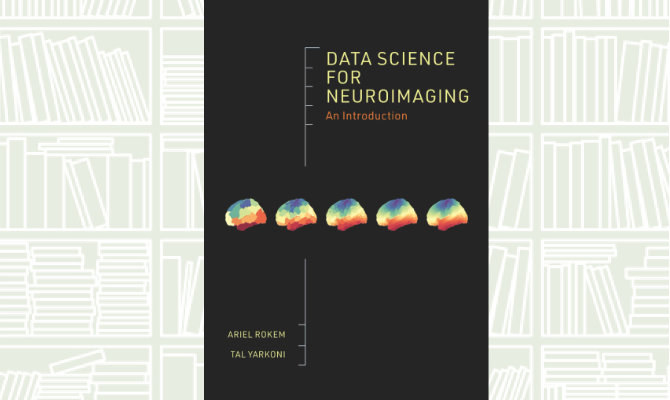

Authors: Ariel Rokem and Tal Yarkoni
As neuroimaging turns toward data-intensive discovery, researchers in the field must learn to access, manage, and analyze datasets at unprecedented scales.
Concerns about reproducibility and increased rigor in reporting of scientific results also demand higher standards of computational practice.
This book offers neuroimaging researchers an introduction to data science, presenting methods, tools, and approaches that facilitate automated, reproducible, and scalable analysis and understanding of data.
Through guided, hands-on explorations of openly available neuroimaging datasets, the book explains such elements of data science as programming, data management, visualization, and machine learning, and describes their application to neuroimaging.
Readers will come away with broadly relevant data science skills that they can easily translate to their own questions.
• Fills the need for an authoritative resource on data science for neuroimaging researchers
• Strong emphasis on programming
• Provides extensive code examples written in the Python programming language
• Draws on openly available neuroimaging datasets for examples
• Written entirely in the Jupyter notebook format, so the code examples can be executed, modified, and re-executed as part of the learning process


