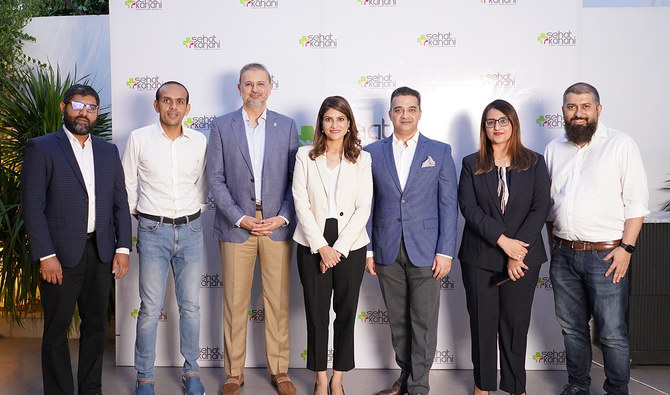
KARACHI: In a groundbreaking achievement for the Pakistani startup landscape, health-tech startup Sehat Kahani has become the first all-women led company from the South Asian nation to secure $2.7 million in Series A funding, the firm said in a statement on Thursday.
Amaanah Circle, a Singapore-based health-tech fund led by Dr. Razi Yousuf, spearheaded the funding, joined by key investors including Epic Angels, a female-only investor collective, Cross Fund, USAID Investment Promotion Activity (IPA), Augmentor, Impact Investment Exchange(IIX) and the Elahi group of companies.
Sehat Kahani is among a myriad of social enterprises — businesses seeking to build a better world — that are innovating to plug health care gaps in developing countries, a task given added urgency by the COVID-19 crisis.
“Sehat Kahani is an incredible health-tech story led by Dr. Sara Saeed Khurram and Dr. Iffat Zafar Aga. Amaanah Circle (Singapore) is proud to contribute to the subject matter expertise, and in upscaling regionally and globally to the overall vision of Sehat Kahani in the future of digital health and preventive health care,” Yousuf said in a statement.
Sehat Kahani’s technology ensures a “seamless virtual connection” between doctors and patients within 60 seconds, offering on-demand at-home or on-premise laboratory services and online medicine delivery. The platform caters to a diverse nationwide patient base, including B2B clients, B2C consumers, and underserved populations in rural areas.
Sehat Kahani extends its corporate application into a comprehensive OPD management solution, providing corporate employees and their families 24/7 hassle-free and cashless access to specialists, online medicine delivery, and efficient claims management.
“The holistic 360-degree well-being program for corporates emphasizes health promotion and preventative care. The Consumer Application, operational in over 310 cities and towns across Pakistan, integrates seamlessly into prominent banking and lifestyle platforms, ensuring affordable and accessible health care,” the statement added.
Founder Khurram said the funding infusion marked “a pivotal moment for Sehat Kahani.”
“It will enable us to develop advanced features, including decision support systems, precision medicine tools, and predictive AI models to help our patients live fully by knowing their disease better,” she said.
Co-founder Aga said the company had shown average year on year growth of 141 percent in the last three years, overcoming the myth that telemedicine was only beneficial during the COVID-19 pandemic.
“We have seen five times the cumulative growth in the number of consultations in the post covid era,” Aga said. “This gives us the confidence to expand operations to other countries and take Sehat Kahani global as our next move for expansion.”
In 2021, Khurram was announced as one of the five winners of the ‘WE Empower UN SDG Challenge,’ a first-of-its-kind global competition for women social entrepreneurs who are advancing UN Sustainable Development Goals and inspiring communities in their respective countries.
As COVID-19 strained Pakistan’s health system after 2020, the founders of Sehat Kahani decided to tap into tens of thousands of women doctors sitting at home, their talents squandered in a country where millions have no access to medical care.
Many families encourage their daughters to study medicine not for a career, but to bolster their marriage prospects. The phenomenon even has a name — “doctor-brides”.
Appalled by the waste of expertise, Khurram and Aga set up their telemedicine platform enabling female medics to provide e-consultations from their homes to patients in rural communities.
Sehat Kahani also liaised with the Pakistani federal government to provide free consultations to all patients during the first wave of COVID-19. They also installed apps in hospital intensive care units treating COVID patients, allowing junior doctors to get immediate advice from critical care experts based elsewhere.


![]()

Sehat Kahani becomes first all-women Pakistani company to raise $2.7 million Series A funding
Short Url
https://arab.news/rvfst
Sehat Kahani becomes first all-women Pakistani company to raise $2.7 million Series A funding
- Sehat Kahani’s technology ensures a “seamless virtual connection” between doctors and patients within 60 seconds
- The health-tech startup has shown a significant average year-on-year growth of 141% in the last three years
Latest updates


© 2026 SAUDI RESEARCH & PUBLISHING COMPANY, All Rights Reserved And subject to Terms of Use Agreement.