

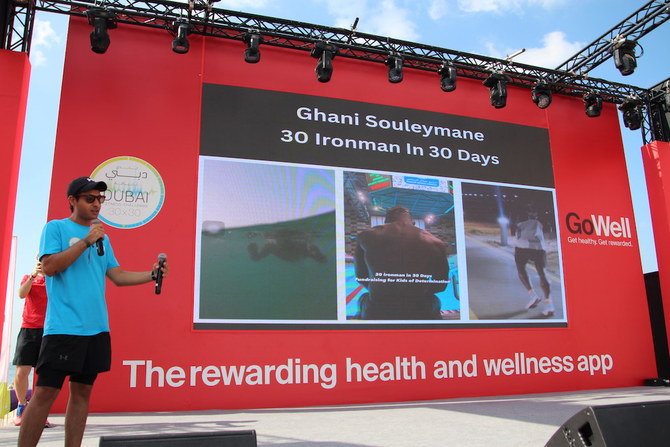

“There were days I woke up and I felt like I can’t do it anymore, because I was extremely exhausted,” said Ghani Souleymane.
Those familiar with the Togolese athlete’s almost superhuman endurance capacity will understand the weight of those words, uttered in the aftermath of his outstanding achievement at the recent Dubai Fitness Challenge.
From Oct. 28 until Nov. 26, Souleymane, a prominent and popular member of Dubai’s sporting community, tackled a challenge only two people had previously achieved — to complete 30 full Ironman triathlon races in 30 days.
“Days two, 11 and 18 were among some of the most personally challenging,” he recalled. “I was in pain, absolutely exhausted, and barely functioning. Some days I could not even sleep and I could barely feel my legs.”
Souleyman, a resident in the city since 2017, is no stranger to the pain game.
The Adidas athlete rose to prominence by running 30 ultramarathons in 30 days in 2020, before completing 30 Ironman 70.3 events — a 1.9 km swim, 90 km bike ride and 21.1 km run — in 30 days the following year.
His latest feat has seen him honored in the Dubai Fitness Challenge Hall of Fame for the second time by Sheikh Hamdan bin Mohammed bin Rashid Al-Maktoum, crown prince of Dubai.
“I’m fortunate to have been born with a gift for endurance and sports,” said the 40-year-old. “I am passionate about encouraging everyone to harness the benefits of fitness and sport to make themselves mentally and physically stronger. I believe it is part of my duty to give back to others.”
Souleymane set out to raise funds and awareness for the Heroes of Hope not-for-profit group, run in partnership with Al Jalila Foundation, which supports children and young adults through sport.
The organization is “dedicated to empowering children with special needs to gain confidence through sports,” he said.
“As an athlete myself who is active in several local communities, I see how much power sport has to bring people together and enrich our daily lives. I chose Heroes of Hope because I have trained a lot of the children there, and the experience touched me spiritually and emotionally. I see so much potential in these young athletes.”
It was, he says, his way of giving back to the country that has welcomed him and allowed him “to flourish” as an athlete.
“Where some see an obstacle, I see an opportunity,” Souleymane said. “I love challenges, and endurance is the biggest challenge in sports.”
But how does he even begin to prepare for such a task?
“Running and sports are already a really big part of my life. I’m an assistant coach at LK Running Performance, which is a leading running performance company here in Dubai run by coach Lee Harris,” Souleymane said.
“I am also a coach at Adidas Runners Dubai, so I train seven days a week. In this way my fitness allows me to be ready for anything I choose to do as a challenge.
“For this particular challenge, my training was more focused on getting better on the bike, which was very kindly sponsored by Trek Dubai,” he added. “Sponsorships and support such as theirs made a huge difference — even my local breakfast spot 95 Degrees gave me a daily breakfast after my 3.8 km swim each day at Kite Beach.”
Souleymane’s challenge, laid out in numbers, is eye-watering: 30 daily Ironman events consisting of a 3.8 km swim, 180 km bike ride and 42 km run.
The schedule required him to be up at 5 a.m. to complete the swim, and then, after a meal and short rest, head down to Dubai’s Meydan cycling track to complete 18 loops of the 10 km route.
Then, the small matter of running a full marathon. The three disciplines took up to 16 hours, leaving Souleymane to average only two or three hours of sleep a night as he struggled with growing fatigue and muscle pain.
“Many things went through my mind during my daily Ironman, the most common one being ‘why?’, and how this little ‘why?’ can help those kids and how this challenge can inspire others.”
Marathon runners notoriously experience what they call “hitting the wall,” when their bodies are simply overcome with fatigue and threaten to shut down.
“Hitting the wall, yes, it happened many times, especially from day 10 when I couldn’t sit on the saddle, when the pain became so unbearable that I couldn’t even speak to my helpers — my running community friends Emily, Yuri and Vicki.
“There were days I almost crashed on the bike from exhaustion.”
Run when you can, walk if you have to, crawl if you must; just never give up.
Dean Karnazes wrote the book — literally, “The Ultramarathon Man” — on endurance running, and that mantra is echoed by Souleymane.
Giving up, he said, simply “wasn’t an option.”
“To keep going in those circumstances, I need to remind myself why I’m doing it, what impact I want to make in my community, and prove the impossible is nothing.”
As he neared the end, both literal and metaphorical, exhilaration awaited.
“I thought about the final day as a motivation, thinking that I will be among just three people in the world who have completed this kind of challenge,” he said.
Mind and body would take several weeks to recuperate. Having just completed this monumental, but physically exhausting, achievement, Souleymane could be forgiven for not racing to set new targets just yet.
But, then again, he is no ordinary athlete.
“New goals and challenges are already coming to mind,” Souleymane said. “I was thinking about this during the challenge. I do believe that I have a responsibility to my sponsors and supporters, as well as how this kind of challenge impacts the community.
“I am proud to be a representative of sports in the UAE, and to be sponsored also as a black athlete — this is additionally important in terms of diversity.”


