

‘Cold–blooded’ killing of 2 women at Gaza church undermines Israeli ‘right to self-defense,’ says British Catholic cardinal

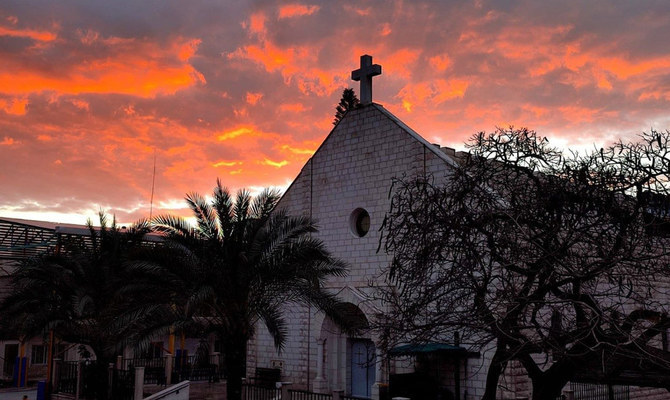
The Holy Family Catholic church in Gaza. (X: @LaylaMoran)
Short Url
Updated 19 December 2023
Follow

‘Cold–blooded’ killing of 2 women at Gaza church undermines Israeli ‘right to self-defense,’ says British Catholic cardinal

  • Pope Francis condemned the shooting
  • Israeli army officials have rejected the claims, saying it “does not target civilians, no matter (what) their religion”

LONDON: The alleged murder of two women by an Israeli sniper in a church complex in Gaza undermines claims of Israel’s “right to defend itself” in its war with Hamas, a British Catholic cardinal said on Monday.

Nahida Khalil Anton and her daughter Samar were shot and killed in the grounds of the complex, according to the Latin Patriarchate of Jerusalem, in an attack Cardinal Vincent Nichols, the archbishop of Westminster, called a “cold–blooded killing.”

Speaking to Sky News, Nichols said seven more people had been wounded while they were attempting to protect others inside the Holy Family Church, the only Roman Catholic church in Gaza.

“No warning was given, no notification was provided. They were shot in cold blood inside the premises of the parish, where there are no belligerents,” he said.

“This (happened) within what has been clearly designated as a church place, which I cannot believe for a minute has rocket launchers in it (as Israel claims). It’s a community that, since October, has sheltered hundreds of people and looked after them.

“It’s certainly a cold-blooded killing. What absolutely puzzles me is that this does nothing to further Israel’s right to defend itself.”

Pope Francis condemned the shooting, and said: “Some say this is terrorism, this is war; yes, it is war, it is terrorism.”

Israeli army officials have rejected the claims, saying it “does not target civilians, no matter (what) their religion.”

A relative of one of the 300 people trapped in the church said civilians inside the complex were living with an “unreal” sense of fear, and were scared of moving in case they were also shot.

Fifi Saba, whose sister is one of those confined in the church, told the BBC: “They are locked in. They can’t really see the street very much, and most of the time they’re cut off from the world. They don’t have their phones, they don’t have the internet, they don’t have the news.”

A British politician said she feared that her relatives, who are also trapped in the church, would not survive to see Christmas.

Layla Moran, a Liberal Democrat member of Parliament, has five extended family members sheltering inside the complex.

Her relatives — a grandmother, her son, his wife and their 11-year-old twins — sought refuge in the church during the first week of Israel’s retaliatory offensive inside Gaza after Hamas’ Oct. 7 cross-border attacks.

She told Agence France-Presse that those inside were running out of food and water, had no electricity, and were petrified. 

Another elderly family member was with them but died in the middle of November, “primarily through dehydration,” she said.

“It’s dire, absolutely dire,” Moran, who became the UK’s first MP of Palestinian descent when she was elected in 2017, added.

“They need water, they need food and they need it quickly. There’s only so long a human can survive without water.

“They are absolutely desperate; they are terrified. Christmas is not just a time of peace on Earth and goodwill to men, but actually centered on Palestine as the center of the story.”


Death toll in Iran protests over 3,000, rights group says

Updated 17 January 2026
Follow

Death toll in Iran protests over 3,000, rights group says

  • The protests erupted on December 28 over economic hardship and swelled into widespread demonstrations calling for the end of clerical rule
  • President Donald Trump, who had threatened ‘very strong action’ if Iran executed protesters, said Tehran’s leaders had called off mass hangings

DUBAI: More than 3,000 people have died in Iran’s nationwide protests, rights activists said on Saturday, while a “very slight rise” in Internet activity was reported in the country after an eight-day blackout.

The US-based HRANA ​group said it had verified 3,090 deaths, including 2,885 protesters, after residents said the crackdown appeared to have broadly quelled protests for now and state media reported more arrests.

The capital Tehran has been comparatively quiet for four days, said several residents reached by Reuters. Drones were flying over the city, but there were no signs of major protests on Thursday or Friday, said the residents, who asked not to be identified ‌for their safety.

A ‌resident of a northern city on the ‌Caspian ⁠Sea ​said ‌the streets there also appeared calm.

The protests erupted on December 28 over economic hardship and swelled into widespread demonstrations calling for the end of clerical rule in the Islamic Republic, culminating in mass violence late last week. According to opposition groups and an Iranian official, more than 2,000 people were killed in the worst domestic unrest since Iran’s 1979 Islamic Revolution.

“Metrics show a very ⁠slight rise in Internet connectivity in #Iran this morning” after 200 hours of shutdown, the ‌Internet monitoring group NetBlocks posted on X. Connectivity ‍remained around 2 percent of ordinary levels, ‍it said.

A few Iranians overseas said on social media that ‍they had been able to message users living inside Iran early on Saturday.

US President Donald Trump, who had threatened “very strong action” if Iran executed protesters, said Tehran’s leaders had called off mass hangings.

“I greatly respect the fact that all scheduled ​hangings, which were to take place yesterday (Over 800 of them), have been canceled by the leadership of Iran. Thank you!” he ⁠posted on social media.

Iran had not announced plans for such executions or said it had canceled them.

Indian students and pilgrims returning from Iran said they were largely confined to their accommodations while in the country, unable to communicate with their families back home.

“We only heard stories of violent protests, and one man jumped in front of our car holding a burning baton, shouting something in the local language, with anger visible in his eyes,” said Z Syeda, a third-year medical student at a university in Tehran.

India’s External Affairs Ministry said on Friday that commercial flights were available and that ‌New Delhi would take steps to secure the safety and welfare of Indian nationals.