

Saudi Arabia’s vision is to become a magnet for global talent, says minister 

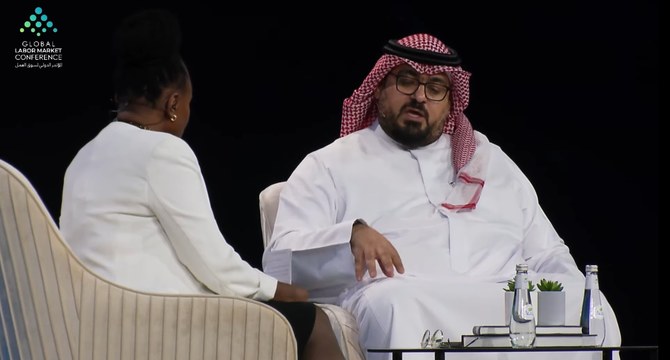
Saudi Minister of Economy and Planning Faisal bin Fadel Al-Ibrahim speaks at the Global Labor Market Conference in Riyadh on Wednesday. AN photo
Short Url
Updated 14 December 2023
Follow

Saudi Arabia’s vision is to become a magnet for global talent, says minister 

RIYADH: Saudi Arabia should not only serve as an engine of advancement but also act as a “magnet for talent to come to the Kingdom,” according to the minister of economy and planning.   

During a fireside chat at the Global Labor Market Conference, Faisal bin Fadel Al-Ibrahim noted that Saudis aspire to work alongside the best talent globally, aiming for positions where they can learn and make a meaningful impact.  

“For us to achieve our objectives, it needs to be not only an engine of growth of talent but also a magnet for talent to come to the Kingdom, and that’s what the good working obviously,” the minister said. 

He added: “We’re very scientific about which sectors need what kind of talent around the world because we still want to create more and more jobs. But with time, these jobs are going to be more high quality, and there will be room for talents.” 

He also underscored the Kingdom’s ambitions to become a productivity-led economy, which “is truly how we can be sustainable, and that is how we can be more resilient.” 

With the advent of technology and artificial intelligence, Al-Ibrahim highlighted, the primary focus must be on investments and nurturing talent that positions the Kingdom at the forefront of technological transformations. 

“The changes in technology that we’re witnessing today, including artificial intelligence, will almost disrupt every sector. We can be a part of that, let’s say, a group of authors who will define what this looks like, or we can be one of the first early adopters who can benefit from these changes,” said the minister. 

For instance, the Kingdom’s growing industrial complex aims to enhance global competitiveness by upgrading facilities Industry 4.0 lighthouses, as it “could give us an opportunity to shorten that training period and push people toward these high-quality, highly skilled jobs,” he explained. 

Al-Ibrahim further explained the need to create appropriate spaces, which are well served through the several economic zones and logistics parks that Saudi Arabia has announced, and the Kingdom plans to transform them into cohesive industry clusters. 

The minister explained that the clustering effect is essential, where people focus on solving the same problem or live, work and engage together in the same fields. 

He also pointed out the necessity to place big bets. 

“One big bet we have, we call this, the biggest drive productivity attempt like NEOM and the Line. The Line is attracting the best innovators and problem solvers from around the world to define what the future looks like,” Al-Ibrahim said. 


Saudi Arabia, Japan trade rises 38% between 2016 and 2024, minister says

Updated 11 January 2026
Follow

Saudi Arabia, Japan trade rises 38% between 2016 and 2024, minister says

RIYADH: Trade between Saudi Arabia and Japan has increased by 38 percent between 2016 and 2024 to reach SR138 billion ($36 billion), the Kingdom’s investment minister revealed.

Speaking at the Saudi-Japanese Ministerial Investment Forum 2026, Khalid Al-Falih explained that this makes the Asian country the Kingdom’s third-largest trading partner, according to Asharq Bloomberg.

This falls in line with the fact that Saudi Arabia has been a very important country for Japan from the viewpoint of its energy security, having been a stable supplier of crude oil for many years.

It also aligns well with how Japan is fully committed to supporting Vision 2030 by sharing its knowledge and advanced technologies.

“This trade is dominated by the Kingdom's exports of energy products, specifically oil, gas, and their derivatives. We certainly look forward to the Saudi private sector increasing trade with Japan, particularly in high-tech Japanese products,” Al-Falih said.

He added: “As for investment, Japanese investment in the Kingdom is good and strong, but we look forward to raising the level of Japanese investments in the Kingdom. Today, the Kingdom offers promising opportunities for Japanese companies in several fields, including the traditional sector that links the two economies: energy.”

The minister went on to note that additional sectors that both countries can also collaborate in include green and blue hydrogen, investments in advanced industries, health, food security, innovation, entrepreneurship, among others.

During his speech, Al-Falih shed light on how the Kingdom’s pavilion at Expo 2025 in Osaka achieved remarkable success, with the exhibition receiving more than 3 million visitors, reflecting the Japanese public’s interest in Saudi Arabia.

“The pavilion also organized approximately 700 new business events, several each day, including 88 major investment events led by the Ministry of Investment. Today, as we prepare for the upcoming Expo 2030, we look forward to building upon Japan’s achievements,” he said.

The minister added: “During our visit to Japan, we agreed to establish a partnership to transfer the remarkable Japanese experience from Expo Osaka 2025 to Expo Riyadh 2030. I am certain that the Japanese pavilion at Expo Riyadh will rival the Saudi pavilion at Expo Osaka in terms of organization, innovation, and visitor turnout.”

Al-Falih also shed light on how Saudi-Japanese relations celebrated their 70th anniversary last year, and today marks the 71st year of these relations as well as how they have flourished over the decades, moving from one strategic level to an even higher one.