‘Absolutely no dialogue’: Islamabad denies reports of talks with Pakistan Taliban

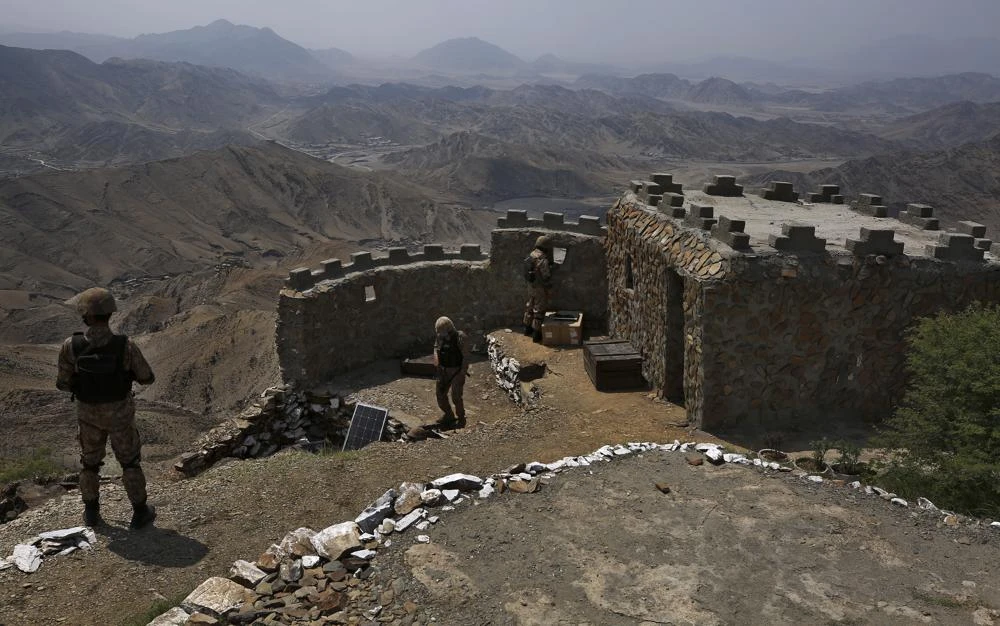
Army soldiers carry the casket of their comrade who was killed in Tuesday's suicide bombing, at a funeral prayer in Chitta Batta village near Mansehra, Pakistan, Wednesday, Dec. 13, 2023. (AP)
Short Url
Updated 15 February 2024
Follow

‘Absolutely no dialogue’: Islamabad denies reports of talks with Pakistan Taliban

  • Foreign office urges Afghan government to take action against perpetrators of Dec. 12 attack in which 23 Pakistani soldiers killed
  • Islamabad has accused Kabul of not acting against militants using Afghanistan to attack Pakistan, Afghan Taliban deny this

ISLAMABAD: Pakistan’s foreign office on Thursday “strongly” denied reports of talks with the Tehrik-e Taliban Pakistan (TTP), saying “absolutely no dialogue” was taking place with the militant organization responsible for a series of recent high-profile attacks in the South Asian nation.

The FO statement came in response to media reports that Islamabad was holding negotiations with the TTP, or Pakistan Taliban, which were being mediated by the Afghan Taliban government in Kabul.

“Pakistan strongly denies such reports or speculation of any talks which are claimed to be taking place between Pakistan and the TTP,” Foreign Office Spokesperson Mumtaz Zahra Baloch told reporters in a weekly media briefing.

“There is absolutely no dialogue taking place.”

She reiterated the demand that the interim Afghan government take “strong action” against TTP and other militants that Islamabad believes are using Afghan soil to launch attacks in Pakistan, particularly against perpetrators of an assault this week in which 23 soldiers were killed in the country’s northwest on Tuesday. Kabul says it does not harbor militants.

The attack occurred in the remote district of Dera Ismail Khan on the edge of tribal regions bordering Afghanistan, the army said in a statement, adding that all six attackers who drove an explosive-laden truck into a military camp were killed in an ensuing battle.

In a statement, the Tahreek-e-Jihad Pakistan (TJP), believed to be an offshoot of the TTP and which has emerged recently and claimed several big bombings in recent months, said its militants carried out the attack to target the Pakistani army.

Pakistan has already issued a demarche to the Afghan interim government over Tuesday’s assault.

“Afghanistan must take strong action against perpetrators of this heinous attack and hand them over to Pakistan, along with the TTP leadership in Afghanistan,” the spokesperson said, adding that Pakistan had acknowledged the statement by the Afghan interim government that it would investigate the Dec. 12 assault.

“We also expect Afghanistan to take concrete and verifiable steps to prevent the use of Afghan soil by terrorist entities against Pakistan.”

Baloch said the United Nations Security Council (UNSC) had also condemned the attack and underlined the need to hold perpetrators, organizers, financiers, and sponsors accountable and bring them to justice.

“They [members of the UNSC] have also urged all states to cooperate actively with the government of Pakistan, as well as all relevant authorities in this regard,” she added.

Pakistan has witnessed a surge in militant attacks in its northwestern and southwestern regions that border Afghanistan since the TTP called off its fragile truce with the government in Islamabad in November 2022.

The attacks prompted Islamabad in October to order the expulsion of all illegal foreigners, mostly Afghans, which was followed by a crackdown against them across the country.

Hundreds of thousands of Afghans, many of whom had been living in Pakistan for decades, have since left the country. 

In a strongly worded press conference last month, Prime Minister Anwaar-ul-Haq Kakar said Pakistan’s move to expel Afghans was a response to the unwillingness of the Taliban-led administration to act against militants using Afghanistan to carry out attacks in Pakistan.

The Pakistan army chief has also endorsed the deportation policy, citing security concerns and drains to the economy from the almost 3.7 million Afghans that have been living in Pakistan for decades. 

Pakistan, global crypto exchange discuss modernizing digital payments, creating job prospects 

Updated 05 December 2025
Follow

Pakistan, global crypto exchange discuss modernizing digital payments, creating job prospects 

  • Pakistani officials, Binance team discuss coordination between Islamabad, local banks and global exchanges
  • Pakistan has attempted to tap into growing crypto market to curb illicit transactions, improve oversight

ISLAMABAD: Pakistan’s finance officials and the team of a global cryptocurrency exchange on Friday held discussions aimed at modernizing the country’s digital payments system and building local talent pipelines to meet rising demand for blockchain and Web3 skills, the finance ministry said.

The development took place during a high-level meeting between Finance Minister Muhammad Aurangzeb, Pakistan Virtual Assets Regulatory Authority (PVARA) Chairman Bilal bin Saqib, domestic bank presidents and a Binance team led by Global CEO Richard Teng. The meeting was held to advance work on Pakistan’s National Digital Asset Framework, a regulatory setup to govern Pakistan’s digital assets.

Pakistan has been moving to regulate its fast-growing crypto and digital assets market by bringing virtual asset service providers (VASPs) under a formal licensing regime. Officials say the push is aimed at curbing illicit transactions, improving oversight, and encouraging innovation in blockchain-based financial services.

“Participants reviewed opportunities to modernize Pakistan’s digital payments landscape, noting that blockchain-based systems could significantly reduce costs from the country’s $38 billion annual remittance flows,” the finance ministry said in a statement. 

“Discussions also emphasized building local talent pipelines to meet rising global demand for blockchain and Web3 skills, creating high-value employment prospects for Pakistani youth.”

Blockchain is a type of digital database that is shared, transparent and tamper-resistant. Instead of being stored on one computer, the data is kept on a distributed network of computers, making it very hard to alter or hack.

Web3 refers to the next generation of the Internet built using blockchain, focusing on giving users more control over their data, identity and digital assets rather than big tech companies controlling it.

Participants of the meeting also discussed sovereign debt tokenization, which is the process of converting a country’s debt such as government bonds, into digital tokens on a blockchain, the ministry said. 

Aurangzeb called for close coordination between the government, domestic banks and global exchanges to modernize Pakistan’s payment landscape.

Participants of the meeting also discussed considering a “time-bound amnesty” to encourage users to move assets onto regulated platforms, stressing the need for stronger verifications and a risk-mitigation system.

Pakistan has attempted in recent months to tap into the country’s growing crypto market, crack down on money laundering and terror financing, and promote responsible innovation — a move analysts say could bring an estimated $25 billion in virtual assets into the tax net.

In September, Islamabad invited international crypto exchanges and other VASPs to apply for licenses to operate in the country, a step aimed at formalizing and regulating its fast-growing digital market.