JERUSALEM: Almost three in four Palestinians believe the Oct. 7 attack by Hamas on Israel was correct, and the ensuing Gaza war has lifted support for the Islamist group both there and in the West Bank, a survey from a respected Palestinian polling institute found.
The Palestinian Center for Policy Survey and Research (PCPSR) findings were published as international alarm grows over the spiralling Palestinian civilian toll in the Israeli counter-offensive against Hamas, now in its third month.
Seventy-two percent of respondents said they believed the Hamas decision to launch the cross-border rampage in southern Israel was “correct” given its outcome so far, while 22 percent said it was “incorrect.” The remainder were undecided or gave no answer.
Hamas, which is sworn to Israel’s destruction, has ruled Gaza since splitting with the Palestinian Authority (PA) in 2007. The PA exercises limited governance in the West Bank.
The PCPSR found that, compared to pre-war polling, support for Hamas had risen in Gaza and more than tripled in the West Bank, which has seen the highest levels in violence in years, with repeated deadly clashes between Israeli troops and settlers and Palestinians.
Fifty-two percent of Gazans and 85 percent of West Bank respondents — or 72 percent of Palestinian respondents overall — voiced satisfaction with the role of Hamas in the war. Only 11 percent of Palestinian voiced satisfaction with PA President Mahmoud Abbas.
Abbas has seen his popularity plummet amid an almost decade-long impasse in US-sponsored negotiations on the creation of a Palestinian state alongside Israel.
Oct. 7 was the deadliest day for Israel in its 75 year history, with around 1,200 people killed and some 240 seized and taken as hostages into Gaza, according to Israeli tallies.
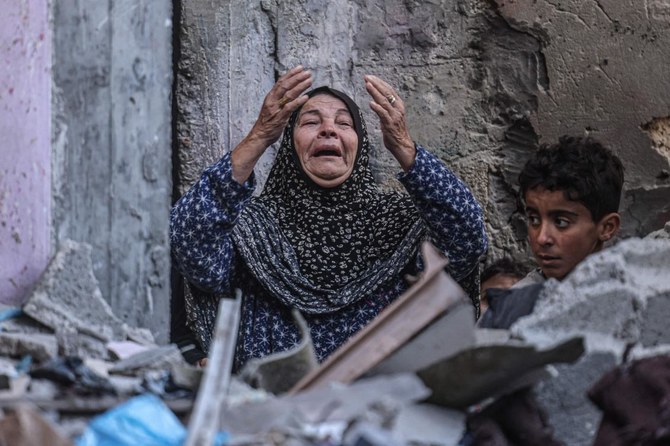
At least 18,608 Palestinians, including thousands under 18, have been killed in the Gaza war, according to the enclave’s health ministry. The majority of Gaza’s 2.3 million residents have been displaced by widespread Israeli strikes.
The PCPSR poll found that 44 percent of Gazans say they have enough food and water for a day or two, and 56 percent say that they do not. Almost two-thirds of Gazan respondents — 64 percent — said a member of their family had been killed or injured in the war.


![]()


Poll shows Palestinians back Oct. 7 attack on Israel, support for Hamas rises
Short Url
https://arab.news/9mkrf
Poll shows Palestinians back Oct. 7 attack on Israel, support for Hamas rises
- 72 percent of Palestinian respondents overall voiced satisfaction with the role of Hamas in the war
- At least 18,608 Palestinians, including thousands under 18, have been killed in the Gaza war


More than 30,000 displaced in Lebanon by Middle East war: UN
"As of Monday, more than 31,000 people were being hosted and registered at collective shelters" in Lebanon, Baloch said
Many more "slept in their cars on the side of roads, or were still stuck in traffic jams on the roads leaving the south of Beirut"
GENEVA: More than 30,000 people have been forced to flee their homes in Lebanon by the escalation of hostilities in the Middle East, the United Nations said Tuesday.
Israel is continuing to carry out air raids in Lebanon in a campaign against Iran-backed militant group Hezbollah, particularly on the southern suburbs of the capital Beirut and the south of the country, after issuing evacuation warnings to residents.
"As of Monday, more than 31,000 people were being hosted and registered at collective shelters" in Lebanon, Babar Baloch, spokesman for the UN refugee agency, UNHCR, told AFP.
At a press conference in Geneva, he said many more "slept in their cars on the side of roads, or were still stuck in traffic jams on the roads leaving the south of Beirut".
Baloch said others were attempting to leave on foot with limited belongings, seeking safety in other areas as the war triggered by the US-Israeli strikes on Iran engulfs the region.
"Heavy displacement is being reported across parts of southern Lebanon, the Bekaa and southern suburbs of Beirut, after Israel issued evacuation warnings to the residents of more than 53 Lebanese villages, and intense air strikes across all three parts of Lebanon," he said.
Baloch said that on the Lebanon-Syrian border, UNHCR had noticed an increase in regular movements, with a few hundred more Syrian refugees crossing back into Syria.
"We have a contingency plan for any possible influx from Lebanon in case things develop," he said.
- 'Nowhere else to turn' -
Hezbollah on Tuesday said it had targeted three Israeli military bases in response to Israeli strikes on the group's strongholds in Lebanon, including the south Beirut suburbs.
UN rights office spokeswoman Ravina Shamdasani voiced grave concern at the escalation of hostilities in Lebanon.
She cited reports of civilian casualties and damage to civilian infrastructure, plus significant re-displacement in southern Lebanon.
"We urge both parties to immediately end this major escalation in violence and to return to the agreed ceasefire," she said.
The UN's World Food Programme said it had already begun distributing meals to people uprooted by the conflict.
"Within hours of shelters opening in Lebanon, WFP was on the ground -- providing hot meals, ready-to-eat rations, and bread to families who had nowhere else to turn," the agency's Middle East regional director Samer Abdeljaber said.
Speaking from Cairo, he said the WFP expected the number of people forced from their homes to climb "much higher".
The agency is working with the Lebanese government to get an emergency cash safety net up and running for 100,000 people, if the situation deteriorates further.
Abdeljaber said the conflict's impact on shipping and air transport were piling pressure on humanitarian supply chains.
With airspace and shipping routes choked, WFP is trying to switch to overland corridors from Turkey, Egypt, Jordan, Pakistan and the United Arab Emirates.
Many more "slept in their cars on the side of roads, or were still stuck in traffic jams on the roads leaving the south of Beirut"
GENEVA: More than 30,000 people have been forced to flee their homes in Lebanon by the escalation of hostilities in the Middle East, the United Nations said Tuesday.
Israel is continuing to carry out air raids in Lebanon in a campaign against Iran-backed militant group Hezbollah, particularly on the southern suburbs of the capital Beirut and the south of the country, after issuing evacuation warnings to residents.
"As of Monday, more than 31,000 people were being hosted and registered at collective shelters" in Lebanon, Babar Baloch, spokesman for the UN refugee agency, UNHCR, told AFP.
At a press conference in Geneva, he said many more "slept in their cars on the side of roads, or were still stuck in traffic jams on the roads leaving the south of Beirut".
Baloch said others were attempting to leave on foot with limited belongings, seeking safety in other areas as the war triggered by the US-Israeli strikes on Iran engulfs the region.
"Heavy displacement is being reported across parts of southern Lebanon, the Bekaa and southern suburbs of Beirut, after Israel issued evacuation warnings to the residents of more than 53 Lebanese villages, and intense air strikes across all three parts of Lebanon," he said.
Baloch said that on the Lebanon-Syrian border, UNHCR had noticed an increase in regular movements, with a few hundred more Syrian refugees crossing back into Syria.
"We have a contingency plan for any possible influx from Lebanon in case things develop," he said.
- 'Nowhere else to turn' -
Hezbollah on Tuesday said it had targeted three Israeli military bases in response to Israeli strikes on the group's strongholds in Lebanon, including the south Beirut suburbs.
UN rights office spokeswoman Ravina Shamdasani voiced grave concern at the escalation of hostilities in Lebanon.
She cited reports of civilian casualties and damage to civilian infrastructure, plus significant re-displacement in southern Lebanon.
"We urge both parties to immediately end this major escalation in violence and to return to the agreed ceasefire," she said.
The UN's World Food Programme said it had already begun distributing meals to people uprooted by the conflict.
"Within hours of shelters opening in Lebanon, WFP was on the ground -- providing hot meals, ready-to-eat rations, and bread to families who had nowhere else to turn," the agency's Middle East regional director Samer Abdeljaber said.
Speaking from Cairo, he said the WFP expected the number of people forced from their homes to climb "much higher".
The agency is working with the Lebanese government to get an emergency cash safety net up and running for 100,000 people, if the situation deteriorates further.
Abdeljaber said the conflict's impact on shipping and air transport were piling pressure on humanitarian supply chains.
With airspace and shipping routes choked, WFP is trying to switch to overland corridors from Turkey, Egypt, Jordan, Pakistan and the United Arab Emirates.
Latest updates


© 2026 SAUDI RESEARCH & PUBLISHING COMPANY, All Rights Reserved And subject to Terms of Use Agreement.