

Bollywood star or deepfake? AI floods social media in Asia 

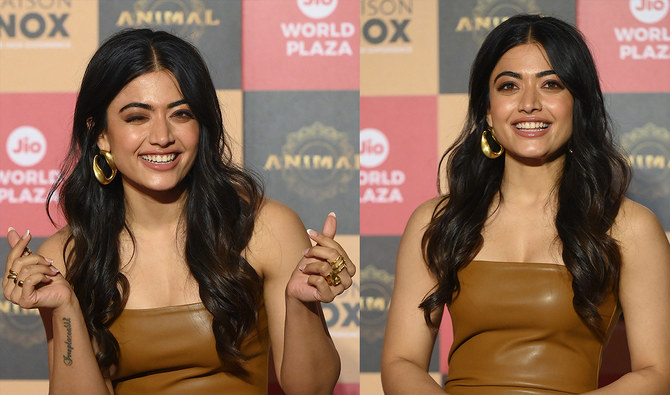
Bollywood actress Rashmika Mandanna poses for a photograph during the promotion of her film 'Animal' in Mumbai on November 30, 2023. (AFP/File)
Short Url
Updated 14 December 2023
Follow

Bollywood star or deepfake? AI floods social media in Asia 

  • Among those targeted with deepfakes are Bollywood actors like Katrina Kaif, Alia Bhatt and Deepika Padukone 
  • 18-year-old Pakistani woman allegedly shot dead by family last month after doctored photo of her with a man went viral

There was the Bollywood star in skin-tight lycra, the Bangladeshi politician filmed in a bikini and the young Pakistani woman snapped with a man. 

None was real, but all three images were credible enough to unleash lust, vitriol — and even allegedly a murder, underlining the sophistication of generative artificial intelligence, and the threats it poses to women across Asia. 

The two videos and the photo were deepfake, and went viral in a vibrant social mediascape that is struggling to come to grips with the technology that has the power to create convincing copies that can upend real lives. 

“We need to address this as a community and with urgency before more of us are affected by such identity theft,” Indian actor Rashmika Mandanna said in a post on X, formerly Twitter, that has garnered more than 6.2 million views. 

She is not the only Bollywood star to be cloned and attacked on social media, with top actors including Katrina Kaif, Alia Bhatt and Deepika Padukone also targeted with deepfakes. 

The lycra video, said Mandanna, was “extremely scary not only for me, but also for each one of us who today is vulnerable to so much harm because of how technology is being misused.” 

While digitally manipulated images and videos of women were once easy to spot, usually lurking in the dark corners of the Internet, the explosion in generative AI tools such as Midjourney, Stable Diffusion and DALL-E has made it easy and cheap to create and circulate convincing deepfakes. 

More than 90 percent of deepfake videos online are pornographic, according to tech experts, and most are of women. 

While there are no separate data for South Asian countries, digital rights experts say the issue is particularly challenging in conservative societies, where women have long been harassed online and abuse has gone largely unpunished. 

Social media firms are struggling to keep up. 

Google’s YouTube and Meta Platforms — which owns Facebook, Instagram and WhatsApp — have updated their policies, requiring creators and advertisers to label all AI-generated content. 

But the onus is largely on victims — usually girls and women — to take action, said Rumman Chowdhury, an AI expert at Harvard University who previously worked at reducing harms on Twitter. 

“Generative AI will regrettably supercharge online harassment and malicious content ... and women are the canaries in the coal mine. They are the ones impacted first, the ones on whom the technologies are tested,” she said. 

“It is an indication to the rest of the world to pay attention, because it’s coming for everyone,” Chowdhury told a recent United Nations briefing. 

DEEPFAKES AND THE LAW 

As deepfakes have proliferated worldwide, there are growing concerns — and rising instances — of their use in harassment, scams and sextortion. 

Regulations have been slow to follow. 

The US Executive Order on AI touches on dangers posed by deepfakes, while the European Union’s proposed AI Act will require greater transparency and disclosure from providers. 

Last month, 18 countries — including the United States and Britain — unveiled a non-binding agreement on keeping the wider public safe from AI misuse, including deepfakes. 

Among Asian nations, China requires providers to use watermarks and report illegal deepfakes, while South Korea has made it illegal to distribute deepfakes that harm “public interest,” with potential imprisonment or fines. 

India is taking a tough stance as it drafts new rules. 

IT Minister Ashwini Vaishnaw has said social media firms must remove deepfakes within 36 hours of receiving a notification, or risk losing their safe-harbor status that protects them from liability for third-party content. 

But the focus should be on “mitigating and preventing incidents, rather than reactive responses,” said Malavika Rajkumar at the advocacy group IT for Change. 

While the Indian government has indicated it may force providers and platforms to disclose the identity of deepfake creators, “striking a balance between privacy protection and preventing abuse is key,” Rajkumar added. 

WOMEN TARGETED 

Deepfakes of women and other vulnerable communities such as LGBTQ+ people — especially sexual images and videos — can be particularly dangerous in deeply religious or conservative societies, human rights activists say. 

In Bangladesh, deepfake videos of female opposition politicians — Rumin Farhana in a bikini and Nipun Roy in a swimming pool — have emerged ahead of an election on Jan. 7. 

And last month, an 18-year-old woman was allegedly shot dead by her father and uncle in a so-called honor killing in Pakistan’s remote Kohistan province, after a photograph of her with a man went viral. Police say the image was doctored. 

Shahzadi Rai, a transgender member of Pakistan’s Karachi Municipal Council, who has been the target of abusive trolling with deepfake images, has said they could exacerbate online gender-based violence and “seriously jeopardize” her career. 

Even if audiences are able to distinguish between a real image and a deepfake, the woman’s integrity is questioned, and her credibility may be damaged, said Nighat Dad, founder of the non-profit Digital Rights Foundation in Pakistan. 

“The threat to women’s privacy and safety is deeply concerning,” she said, particularly as disinformation campaigns gain steam ahead of an election scheduled for Feb. 8. 

“Deepfakes are creating an increasingly unsafe online environment for women, even non-public figures, and may discourage women from participating in politics and online spaces,” she said. 

In several countries including India, entrenched gender biases already affect the ability of girls and young women to use the Internet, a recent report found. 

Deepfakes of powerful Bollywood stars only underline the risk that AI poses to all women, said Rajkumar. 

“Deepfakes have affected women and vulnerable communities for a long time; they have gained widespread attention only after popular actresses were targeted,” she said. 

The heightened focus now should push “platforms, policymakers, and society at large to create a safer and more inclusive online environment,” she added. 


Biden, Obama, GW Bush and Clinton assigned unflattering descriptions on Trump’s Presidential Walk of Fame

Updated 21 min 59 sec ago
Follow

Biden, Obama, GW Bush and Clinton assigned unflattering descriptions on Trump’s Presidential Walk of Fame

  • Two plaques are reserved for Trump's two presidency, each is full of praise and superlatives,  and concludes with “THE BEST IS YET TO COME”
  • Those not to Trump's liking have unflattering descriptions, with Joe Biden introduced as “Sleepy Joe” and “by far, the worst President in American History"

WASHINGTON: President Donald Trump has affixed partisan plaques to the portraits of all US commanders in chief, himself included, on his Presidential Walk of Fame at the White House, describing Joe Biden as “sleepy,” Barack Obama as “divisive” and Ronald Reagan as a fan of a young Trump.
The additions, first seen publicly Wednesday, mark Trump’s latest effort to remake the White House in his own image, while flouting the protocols of how presidents treat their predecessors and doubling down on his determination to reshape how US history is told.
“The plaques are eloquently written descriptions of each President and the legacy they left behind,” White House press secretary Karoline Leavitt said in a statement describing the installation in the colonnade that runs from the West Wing to the residence. “As a student of history, many were written directly by the President himself.”
Indeed, the Trumpian flourishes include the president’s typical bombastic language and haphazard capitalization. They also highlight Trump’s fraught relationships with his more recent predecessors.
An introductory plaque tells passersby that the exhibit was “conceived, built, and dedicated by President Donald J. Trump as a tribute to past Presidents, good, bad, and somewhere in the middle.”
Besides the Walk of Fame and its new plaques, Trump has adorned the Oval Office in gold and razed the East Wing in preparation for a massive ballroom. Separately, his administration has pushed for an examination of how Smithsonian exhibits present the nation’s history, and he is playing a strong hand in how the federal government will recognize the nation’s 250th anniversary in 2026.
Here’s a look at how Trump’s colonnade exhibit tells the presidential story.
Joe Biden
Joe Biden is still the only president in the display not to be recognized with a gilded portrait. Instead, Trump chose an autopen, reflecting his mockery of Biden’s age and assertions that Biden was not up to the job.
Biden, who defeated Trump in the 2020 election and dropped out of the 2024 election before their pending rematch, is introduced as “Sleepy Joe” and “by far, the worst President in American History” who “brought our Nation to the brink of destruction.”
Two plaques blast Biden for inflation and his energy and immigration policy, among other things. The text also blames Biden for Russian President Vladimir Putin’s invasion of Ukraine and asserts falsely that Biden was elected fraudulently.
Biden’s post-White House office had no comment on his plaque.
Barack Obama
The 44th president is described as “a community organizer, one term Senator from Illinois, and one of the most divisive political figures in American History.”
The plaque calls Obama’s signature domestic achievement “the highly ineffective ‘Unaffordable Care Act.”
And it notes that Trump nixed other major Obama achievements: “the terrible Iran Nuclear Deal ... and ”the one-side Paris Climate Accords.”
An aide to Obama also declined comment.
George W. Bush
George W. Bush, who notably did not speak to Trump when they were last together at former President Jimmy Carter’s funeral, appears to win approval for creating the Department of Homeland Security and leading the nation after the terrorist attacks of Sept. 11, 2001.
But the plaque decries that Bush “started wars in Afghanistan and Iraq, both of which should not have happened.”
An aide to Bush didn’t return a message seeking comment.
Bill Clinton
The 42nd president, once a friend of Trump’s, gets faint praise for major crime legislation, an overhaul of the social safety net and balanced budgets.
But his plaque notes Clinton secured those achievements with a Republican Congress, the help of the 1990s “tech boom” and “despite the scandals that plagued his Presidency.”
Clinton’s recognition describes the North American Free Trade Agreement, another of his major achievements, as “bad for the United States” and something Trump would “terminate” during his first presidency. (Trump actually renegotiated some terms with Mexico and Canada but did not scrap the fundamental deal.)
His plaque ends with the line: “In 2016, President Clinton’s wife, Hillary, lost the Presidency to President Donald J. Trump!”
An aide to Clinton did not return a message seeking comment.
Other notable plaques
The broadsides dissipate the further back into history the plaques go.
Republican George H.W. Bush, who died during Trump’s first term, is recognized for his lengthy resume before becoming president, along with legislation including the Clean Air Act and Americans With Disabilities Act — despite Trump’s administration relaxing enforcement of both. The elder Bush’s plaque does not note that he, not Clinton, first pushed the major trade law that became NAFTA.
Lyndon Johnson’s plaque credits the Texas Democrat for securing the Civil Rights Act of 1964 and Voting Rights Act of 1965 (seminal laws that Trump’s administration interprets differently than previous administrations). It correctly notes that discontent over Vietnam led to LBJ not seeking reelection in 1968.
Democrat John F. Kennedy, the uncle of Trump’s health secretary, Robert F. Kennedy Jr., is credited as a World War II “war hero” who later used “stirring rhetoric” as president in opposition to communism.
Republican Richard Nixon’s plaque states plainly that the Watergate scandal led to his resignation.
While Trump spared most deceased presidents of harsh criticism, he jabbed at one of his regular targets, the media — this time across multiple centuries: Andrew Jackson’s plaque says the seventh president was “unjustifiably treated unfairly by the Press, but not as viciously and unfairly as President Abraham Lincoln and President Donald J. Trump would, in the future, be.”
Donald Trump
With two presidencies, Trump gets two displays. Each is full of praise and superlatives — “the Greatest Economy in the History of the World.” He calls his 2016 Electoral College margin of 304-227 a “landslide.”
Trump’s second-term plaque notes his popular vote victory — something he did not achieve in 2016 — and concludes with “THE BEST IS YET TO COME.”
Meanwhile, the introductory plaque presumes Trump’s addition will be a White House fixture once he is no longer president: “The Presidential Walk of Fame will long live as a testament and tribute to the Greatness of America.”