Gaza faces public health disaster, UN humanitarian office says

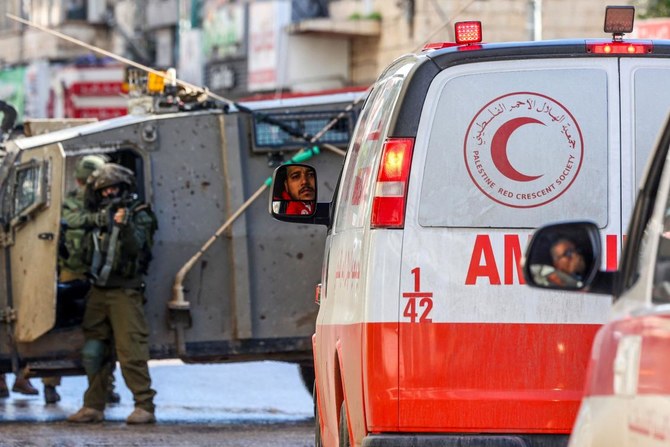
An Israeli soldier aims his weapon as Palestinian Red Crescent ambulances wait on December 13, 2023. (AFP)
Short Url
Updated 13 December 2023
Follow

Gaza faces public health disaster, UN humanitarian office says

  • Israel's forced displacement of 85 percent of Gaza population has caused overcrowding in shelters and other temporary living facilities

GENEVA: The UN humanitarian office said on Wednesday that Gaza faced a public health disaster due to the collapse of its health system and the spread of disease amid an offensive by Israel that has hit hospitals and displaced hundreds of thousands of people.
The United Nations and aid groups have sounded the alarm about the spread of infectious disease in Gaza, where the internal displacement of 85 percent of the population has caused overcrowding in shelters and other temporary living facilities.
Israel, which went to war in Gaza after the Palestinian enclave’s ruling Hamas militants launched a devastating attack on its southern communities on Oct. 7, has told civilians to flee battle zones and says it seeks avert humanitarian distress.
“We all know that the health care system is or has collapsed,” said Lynn Hastings, the UN Humanitarian Coordinator for the Occupied Palestinian Territory.
“We’ve got a textbook formula for epidemics and a public health disaster.”
WHO has reported a sharp rise in acute respiratory infections, diarrhea, lice, scabies and other fast-spreading diseases.
Hastings said people in Gaza had to line up for hours just to access a toilet.
“You can imagine what the sanitation conditions are like,” she said.
WHO said on Tuesday that only 11 of Gaza’s 36 hospitals were partially functional, one in the north and 10 in the south of the enclave.
In Jerusalem, a senior Israeli lawmaker from Prime Minister Benjamin Netanyahu’s Likud party, said field hospitals had been erected within Gaza by the United Arab Emirates and Jordan.
“We offered every possible help (and) we are prepared to do more,” Yuli Edelstein, chairman of the Israeli parliament’s Foreign Affairs and Defense Committee, told Reuters.
“But one thing has to be clear. There is overlapping between medical system and hospitals and Hamas terrorist activities,” he said, reiterating Israeli allegations — denied by Hamas — that the Palestinian militants have been operating within hospitals.
“So this is not something that we will tolerate.”
Hasting said that almost half of Gaza’s population of 2.3 million was now in Rafah in the southern tip of the enclave to escape Israeli bombardment.
“This is leading to nothing but a health crisis,” she said. (Reporting by Gabrielle Tétrault-Farber, Editing by Kirsti Knolle and Angus MacSwan)


Baghdad says it will prosecute Daesh militants being moved from Syria to Iraq

Updated 6 sec ago
Follow

Baghdad says it will prosecute Daesh militants being moved from Syria to Iraq

  • The US military started the transfer process on Friday with the first Daesh prisoners moved from Syria to Iraq

BAGHDAD: Baghdad will prosecute and try militants from the Daesh group who are being transferred from prisons and detention camps in neighboring Syria to Iraq under a US-brokered deal, Iraq said Sunday.
The announcement from Iraq’s highest judicial body came after a meeting of top security and political officials who discussed the ongoing transfer of some 9,000 IS detainees who have been held in Syria since the militant group’s collapse there in 2019.
The need to move them came after Syria’s nascent government forces last month routed Syrian Kurdish-led fighters — once top US allies in the fight against Daesh — from areas of northeastern Syria they had controlled for years and where they had been guarding camps holding Daesh prisoners.
Syrian troops seized the sprawling Al-Hol camp — housing thousands, mostly families of Daesh militants — from the Kurdish-led force, which withdrew as part of a ceasefire. Troops last Monday also took control of a prison in the northeastern town of Shaddadeh, from where some Daesh detainees had escaped during the fighting. Syrian state media later reported that many were recaptured.
Now, the clashes between the Syrian military and the Kurdish-led Syrian Democratic Forces, or SDF, sparked fears of Daesh activating its sleeper cells in those areas and of Daesh detainees escaping. The Syrian government under its initial agreement with the Kurds said it would take responsibility of the Daesh prisoners.
Baghdad has been particularly worried that escaped Daesh detainees would regroup and threaten Iraq’s security and its side of the vast Syria-Iraq border.
Once in Iraq, Daesh prisoners accused of terrorism will be investigated by security forces and tried in domestic courts, Iraq’s Supreme Judicial Council said.
The US military started the transfer process on Friday with the first Daesh prisoners moved from Syria to Iraq. On Sunday, another 125 Daesh prisoners were transferred, according to two Iraqi security officials who spoke to The Associated Press on condition of anonymity in line with regulations.
So far, 275 prisoners have made it to Iraq, a process that officials say has been slow as the US military has been transporting them by air.
Both Damascus and Washington have welcomed Baghdad’s offer to have the prisoners transferred to Iraq.
Iraq’s parliament will meet later on Sunday to discuss the ongoing developments in Syria, where its government forces are pushing to boost their presence along the border.
The fighting between the Syrian government and the SDF has mostly halted with a ceasefire that was recently extended. According to Syria’s Defense Ministry, the truce was extended to support the ongoing transfer operation by US forces.
The Daesh group was defeated in Iraq in 2017, and in Syria two years later, but Daesh sleeper cells still carry out deadly attacks in both countries. As a key US ally in the region, the SDF played a major role in defeating Daesh.
During the battles against Daesh, thousands of extremists and tens of thousands of women and children linked to them were taken and held in prisons and at the Al-Hol camp. The sprawling Al-Hol camp hosts thousands of women and children.
Last year, US troops and their partner SDF fighters detained more than 300 Daesh militants in Syria and killed over 20. An ambush in December by Daesh militants killed two US soldiers and one American civilian interpreter in Syria.