Pakistan top court suspends its own verdict nullifying military trials of civilians

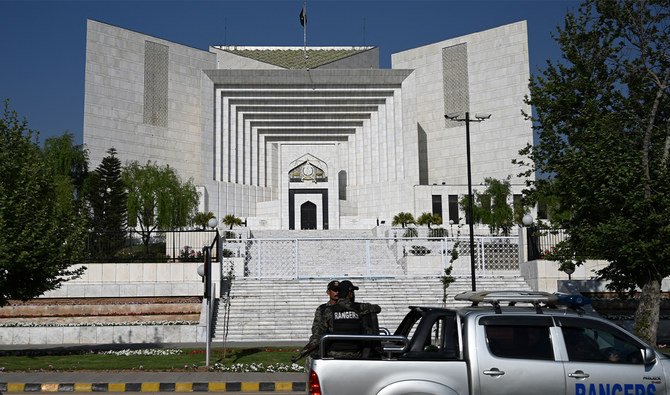
Rangers patrol along a street past Pakistan's Supreme Court in Islamabad on April 5, 2022. (AFP/File)
Short Url
Updated 13 December 2023
Follow

Pakistan top court suspends its own verdict nullifying military trials of civilians

  • Pakistan government, army said this year suspects involved in attacks on army installations would be tried in military courts
  • Supreme Court had ruled on Oct.23 proceedings under Army Act would have no legal effect, ordered trials moved to civilian courts

ISLAMABAD: The Supreme Court on Wednesday suspended its own order from October that had declared null and void the trial of civilians by military courts arrested in the wake of nationwide protests on May 9, allowing the army to resume hearing cases of 103 civilians.

A five-member bench of the Supreme Court had on Oct.23 heard about a dozen petitions challenging the trials of civilians in military courts and declared them unconstitutional, a relief for dozens under arrest for ransacking military installations during protests in May after the brief arrest of former Prime Minister Imran Khan.

The Pakistan government and army subsequently said those who had damaged army properties would be tried in military courts, an announcement that unleashed widespread criticism from within Pakistan and rights organizations globally because of the courts’ secretive nature and existence alongside a functioning civilian legal system.

An intra-court appeal was filed against the Oct. 23 ruling by the caretaker federal government, the ministries of defense and interior, and the interim governments in the provinces of Punjab, Khyber Pakhtunkhwa and Balochistan.

“103 people have been in custody for seven months, it would be appropriate to complete their trial,” Defense Ministry’s lawyer Khawaja Haris said during arguments.

The court subsequently ruled that military courts could resume trials of 103 civilians and adjourned the hearing until the third week of January.

Pakistan’s Army Act of 1952 established military courts primarily to try members of the military or enemies of the state. Civilians can only be tried under a federal government order.

Civilians accused of offenses such as waging war against the armed forces or law enforcement agencies, or attacking military installations or inciting mutiny, can be tried at military courts.

Military courts operate under a separate system from the civilian legal system and are run by military officers. The judges are also military personnel and cases are tried at military installations.

Trials are closed to outsiders, and no media presence is allowed.

Anyone tried under the Army Act has the right to defend themselves and a counsel of their choice.

There is no right to appeal but individuals can challenge the question of jurisdiction in high courts and the Supreme Court.

China backs Pakistan in fight against militancy after deadly Balochistan attacks

Updated 03 February 2026
Follow

China backs Pakistan in fight against militancy after deadly Balochistan attacks

  • China is a major ally and investor in Pakistan and has pledged over $65 billion in major infrastructure projects, including in Balochistan
  • Chinese Foreign Ministry spokesperson Lin Jian says ‘we mourn for lives lost, and our hearts go out to injured and those who lost loved ones’

ISLAMABAD: China condemns the recent attacks that killed more than 200 people in Pakistan’s southwestern Balochistan province, a Chinese foreign ministry spokesperson said on Tuesday, reaffirming Beijing’s support for Pakistan in its fight against militancy.

The Baloch Liberation Army (BLA) group launched coordinated attacks in several cities across Balochistan on Saturday, killing 33 civilians and 17 security personnel. Officials said 117 militants were killed in skirmishes and follow-up operations.

Balochistan, which borders Iran and Afghanistan, is the site of a decades-long insurgency waged by Baloch separatist groups who often attack security forces, foreigners and non-local Pakistanis and kidnap government officials.

China is a major ally and investor in Pakistan and has pledged over $65 billion in investment in road, infrastructure and development projects under the China-Pakistan Economic Corridor (CPEC).

“China strongly condemns the [Balochistan] attacks... We mourn for the lives lost, and our hearts go out to the injured and those who lost their loved ones,” Chinese Foreign Ministry spokesperson Lin Jian said at a press briefing on Tuesday.

“China firmly opposes any form of terrorism and will as always firmly support Pakistan in combating terrorism, maintaining solidarity and social stability, and protecting the safety of the people.”

Chinese nationals working in Pakistan have often been targeted by militants, particularly in the southwestern Balochistan province, where China is developing a deep seaport that is touted as the crown jewel of CPEC.

Interior Minister Mohsin Naqvi said last week the attacks, claimed by the separatist Baloch Liberation Army (BLA), were planned from India. New Delhi rejected the allegation as “baseless,” saying Islamabad was attempting to deflect attention from its internal challenges.

Balochistan is home to vast reserves of minerals and hydrocarbons. Separatist militant groups such as the BLA blame Islamabad for exploiting Balochistan’s natural resources and denying locals a share in them. The military and civilian government reject these allegations and say they are investing in the province’s development.