

Ex-PM Khan’s legal team objects to prison trial conduct as cipher case hearing resumes in Rawalpindi

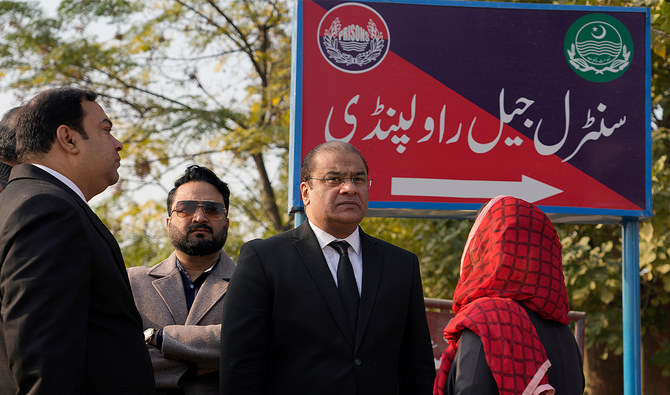
Salman Sardar, center, a lawyer of Pakistan's former Prime Minister Imran Khan's legal team, is pictured as he arrives for a hearing of Cipher case against Khan at Adiala prison, in Rawalpindi, Pakistan, on December 12, 2023. (AP/File)
Short Url
Updated 13 December 2023
Follow

Ex-PM Khan’s legal team objects to prison trial conduct as cipher case hearing resumes in Rawalpindi

  • A spokesperson to former prime minister says media and public are not getting proper access to the trial
  • Naeem Panjutha calls the ongoing proceedings a violation of Islamabad High Court open trial order

RAWALPINDI: Former prime minister Imran Khan’s legal team objected to the conduct of his prison trial on charges of leaking state secrets shortly the resumption of the proceedings on Wednesday which it said violated the Islamabad High Court’s instructions to hold an open trial.

A special court established to hear the case – commonly known as the “cipher reference” – had been conducting the trial inside the Adiala prison in Rawalpindi for weeks without media or members of the public allowed, before the high court ruled the hearings illegal last month and ordered them restarted in an open court.

Khan had already been indicted in the case in October during the now annulled trial but the special court judge announced last week he would be indicted again during the last hearing a day earlier as part of the restarted proceedings.

The special court, however, adjourned the hearing until today without the ex-premier being indicted as was widely expected.

The former prime minister’s spokesperson on legal affairs, Naeem Haider Panjutha, said in a video message the cipher trial could not be described as an open trial. He noted the Islamabad High Court had objected to the way the cipher proceedings were taking place and ordered its resumption from the beginning for the same reason.

However, he pointed out the special court was carrying out the trial in the same manner by only letting its own people and chosen journalists to attend the proceedings even when they were made to sit so far away that they could barely hear anything.

“Is this just a drama that require people to be taken inside [the courtroom],” he asked. “What is the use of sending them in when they cannot even hear what is going on?”

“Can we call it an open trial,” he said. “Open trial means that the public, lawyers, family [of the accused] and journalists can get complete access to the proceedings. In any case, why is this trial being held in jail? If you cannot provide security to one person, how will you provide security to the nation?”

Despite the high court’s orders, only about five journalists were allowed inside on Tuesday while a dozen others waited outside the jail premises. No followers of Khan, arguably the most popular politician in Pakistan and the founder of the Pakistan Tehreek-e-Insaf party, had arrived at the scene, and there was scant police and security presence.


Pakistan, Muslim countries reject Israel’s plan to expel Palestinians from Gaza

Updated 4 sec ago
Follow

Pakistan, Muslim countries reject Israel’s plan to expel Palestinians from Gaza

  • Israel has announced plans to open the Rafah crossing with Egypt for Gaza residents fleeing the enclave
  • Muslim nations seek implementation of Trump’s peace plan, establishment of independent Palestinian state

ISLAMABAD: Pakistan, together with seven other Arab and Muslim countries, on Friday rejected Israel’s attempt to expel Palestinians by opening the Rafah border crossing with Egypt solely for fleeing Gaza residents, and called for adherence to the peace plan proposed by US President Donald Trump’s administration.

Trump’s Gaza plan calls on Israel to allow humanitarian aid into the territory and keep the Rafah crossing open from both sides.

However, Israel has continued to restrict aid flows, and its military said on Wednesday the crossing would open in the coming days “exclusively for the exit of residents from the Gaza Strip to Egypt.”

“The Foreign Ministers of the Islamic Republic of Pakistan, the Arab Republic of Egypt, the Hashemite Kingdom of Jordan, the United Arab Emirates, the Republic of Indonesia, the Republic of Türkiye, the Kingdom of Saudi Arabia, and the State of Qatar express their deep concern regarding the Israeli statements concerning the opening of the Rafah Crossing in one direction, with the aim of transferring residents of the Gaza Strip into the Arab Republic of Egypt,” said the joint statement circulated in Pakistan by the foreign office.

“The Ministers underscore their absolute rejection of any attempts to expel the Palestinian people from their land and stress the necessity of the full adherence to the plan proposed by US President Donald Trump, including its provisions on keeping the Rafah Crossing open in both directions, ensuring the freedom of movement for the population, and refraining from compelling any resident of the Gaza Strip to leave,” it continued.

The statement appreciated the US president’s commitment to establishing peace in the region and emphasized the importance of implementing his plan “without delay or obstruction” to help consolidate regional stability.

“The Ministers underscore the need to fully sustain the ceasefire, alleviate civilian suffering, ensure the unrestricted entry of humanitarian assistance into the Gaza Strip, initiate early recovery and reconstruction efforts, and create the conditions necessary for the Palestinian Authority to resume its responsibilities in the Gaza Strip,” the statement added.

They reaffirmed their countries’ readiness to work with the United States and all concerned regional and international actors to achieve “a just, comprehensive, and sustainable peace in accordance with international legitimacy and the two-state solution,” including the establishment of an independent Palestinian state on the pre-1967 lines with East Jerusalem as its capital.

Pakistan’s foreign office circulated the statement after Deputy Prime Minister Ishaq Dar held a telephone conversation with Saudi Foreign Minister Prince Faisal bin Farhan to discuss regional developments, particularly Gaza.

Dar condemned Israel’s plan to partially reopen the Rafah crossing only for fleeing Gaza residents, calling it a “clear violation” of the region’s peace plan.