

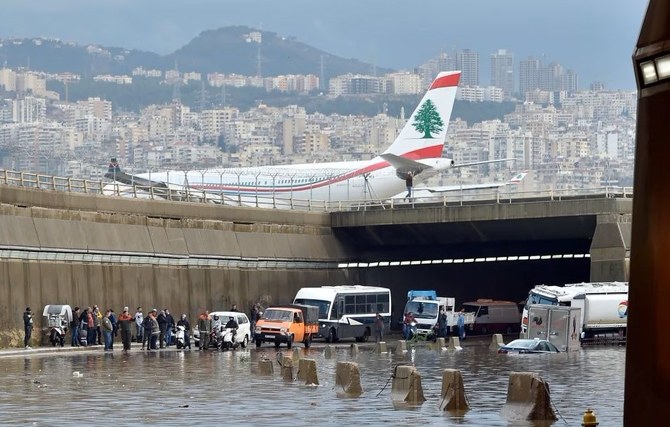
Beirut airport flooded due to heavy rain ahead of holidays
Airport weather station recorded 47 mm of rainfall in 20 minutes, causing water to flow into the premises and surround it from the outside
Social media users shared videos of travelers at the country’s only airport struggling to move between floors and carrying their bags atop their heads
Updated 12 December 2023
NAJIA HOUSSARI
BEIRUT: It only took 20 minutes of rain in Beirut on Tuesday afternoon to flood the Rafic Hariri International Airport with water.
The airport weather station recorded 47 mm of rainfall in 20 minutes, causing water to flow into the premises and surround it from the outside. The surrounding roads and airport parking lot turned into lakes, with the rainwater reaching high enough to submerge car tires and people’s legs up to their knees.
Activists on social media shared videos of travelers at the country’s only airport struggling to move between its floors and carrying their bags atop their heads, as escalators were flooded.
Fadi Al-Hassan, the airport’s director, stated that “work is underway to address the situation.”
A reliable source at the airport told Arab News that “the amount of rain that fell was too much for the drains to handle, coupled with a decline in maintenance work and the accumulation of waste, which led to the disaster that occurred.”
According to the source, the airport’s internal courtyards were flooded, and water seeped into the cafes and duty-free shops. The nearby external car park was also submerged in water.
Activists mocked the situation, saying, “This is Beirut’s port, not its airport.”
Meanwhile, the Lebanese people are hopeful for a revival of the holiday season with the arrival of expatriates and tourists to the country for the holiday break.
Jean Beiruti, secretary-general of the Tourism Unions’ Federations, expects the number of reservations to increase from the 4,000 people who have already booked to come to Lebanon to 8,000 people per day, possibly reaching 12,000 in the coming days.
Beirut airport is currently transporting Lebanese and Syrian passengers from Lebanon to abroad and vice versa.
Several Arab and foreign airlines have decided to suspend flights to and from Beirut airport due to security tensions on the southern Lebanese border and in the region because of the Gaza war. This has led international insurance companies to reduce financial coverage for active aircraft crews on the Lebanon route, including the national company Middle East Airlines, which currently operates only 12 aircraft after transferring nine other aircraft to Cairo, Amman, Larnaca, Istanbul, and Paris, awaiting further developments in the situation.
Beiruti told Arab News that the flooding at Beirut airport happens in all airports around the world and will not prevent anyone from deciding to spend their holiday in Lebanon. It may cause some embarrassment for a few minutes, but it will not deter people from coming to Lebanon, he said.
The tourism unions in Lebanon agree that “Lebanese expatriates are different from foreign tourists as they decide their destination at the last moment, while foreigners plan their vacations,” according to Beiruti.
He added: “This leads us to expect an increase in bookings in the coming days.”
It is expected that Lebanese expatriates working in nearby Arab countries will come to Lebanon to spend the Christmas holiday with their families.
“Emirates Airlines informed Beirut airport that starting from Wednesday, they will organize two daily flights to Beirut airport. Middle East Airlines also increased its flights from Dubai to Beirut by multiple times,” Beiruti said.
He expects the tourism sector “to pick up in the next two weeks if the security situation remains stable.” He also anticipates “the arrival of Iraqi and Syrian tourists.”
Some Lebanese regions have started decorating the streets and lighting them up for the holidays, as well as organizing special celebrations for children.
DUBAI: Gaza’s fishing industry — once a critical source of food, income and affordable protein — has been largely destroyed as a result of Israel’s war with Hamas, worsening the Palestinian enclave’s food security crisis.
According to the UN Food and Agriculture Organization, fishing activity in Gaza now stands at less than 10 percent of prewar levels following the widespread destruction of boats, ports and equipment, combined with prolonged maritime closures enforced under Israel’s naval blockade.
UN and human rights organizations estimate that up to 72 percent of Gaza’s fishing fleet has been damaged or destroyed, alongside near-total devastation of related infrastructure, including landing sites, storage facilities and repair workshops.
Israel's naval blockade has Gaza's fishing industry to decline to about a tenth of pre-war levels. (Reuters photo)
The remaining vessels are small, damaged skiffs capable of operating only meters from shore.
Ramzy Baroud, a journalist, author and editor of The Palestine Chronicle, said the destruction of Gaza’s fishing sector must be understood as part of a deliberate policy aimed at preventing Palestinians from developing independent food-producing systems.
Baroud says Israel had pursued a strategy since 1967 to foster Palestinian dependency — first on the Israeli economy, and later on humanitarian aid entering Gaza through Israeli-controlled crossings — leaving the population permanently vulnerable to economic collapse.
“This vulnerability is functional for Israel, as it allows the Israeli government and military to leverage their control over Palestinian lives through political pressure in pursuit of concessions,” he told Arab News.
Palestinians were prevented from developing local industry through restrictions on imports and exports, while much of Gaza’s arable land was seized or turned into military targets, he said.
“Likewise, the fishing sector was deliberately crippled through direct attacks on fishermen, including arrests, live fire, confiscation of equipment, and the sinking or destruction of boats,” he added.
FAO has documented widespread destruction across Gaza’s coastal fishing areas.
“In Gaza’s fishing areas now lie broken boats, torn nets, and ruined infrastructure, standing in stark contrast to the once-vibrant industry that supported thousands of fishers for generations,” Beth Bechdol, FAO deputy director-general, said in a statement.
Before the war, more than 4,000 registered fishermen worked along Gaza’s 40-kilometer coastline, supporting tens of thousands of family members and contributing to local food security in an enclave heavily dependent on imports.
Today, the majority have been stripped of their livelihoods, as access to the sea has become sporadic, dangerous, or entirely prohibited.
For decades, fishing off Gaza was restricted to shifting maritime zones — typically between three and 12 nautical miles offshore — often tightened or closed entirely during periods of escalation.
Since October 2023, when the Israel-Hamas conflict began, humanitarian organizations say there have been extended periods of total maritime closure, effectively banning fishing and depriving Gaza’s population of one of its few remaining sources of local food production.
Baroud said the assault on Gaza’s fishing sector was not a by-product of war, but part of a deliberate strategy that intensified during the conflict.
“For Gaza, the sea represents freedom,” he said. “All of Gaza’s other borders are controlled by Israel, either directly or indirectly.”
Israel had consistently worked to deny Palestinians access to the sea, he said. And despite commitments under the Oslo Accords to allow fishing up to 20 nautical miles offshore, those provisions were never honored.
“The assault on Gaza’s fishing sector is therefore not incidental,” Baroud said. “It is about severing Palestinians from one of the few spaces not entirely enclosed by walls, checkpoints, and military control.”
Israel has generally rejected or not accepted accusations that it is unlawfully targeting Gaza’s fishermen, framing incidents at sea as enforcement of security zones or as under investigation rather than deliberate attacks on civilians.
In past lethal incidents at sea highlighted by Human Rights Watch, the Israel Defense Forces have typically said boats “deviated from the designated fishing zone” and that forces fired after warnings were ignored.
According to FAO, rebuilding Gaza’s fishing sector will be impossible without a fundamental change in access and security conditions.
“For Gazans, the sea was not just a source of food, but a source of livelihood and identity,” Bechdol said.
“FAO can assist to help rebuild Gaza’s fishing industry. But for this to happen, peace must first be established and fishers must be allowed to operate their boats and cast their nets without fear of harm.”
Ciro Fiorillo, head of the FAO office for the West Bank and Gaza, said the agency is primed to offer assistance once the security situation improves.
“FAO is ready to restart projects, replenish damaged boats and equipment, and inject emergency funds as soon as these key fishing inputs for production are allowed to enter the Strip, a sustained ceasefire is in place, and access to the sea is restored,” Fiorillo said in a statement.
Since the Oct. 7, 2023, Hamas-led attack on southern Israel triggered the Israeli military assault on Gaza, much of the enclave has been flattened, tens of thousands killed, and some 90 percent of the population displaced.
Even since the ceasefire came into effect with the exchange of hostages and prisoners in October last year, pockets of violence have continued and humanitarian needs remain dire. The collapse of fishing has only compounded an already catastrophic food crisis.
The UN Office for the Coordination of Humanitarian Affairs has repeatedly warned that the destruction of food-producing systems — including agriculture, fisheries and markets — has pushed Gaza toward famine, with households facing extreme shortages of protein and calories.
With farmland destroyed, livestock killed and imports severely restricted, fish was once among the few foods that could still be sourced locally.
Its near disappearance has driven prices beyond reach for most families and increased dependence on limited humanitarian aid.
“This is about denying Palestinians access to life itself — to survival,” said Baroud.
The destruction of fishing forces Palestinians into deeper dependence on humanitarian aid that Israel itself controls, effectively weaponizing food rather than allowing Palestinians to sustain themselves independently, he said.
Human rights groups documenting maritime enforcement report that fishermen attempting to operate — even close to the shore — face gunfire, pursuit, detention and arrest, contributing to a climate in which fishing has become a life-threatening activity rather than a livelihood.
According to rights monitors, the destruction of larger vessels has eliminated the possibility of reaching deeper waters, forcing the few remaining fishermen to operate in unsafe, shallow zones with damaged equipment, limited fuel and no protection.
Baroud said international law clearly obligates an occupying power to protect civilian livelihoods and ensure access to food and means of survival.
“The systematic targeting of fishermen — who are civilians engaged in subsistence activity — cannot be justified as a military necessity, especially when it results in starvation and famine,” Baroud said.
He said the Fourth Geneva Convention prohibits collective punishment, the destruction of civilian infrastructure and the targeting of livelihoods.
The Palestinian Centre for Human Rights has described the restriction of Gaza’s fishing sector as part of a broader assault on civilian survival systems, warning that the denial of access to the sea has direct implications for nutrition, employment and aid dependency.
Baroud said the recovery of Gaza’s fishing sector could not occur in isolation from the broader economy.
“Only a measure of real freedom for Palestinians — freedom of movement, access to land and sea, and the ability to import, export and produce independently — can allow Gaza’s industries and economy to recover,” he said.
Without ending the system of control governing Palestinian life, Baroud said, any discussion of reconstruction or recovery would remain hollow.
As famine warnings intensify, the fishing sector’s collapse stands as a stark example of how Gaza’s food system has fractured.
What was once a daily livelihood is now reduced to occasional, high-risk attempts to secure food.
With no functioning fleet and no safe access to waters, Gaza’s fishermen are operating at the edge of survival.